- English
- French
- German
- Portuguese
- Spanish
- Russian
- Japanese
- Korean
- Arabic
- Greek
- German
- Turkish
- Italian
- Danish
- Romanian
- Indonesian
- Czech
- Afrikaans
- Swedish
- Polish
- Basque
- Catalan
- Esperanto
- Hindi
- Lao
- Albanian
- Amharic
- Armenian
- Azerbaijani
- Belarusian
- Bengali
- Bosnian
- Bulgarian
- Cebuano
- Chichewa
- Corsican
- Croatian
- Dutch
- Estonian
- Filipino
- Finnish
- Frisian
- Galician
- Georgian
- Gujarati
- Haitian
- Hausa
- Hawaiian
- Hebrew
- Hmong
- Hungarian
- Icelandic
- Igbo
- Javanese
- Kannada
- Kazakh
- Khmer
- Kurdish
- Kyrgyz
- Latin
- Latvian
- Lithuanian
- Luxembou..
- Macedonian
- Malagasy
- Malay
- Malayalam
- Maltese
- Maori
- Marathi
- Mongolian
- Burmese
- Nepali
- Norwegian
- Pashto
- Persian
- Punjabi
- Serbian
- Sesotho
- Sinhala
- Slovak
- Slovenian
- Somali
- Samoan
- Scots Gaelic
- Shona
- Sindhi
- Sundanese
- Swahili
- Tajik
- Tamil
- Telugu
- Thai
- Ukrainian
- Urdu
- Uzbek
- Vietnamese
- Welsh
- Xhosa
- Yiddish
- Yoruba
- Zulu
opc oligomeric procyanidins
Active Ingredient: Oligomeric Proanthocyanidins (OPC)
Specification: 95%
Test Method: HPLC / UV
Appearance: Fine Brownish Red Powder
Certifications: ISO9001, KOSHER, HALAL
Packing Size: 25kg/drum
Transportation: Courier, Air, Ocean
Delivery: Ready Stock, Prompt and Secure Shipment
Our Services: Customized Production and Packaging
Delivery Time: Within 2–3 Working Days After Order Confirmation
OPC Oligomeric Procyanidins Grape Seed Extract — 95% Standardized Powder for Supplements & Cosmetics
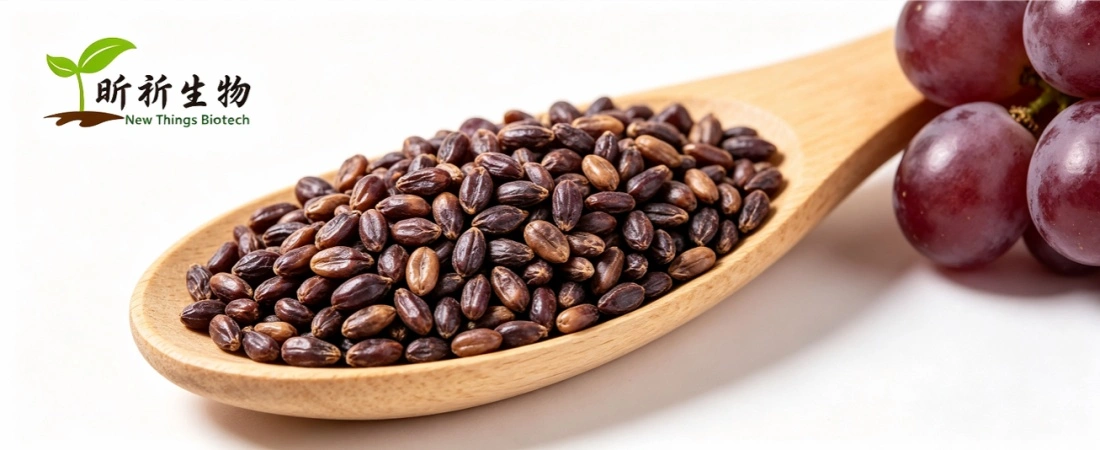
The OPC oligomeric procyanidins extract from Shaanxi New Things Biotech is derived from quality Vitis vinifera grape seeds and is standardised to 95% Oligomeric Proanthocyanidins, among the highest standards available in the B2B botanical ingredient marketplace. This substance isolates low molecular weight proanthocyanidin fractions (dimers, trimers and tetramers) unlike generic polyphenol extracts, which have superior bioavailability and quantifiable antioxidant effectiveness. Each batch is tested by both HPLC and UV tests and satisfies consistent purity criteria. ISO 9001, KOSHER and HALAL certifications enable access to global regulated markets.
Product Specifications
|
Product and Batch Information |
|||
|
Product Name: |
Grape Seed Extract |
Latin Name: |
Vitis vinifera |
|
Plant Part: |
Seed |
Manufacture Date: |
2026-05-26 |
|
Batch: |
NT260526001 |
Analysis Date: |
2026-05-28 |
|
Ananlysis: |
1500 Kg |
Report Date: |
2026-05-28 |
|
Analysis Item |
Specification |
Result |
Test Method |
|
Active Ingredeints |
|||
|
Assay Proanthocyanidins |
≥95% |
96.62% |
UV |
|
Physical Control |
|||
|
Appearance |
Brownish Red Powder |
Complies |
Visual |
|
Odor |
Characteristic |
Complies |
Organoleptic |
|
Taste |
Characteristic |
Complies |
Organoleptic |
|
Sieve Analysis |
100% pass 80 mesh |
Complies |
GB/T 5507 |
|
Loss on Drying |
5% Max |
3.69% |
GB 5009.3 |
|
Ash |
5.0% Max |
1.27% |
GB 5009.4 |
|
Tap Density |
≥65.0g/cm3 |
Complies |
GB/T 21354 |
|
Chemical Control |
|||
|
Arsenic (As) |
NMT2ppm |
Complies |
Atomic Absorption |
|
Cadmium(Cd) |
NMT1ppm |
Complies |
Atomic Absorption |
|
Lead (Pb) |
NMT3ppm |
Complies |
Atomic Absorption |
|
Mercury(Hg) |
NMT0. 1ppm |
Complies |
Atomic Absorption |
|
Heavy Metals |
10ppm Max |
Complies |
Atomic Absorption |
|
Pesticides Residues |
NMT 1ppm |
Complies |
Gas Chromatography |
|
Microbiological |
|||
|
Total Plate Count |
1000cfu/g Max |
300cfu/g |
GB4789.2 |
|
Salmonella |
Negative |
Negative |
GB 4789.4 |
|
Yeast & Mold |
100cfu/g Max |
<10 |
GB4789.15 |
|
E.Coli |
Negative |
Negative |
GB 4789.3 |
|
Staphylococcus |
Negative |
Negative |
GB 4789.10 |
Key Product Characteristics
This extract is far higher than the lesser grade alternatives with a 95% standardisation. Most commodity grape seed powders are standardised to 70-80% OPC, which will include a higher concentration of big, insoluble tannins with low bioavailability. At 95% you get a concentrated dose of bioactive oligomers – the ingredients your final formulation really requires.
Physically, the extract is a fine brown-red powder with a bulk density of 0.35–0.65 g/ml, which allows its encapsulation in capsules or tablets without flow problems. Its excellent solubility in water and ethanol permits a wide variety of formulation options, from hard capsules to clear functional beverages and topical serums.
The ORAC value is consistently higher than 15,000 µmol TE/g, a standard that demonstrates true hydrogen donating and metal chelating antioxidant capacity. Independent evaluations show that 95% OPC extracts regularly score higher in ferric reduction antioxidant potency (FRAP) than 70–80% grade products.

Applications & Formulation Guidance
This constituent is used in two major B2B markets, each with its own formulation requirements.
Dietary Supplements: The most frequent forms for delivery are capsules and tablets. Clinical literature supports antioxidant and vascular support claims at 100–300 mg per day. The small particle size and good bulk density of the extract is well suited for blending and filling at typical capsule manufacturing speeds.
Cosmetics & Skincare: High OPC concentration is beneficial for anti-aging serums, moisturisers and topical antioxidant compositions. Its water solubility allows clean inclusion into aqueous phase compositions without impacting texture or clarity.
Functional Beverages: The extract is stable to thermal treatments in the short pasteurisation cycles (85–90°C). Add following high-heat step for heat-processed items to preserve oligomeric structure. By choosing a low-tannin, high-oligomer standard like this product, one avoids turbidity or sedimentation in clear drink formats.
One essential point about formulation: OPC fractions are most active at pH 3–5. This range of stability makes them ideal for acidified beverages and fruit-based supplement mixtures.

Quality Assurance and Safety
Before reaching you, each batch of this extract goes through a multi-stage process of quality checking.
Raw material inspection on receipt confirms the botanical identification and initial purity. Process monitoring during manufacturing checks extraction solvent ratios (ethanol/water) for low residual solvents levels in the finished powder. Finished product testing: active ingredient level, microbiological limits, heavy metals (regulated to <10 ppm), contaminant screening.
Quantification by HPLC verifies the proanthocyanidin oligomer profile from dimers to polymers. DPPH• and ABTS•⁺ radical scavenging assays are performed to check antioxidant activity for each lot. It is this mix of analytical procedures that offers B2B purchasers dependable documentation for product claims and regulatory submissions.
The product has ISO 9001 quality management certified, HALAL and KOSHER status and satisfies the needs of nutritional supplement and food ingredient customers in markets of North America, Europe, Middle East and Asia-Pacific.


Storage and Handling Guidelines
Proper storage maintains the antioxidant activity of OPC oligomeric procyanidins throughout its shelf-life.
- Store in a cool, dry place, protected from direct light and heat.
- Storage temperature: Recommended below 25 °C, relative humidity below 60 %
- Once opened, containers should be kept tightly closed to prevent moisture uptake and oxidation.
- Prolonged exposure to high temperatures can transform oligomers into insoluble tannin polymers, which lowers efficacy.
- Under proper storage conditions in its original unopened packaging, the shelf life is generally 24 months.
Packing and Delivery
Standard packing is 25 kg in a fibre drum with inner vacuum composite film or aluminium foil nitrogen filled bags to safeguard product integrity during transit. Custom packaging choices include lower amounts, private label drums and bottles for light-sensitive compositions.
Delivery by courier, air freight and ocean freight according to your order volume and time schedule. Stock held for immediate despatch and delivery is made within 2-3 working days of order confirmation. Complete traceability paperwork from raw materials to finished batch certificate is provided with each shipment.

Our Factory
Shaanxi New Things Biotech has a modern production plant in Xi’an, with supercritical fluid extraction technologies, molecular distillation systems and automated production lines, under GMP standards. An R&D Centre and Quality Control Centre, equipped with HPLC and GC-MS technology, support both product development and batch release testing.
The facility can generate variable output from kilogram-scale trial batches to full commercial volumes and offers OEM/ODM production services for customers requiring unique formulations or packaging.

FAQ
Q1: What is the difference between OPC and total polyphenols?
A: Total polyphenols include large tannins that are not well absorbed. OPCs specifically refer to soluble oligomers (dimers to tetramers), which are the bioavailable, active fractions. Always request HPLC data — not just UV data — to confirm the oligomeric content you are purchasing.
Q2: How do I verify the extract is not adulterated with peanut skin or pine bark?
A: Grape seed exclusively contains B-type proanthocyanidins. Peanut skin contains A-type linkages. HPLC-MS or HPTLC analysis can detect A-type structures and confirm botanical authenticity. Our batch documentation includes this profile data on request.
Q3: Is this extract suitable for clear beverage applications?
A: Yes. The high-oligomer, low-tannin specification of this 95% extract maintains good water solubility and avoids turbidity issues common in lower-grade materials. Add after high-heat processing steps to preserve clarity and potency.
Q4: What dosage is typically used in supplement formulations?
A: Clinical studies indicate 100–300 mg daily for antioxidant and vascular support applications. Final dosage depends on your product claims and target market regulatory requirements.
Q5: Can you support custom specifications or private-label packaging?
A: Yes. Shaanxi New Things Biotech offers OEM/ODM services including customized formulation, particle size adjustment, and private-label packaging in multiple formats and languages.
Q6: What documentation is available for regulatory submissions?
A: Standard documentation includes Certificate of Analysis (COA), Material Safety Data Sheet (MSDS), HPLC test reports, and certificates for ISO 9001, KOSHER, and HALAL. Additional documentation can be arranged based on your market requirements.
Contact Us
Ready to source opc oligomeric procyanidins for your next product launch? Reach out to our team at newthingsbio@163.com for samples, pricing, or technical support.