- English
- French
- German
- Portuguese
- Spanish
- Russian
- Japanese
- Korean
- Arabic
- Greek
- German
- Turkish
- Italian
- Danish
- Romanian
- Indonesian
- Czech
- Afrikaans
- Swedish
- Polish
- Basque
- Catalan
- Esperanto
- Hindi
- Lao
- Albanian
- Amharic
- Armenian
- Azerbaijani
- Belarusian
- Bengali
- Bosnian
- Bulgarian
- Cebuano
- Chichewa
- Corsican
- Croatian
- Dutch
- Estonian
- Filipino
- Finnish
- Frisian
- Galician
- Georgian
- Gujarati
- Haitian
- Hausa
- Hawaiian
- Hebrew
- Hmong
- Hungarian
- Icelandic
- Igbo
- Javanese
- Kannada
- Kazakh
- Khmer
- Kurdish
- Kyrgyz
- Latin
- Latvian
- Lithuanian
- Luxembou..
- Macedonian
- Malagasy
- Malay
- Malayalam
- Maltese
- Maori
- Marathi
- Mongolian
- Burmese
- Nepali
- Norwegian
- Pashto
- Persian
- Punjabi
- Serbian
- Sesotho
- Sinhala
- Slovak
- Slovenian
- Somali
- Samoan
- Scots Gaelic
- Shona
- Sindhi
- Sundanese
- Swahili
- Tajik
- Tamil
- Telugu
- Thai
- Ukrainian
- Urdu
- Uzbek
- Vietnamese
- Welsh
- Xhosa
- Yiddish
- Yoruba
- Zulu
Open a jar of indigo fruit extract powder and the first thing you notice is the colour. It's a deep violet-blue that stains the spatula and hints at the anthocyanin density within. This ingredient, derived from the berries of Lonicera caerulea, or haskap or blue honeysuckle, is moving from the functional-food section into serums, masks and toners, and formulators are asking the practical questions: how much do I use, in which phase do I put it, how do I keep the colour stable and what claims can it honestly back up? In this post, those questions are answered, one by one. The working examples are based on the standardised indigo fruit extract powder from NT Biotech (Shaanxi New Things Biotech) a water soluble berry extract standardised to anthocyanins by UV-Vis and HPLC, produced under ISO9001, KOSHER and HALAL certification, shipped with a batch-specific certificate of analysis, and available for cosmetic OEM projects from a company that manages the crop, the extraction and the documentation under one roof.

Meet the Ingredient: Why Formulators Are Turning to Indigo Fruit Extract Powder
A berry built for harsh climates
Lonicera caerulea thrives in the chilly forests of north-east China, Siberia, Hokkaido and the Canadian prairies, ripening before strawberries and surviving frosts that would kill most fruit. To deal with spring’s extreme ultraviolet radiation and temperature changes, the berry builds up cyanidin-3-glucoside and related anthocyanins, plus chlorogenic acid, quercetin and vitamin C. It’s that defensive chemistry that makes indigo fruit extract powder intriguing for skin. The plant evolved these compounds to protect its own tissue from oxidative and UV damage, and lab studies on human keratinocytes suggests they do a similar job for ours.
What the powder actually is
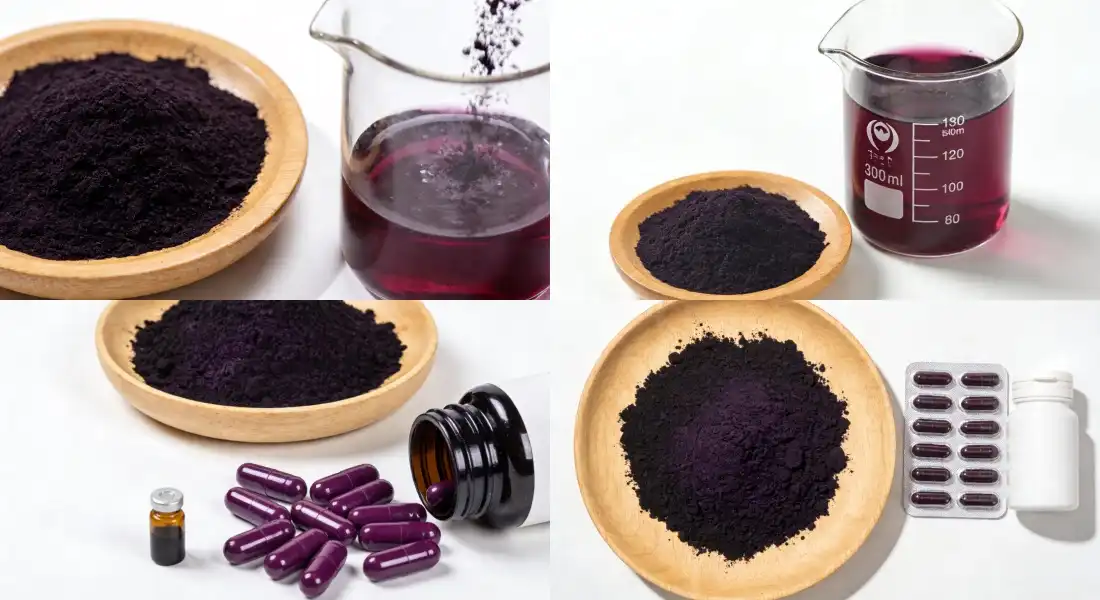
The NT Biotech indigo fruit extract powder is prepared by extracting the whole berry with water and food grade ethanol, concentrating at low temperature to safeguard heat and light sensitive pigments and spray drying to a fine purple powder. Standard grades are 5%, 10% and 25% anthocyanins. For cost sensitive rinse-off solutions an extract with a 10:1 ratio is also available. It is highly soluble in water, glycerine and hydro-alcoholic bases, making it much easier to work with than oil-soluble plant actives.
How it compares with familiar berry actives
Formulators know blueberry, acai & bilberry already. On a fresh-weight basis, haskap usually has two to four times the concentration of anthocyanins than blueberry, with its profile dominated by cyanidin-3-glucoside, the most studied anthocyanin for antioxidant activity. For a brand, that means a lesser use level may tell a stronger antioxidant message and the naturally vibrant colour becomes a visual selling feature for transparent packaging.

What Indigo Fruit Extract Powder Does for Skin
Antioxidant defense against daily oxidative load
Pollution, blue light and UV create free radicals that break down collagen and create the dullness people refer to as "tired skin." Anthocyanins are some of the best plant radicals scavengers. Studies on Lonicera caerulea polyphenols have demonstrated decreased reactive oxygen species and lipid peroxidation in skin cells exposed to UVA and UVB . This makes indigo fruit extract powder a natural fit for city-defense moisturisers and day serums.
Support against photodamage
Two well-cited laboratory investigations from the Czech Republic reported that the phenolic portion of blue honeysuckle protected human keratinocytes against UV-induced DNA damage and cell death. This doesn't make the extract a sunscreen or should be promoted as such, but supports "helps defend against environmental stress" positioning in after-sun and daily-protection products.
Brightening and even tone
In vitro studies have revealed that chlorogenic acid and cyanidin glycosides can modulate the activity of tyrosinase, the enzyme responsible for uneven pigmentation. Indigo fruit extract powder combines with the berry's own vitamin C for a soft brightening tale that's suitable for sensitive-skin lines that don't want to go hard with acids.
Soothing and barrier comfort
In skin models, anthocyanins and quercetin down-regulate inflammatory signalling, which means a calming effect that is sought after in post-procedure, redness-prone, and barrier-repair products. The extract works well with ceramides, allantoin and panthenol.
The table below summarizes the specification of NT Biotech's indigo fruit extract powder as listed on its product page.
| Parameter | Specification | Test Method |
|---|---|---|
| Botanical source | Lonicera caerulea L. fruit | Macroscopic / HPLC fingerprint |
| Standardized grades | Anthocyanins 5%, 10%, 25% | UV-Vis (pH differential), HPLC |
| Marker compound | Cyanidin-3-glucoside dominant | HPLC |
| Ratio grade | 10:1 whole-fruit extract | Input/output ratio |
| Appearance | Dark purple to violet fine powder | Visual |
| Solubility | Freely soluble in water, glycerin, ethanol-water | Bench test |
| Particle size | ≥95% through 80 mesh | Sieve analysis |
| Loss on drying | ≤5.0% | 105 °C, 2 h |
| Extraction solvent | Water / food-grade ethanol | Process record |
| Shelf life | 24 months, sealed, protected from light and heat | Stability data |
Step-by-Step: Formulating with Indigo Fruit Extract Powder
Step one: choose the grade for the job
Low input 25% grade leave on serums and eye treatments that maintain colour controlled and cost per active dose efficient. The 10% grade works great with toners, mists and gel-creams. For a small cost, the 5% or 10:1 grade can be used in masks, cleansers and rinse-off shower products for a powerful visual and sensory return.
Step two: handle pH and color with care
Anthocyanins are natural sensors of pH. Below pH 4 they are red-pink, between 4 and 6 they move to violet-blue and beyond 7 they drift to gray-green and decay faster. Try to get the final formula pH between 4.0 and 5.5, which is also suitable for the skin’s own acid mantle. If your package narrative is a stable blue-violet tone, keep pH near 5 and secure the product in an opaque or UV-filtering container.
Step three: add it in the right phase, at the right temperature
Dissolve Indigo fruit extract powder in a part of water phase or in glycerine at room temperature and add during cool down below 40 °C. Never add it during the hot oil-water emulsification stage; heating above 60 °C promotes the loss of anthocyanins. Do not combine with excessive quantities of free iron or copper which cause colour changes. Trace amount of a chelator such as sodium phytate maintains the colour true.
If you would like NT Biotech's cosmetic technical team to review your base formula and recommend the ideal grade and input level, email info@newthingsbiotech.com with your product type, target pH, and packaging; you will receive a reply within two hours on working days, along with a sample and the current certificate of analysis for bench trials.
Step four: protect stability through the shelf life
In the oil phase, combine with a modest antioxidant system such tocopherol and in the water phase, a tiny amount of ascorbyl glucoside. Anthocyanins and vitamin C derivatives are mutually stabilised. Use a broad-spectrum, low pH friendly preservative, maintain dissolved oxygen low by reducing headspace, and do a light-exposure test in addition to the conventional 40 °C accelerated research. NT Biotech offers stability data for the raw powder for your finished-product testing.
Product Formats and Practical Use Levels
Serums and ampoules
The 25% grade used in brightening or antioxidant serums usually has 0.1% to 0.5% of the 25% grade, meaning it has a decent amount of anthocyanins with a gentle lilac colour. Mix with 2% to 4% niacinamide and low-molecular hyaluronic acid for a full-circle "glow”"claim. Indigo fruit extract powder is water soluble and can be directly incorporated into gel-serum bases without the need of solubilizers.
Toners, mists, and essences
The water-rich forms are great for displaying real colour. Use 0.2% to 0.8% of the 10% grade. Keep pH around 5. Package in violet glass or opaque PET. Use with rose hydrosol and glycerine for a calming daily mist.
Masks, cleansers, and rinse-off treatments
Sheet-mask essences and wash-off gels tolerate higher inputs of indigo fruit extract powder, 0.5% to 2% of the 5% or 10:1 grade, giving a dramatic berry color and a fresh, faintly fruity note. The short contact time makes these formats ideal for introducing the ingredient to first-time users.
Creams and balms
The water-rich forms are great for displaying real colour. Use 0.2% to 0.8% of the 10% grade. Keep pH around 5. Package in violet glass or opaque PET. Use with rose hydrosol and glycerine for a calming daily mist.
The second table offers application guidance developed from NT Biotech's technical recommendations and published anthocyanin-stability practice.
| Product Type | Recommended Grade | Suggested Use Level | Phase / Temperature | Complementary Ingredients |
|---|---|---|---|---|
| Antioxidant serum | 25% anthocyanins | 0.1–0.5% | Water phase, <40 °C | Niacinamide, hyaluronic acid, tocopherol |
| Brightening essence | 25% anthocyanins | 0.2–0.5% | Water phase, <40 °C | Ascorbyl glucoside, licorice extract |
| Soothing toner or mist | 10% anthocyanins | 0.2–0.8% | Room temperature | Panthenol, allantoin, rose hydrosol |
| Sheet-mask essence | 10% or 10:1 | 0.5–1.5% | Room temperature | Glycerin, betaine, centella |
| Gel cleanser / wash-off mask | 5% or 10:1 | 1.0–2.0% | Room temperature | Mild surfactants, kaolin |
| Day cream / eye cream | 25% anthocyanins | 0.1–0.3% | Cool-down phase | Ceramides, squalane, sodium phytate |

Sourcing Indigo Fruit Extract Powder You Can Build a Brand On
Documentation that survives a retailer audit
Cosmetic buyers, especially in the EU and Korea, now expect a full data package before listing a product. NT Biotech provides a batch-specific certificate of analysis with anthocyanin assay, heavy metals, microbiology, and pesticide screening, plus a technical data sheet, safety data sheet, allergen statement, and stability summary. ISO9001, KOSHER, and HALAL certification cover the facility and the indigo fruit extract powder itself, simplifying clean-beauty and halal-beauty positioning across markets.
Consistency from cultivated berries
Wild‐collected haskap material is highly variable in terms of anthocyanin content and cleanliness as a young commercial crop. NT Biotech is dealing in controlled culture, therefore the colour, assay and sensory profile of the powder is consistent lot to lot; this is important when a violet hue is part of your trademark.
Speed, customization, and easy commerce
Popular grades are kept in stock and often ship within 1 to 3 working days from order confirmation. Custom anthocyanin levels or larger runs complete the whole cycle of sourcing, extraction, testing and packing in 3 to 10 working days. Samples are shipped using FedEx or UPS accounts owned by NT Biotech. Bulk drums are shipped by air or sea via trusted forwarders. OEM & ODM services are available for finished serums, masks & toners for the target market, Payment is received in the local currency of the buyer, Every enquiry is responded to within two hours. That technical collaboration is the true distinction for clients seeking an indigo fruit extract powder source that can advise on pH, colour and stability rather than just ship a drum.

Conclusion
Indigo Fruit Extract Powder, a natural skincare antioxidant, environmental-defense, brightening and soothing active, brings the cold climate defensive chemistry of Lonicera caerulea led by cyanidin-3-glucoside. It is largely a question of respecting the behaviour of anthocyanins to use it well: choose the grade according to the format, keep the pH between 4 and 5.5, add it during the cool-down under 40 °C, shield from light and metal ions, and support it with tocopherol or ascorbyl glucoside. The ingredient is suitable for a broad line of products, from serums at 0.1% to wash-off masks at 2%, and offers a natural violet colour that sells itself. With NT Biotech’s standardised grades, batch documentation, ISO9001, KOSHER and HALAL certification, rapid shipment and OEM assistance, formulators have a reliable base to expand on those advantages.
FAQ
1. Which grade of indigo fruit extract powder suits a leave-on serum?
The 25% anthocyanin grade at 0.1% to 0.5% gives strong activity with manageable color.
2. Why does the color of my formula change?
Anthocyanins respond to pH; keep the final product between pH 4 and 5.5 and avoid free metal ions.
3. Can the powder be added during heating?
No. Pre-dissolve in water or glycerin and add during cool-down below 40 °C.
4. Is it a sunscreen replacement?
No. It supports defense against oxidative stress but carries no SPF and should not be marketed as sun protection.
5. What documents does NT Biotech provide?
Batch CoA, TDS, SDS, allergen statement, stability data, and ISO9001, KOSHER, and HALAL certificates.
Create Your Next Berry-Powered Formula with NT Biotech
If you are ready to bring the vivid color and antioxidant strength of indigo fruit extract powder into a serum, mist, mask, or cream, NT Biotech can shorten the path from concept to shelf. The company supplies standardized 5%, 10%, and 25% anthocyanin grades verified by HPLC on every batch, ships stocked material within 1 to 3 working days, and offers cosmetic OEM services adapted to your target market. Its technical team will help you select the right grade, set pH, and design a stability-friendly formula, all backed by ISO9001, KOSHER, and HALAL certification. Email info@newthingsbiotech.com today with your product type and requirements; you will receive a reply within two hours, a current certificate of analysis, pricing in your local currency, and a factory-direct sample. Let NT Biotech turn a remarkable berry into your brand's signature ingredient.
References
1. Svobodová, A., Zdařilová, A., & Vostálová, J. (2009). Lonicera caerulea and Vaccinium myrtillus fruit polyphenols protect HaCaT keratinocytes against UVB-induced phototoxic stress and DNA damage. Journal of Dermatological Science, 56(3), 196–204.
2. Svobodová, A., Rambousková, J., Walterová, D., & Vostálová, J. (2008). Protective effects of phenolic fraction of blue honeysuckle fruits against UVA-induced damage to human keratinocytes. Archives of Dermatological Research, 300(5), 225–233.
3. Celli, G. B., Ghanem, A., & Brooks, M. S.-L. (2014). Haskap berries (Lonicera caerulea L.): A critical review of antioxidant capacity and health-related studies for potential value-added products. Food and Bioprocess Technology, 7(6), 1541–1554.
4. Jurikova, T., Rop, O., Mlcek, J., Sochor, J., Balla, S., Szekeres, L., Hegedusova, A., Hubalek, J., Adam, V., & Kizek, R. (2012). Phenolic profile of edible honeysuckle berries (genus Lonicera) and their biological effects. Molecules, 17(1), 61–79.
5. Svarcova, I., Heinrich, J., & Valentova, K. (2007). Berry fruits as a source of biologically active compounds: The case of Lonicera caerulea. Biomedical Papers of the Medical Faculty of the University Palacký, Olomouc, 151(2), 163–174.
6. Rupasinghe, H. P. V., Yu, L. J., Bhullar, K. S., & Bors, B. (2012). Haskap (Lonicera caerulea): A new berry crop with high antioxidant capacity. Canadian Journal of Plant Science, 92(7), 1311–1317.