- English
- French
- German
- Portuguese
- Spanish
- Russian
- Japanese
- Korean
- Arabic
- Greek
- German
- Turkish
- Italian
- Danish
- Romanian
- Indonesian
- Czech
- Afrikaans
- Swedish
- Polish
- Basque
- Catalan
- Esperanto
- Hindi
- Lao
- Albanian
- Amharic
- Armenian
- Azerbaijani
- Belarusian
- Bengali
- Bosnian
- Bulgarian
- Cebuano
- Chichewa
- Corsican
- Croatian
- Dutch
- Estonian
- Filipino
- Finnish
- Frisian
- Galician
- Georgian
- Gujarati
- Haitian
- Hausa
- Hawaiian
- Hebrew
- Hmong
- Hungarian
- Icelandic
- Igbo
- Javanese
- Kannada
- Kazakh
- Khmer
- Kurdish
- Kyrgyz
- Latin
- Latvian
- Lithuanian
- Luxembou..
- Macedonian
- Malagasy
- Malay
- Malayalam
- Maltese
- Maori
- Marathi
- Mongolian
- Burmese
- Nepali
- Norwegian
- Pashto
- Persian
- Punjabi
- Serbian
- Sesotho
- Sinhala
- Slovak
- Slovenian
- Somali
- Samoan
- Scots Gaelic
- Shona
- Sindhi
- Sundanese
- Swahili
- Tajik
- Tamil
- Telugu
- Thai
- Ukrainian
- Urdu
- Uzbek
- Vietnamese
- Welsh
- Xhosa
- Yiddish
- Yoruba
- Zulu
In the nutraceutical industry, Pyrroloquinoline Quinone is a bioactive ingredient that is modifying cell energy production. The self-production of new mitochondria is promoted by this naturally occurring redox element. This aids energy loss and cell aging. Normal antioxidants degrade after one reaction cycle. However, PQQ cycles redox and catalyzes hundreds of times before running out. Food items that boost brain, heart, and metabolic health need it due to great efficacy of PQQ powder.
Understanding PQQ Powder and Its Role in Cellular Energy
Molecular Identity and Natural Occurrence
Ortho-quinones are Pyrroloquinoline Quinones. They are aromatic C14H6N2O8 molecules with 330.206 molecular weight. This dark red powder dissolves well in water, making it suitable for many recipes. PQQ, unlike NAD+ or FAD cofactors, is a redox catalyst that directly participates in mitochondrial respiration electron transfer processes. Fermented foods, green vegetables, and breast milk contain it, demonstrating its biological relevance. Dietary consumption seldom reaches therapeutic levels without supplementation.
Due to its light sensitivity, the PQQ powder must be handled carefully when manufactured and kept. PQQ degrades fast in direct sunshine, making it less effective. Because of this, procurement professionals must prioritize vendors with strong quality control systems that maintain product stability across the supply chain.
Mechanisms of Mitochondrial Enhancement
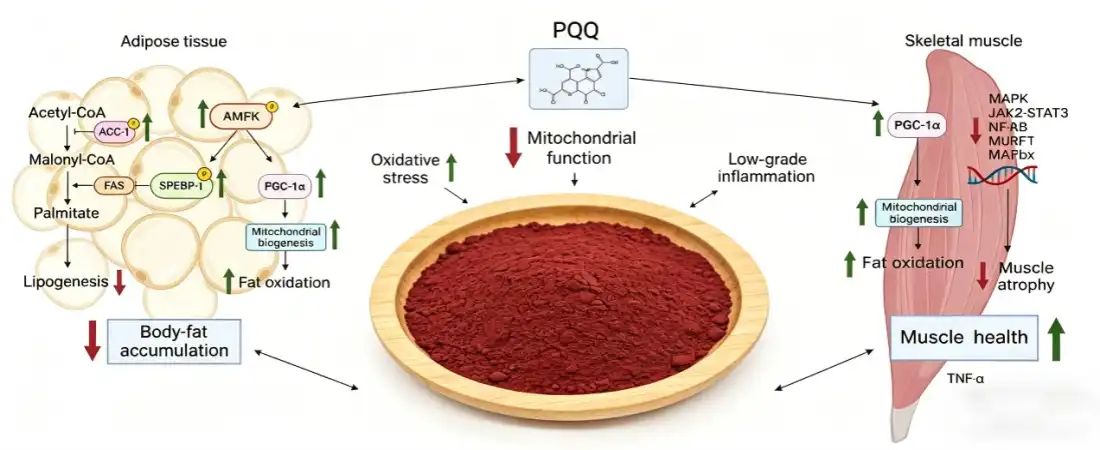
PQQ primarily activates the CREB and PGC-1α signaling pathways. DNA-level mechanisms regulate mitochondrial production. This transcription signal to create new mitochondria reduces age-related mitochondrial degradation. PQQ pills increase heart and brain mitochondria, according to research. This immediately increases cellular energy production and decreases oxidative stress indicators.
PQQ increases mitochondrial function by improving the electron transport chain and boosting mitochondrial numbers. It stabilizes complex I and III, preventing electron leakage that create damaging reactive oxygen species. PQQ differs from single-mechanism energy vitamins by increasing mitochondrial number and efficiency.
PQQ Foods: Natural Dietary Sources of Pyrroloquinoline Quinone
PQQ powder is the most effective way to get therapeutic doses, however many purchasers seek for pqq foods to see what regular meals naturally contain this ingredient. Research on pyrroloquinoline quinone foods demonstrates that PQQ is present in the diet, but only in trace levels, significantly less than the 10–20 mg dosages employed in clinical studies. By understanding natural sources, formulators may construct clean-label and whole-food narratives and establish realistic expectations vs supplementation.
- Fermented soybeans (natto) — the richest known dietary source of PQQ
- Green vegetables such as spinach, parsley, and green peppers
- Kiwi and papaya
- Tofu and edamame (soy-based foods)
- Green tea and oolong tea
- Eggs
- Breast milk — the highest natural PQQ source for infants
When shopping for pyrroloquinoline quinone meals, customers often look for a realistic grocery list. But even the best pqq foods contain just micrograms per serving, thus diet alone is seldom equivalent to the doses used in studies. That gap is precisely why standardized PQQ powder – not food alone – is the practical option for energy, cognitive and metabolic formulations. Use this foods overview as educational background, and depend on a 99% pure PQQ Powder supply for constant, label-claimable potency.
Scientifically Validated Health Benefits
Clinical evidence shows PQQ protects neurons. Studies suggest it helps elderly individuals retain and absorb information faster. The substance protects nerve cells from oxidative damage and promotes neuron development. This fosters neuronal healing and cognitive resilience. Based on these features, it is ideal for formulae that aid mentally exhausted or aging personnel.
PQQ reduces LDL oxidation and improves capillary function, making it useful in cardiovascular health. Constant ingestion decreases inflammatory markers and increases blood flow in trials. Improved glucose absorption and cellular energy use aid weight reduction and metabolic syndrome treatment.
Comparative Analysis: PQQ Powder vs Other Mitochondrial Antioxidants
Functional Differentiation from CoQ10 and Ubiquinol
Coenzyme Q10 in the mitochondrial membrane moves electrons between complexes to produce ATP. Even though CoQ10 is essential for energy, it does not generate new mitochondria. Ubiquinol, a reduced version of CoQ10, is more bioavailable but still has this issue. Pqq powder increases mitochondria, which is the major cause of cell energy loss, whereas CoQ10 enhances mitochondrial activity. Because they operate well together, combination formulations employ both drugs to maximize their synergy.
Absorption patterns vary greatly. Fat-soluble transport mechanisms are needed for CoQ10 absorption, making composition synthesis harder. PQQ dissolves well in water, so it may be added to tablets, capsules, and liquids without carriers. This technique reduces production costs and expands product categories.
Comparison with NMN and Resveratrol
NMN, a building block for NAD+, replenishes enzyme cofactors to provide cells energy. NMN improves age-related NAD+ depletion but doesn't enhance mitochondrial synthesis. Resveratrol activates longevity proteins sirtuins, which regulate cell stress response, but it doesn't affect mitochondrial growth like PQQ. Diverse substances play diverse roles in life supplements.
Bioavailability distinguishes these substances. NMN has problems passing cellular membranes, hence higher dosages are needed for therapy. Resveratrol is swiftly broken down by the liver, limiting its body access. Formulators may trust dosage since PQQ exhibits steady absorption and plasma concentrations when taken orally.
Sourcing Implications: Fermentation vs Synthetic Production
Industrial PQQ synthesis usually uses regulated biosynthesizing bacteria like Hyphomicrobium denitrificans. This approach ensures molecular bio-identity with naturally occurring PQQ, satisfying clients who want natural products. Fermentation-derived PQQ surpasses 99% purity, meeting pharmaceutical requirements.
Synthetic synthesis is cheaper, however trace pollutants and stereochemistry stability are concerns. Purchasing managers must check Certificates of Analysis for HPLC purity data and heavy metals or compounds. Supplier transparency regarding product manufacturing affects product positioning and regulatory compliance.
Guidelines for Using PQQ Powder in B2B Ingredients Sourcing
Evidence-Based Dosing Recommendations
Clinical trials employ 10–20 mg PQQ powder per day for cognitive and cardiovascular effects. These numbers demonstrate that they operate without harming certain groups. Most usage cease at 20 milligrams, however energy metabolism tests can take up to 40. Procurement experts should ensure dose proposals match the desired product and consumer use.
PQQ is stable at many pH levels and interacts well with common excipients, giving formulators several alternatives. The vitamin industry is largely capsules and pills, although functional beverages are growing fast. The substance dissolves well in water, thus it may be utilized directly in liquids without additional delivery systems that complicate production.
Regulatory Compliance and Safety Considerations
PQQ is GRAS in the US and a new food in the EU. This simplifies market entry in both large regions. This regulatory approval comes from rigorous safety investigations that indicate no serious negative effects at prescribed levels. There are few reasons not to use it, although savvy formulators advise blood thinner users to see a doctor due to potential conflicts.
Safety documentation requires allergy, heavy metal, and microbiological testing. The danger of buying from ISO 9001, Kosher, or Halal-certified suppliers is reduced by their organized quality management. Before being sold, the product should have batch-specific Certificates of Analysis proving cleanliness, moisture content, and microbiological limitations.
Supplier Evaluation Criteria
Authentic suppliers provide spectroscopic data (UV, FTIR) to verify molecular identities and HPLC chromatograms to verify purity. Stability tests that indicate a product's shelf life under specified storage settings prevent it from spoiling during distribution. Traceability paperwork from raw ingredients to final powder keeps the supply chain honest and fulfills audit standards.
Analytical testing distinguishes premium merchants from commodity dealers. Each production batch is checked in-house for identity, potency, and impurities, ensuring quality. Independent lab verification enhances dependability, especially for initial supplier qualification.
Strategic Procurement of PQQ Powder for B2B Clients
Wholesale Channel Identification and Pricing Dynamics
PQQ powder is safest from well-known plant extract and fermentation firms. These vendors have specialized production processes that provide regular output and can manage recurring requests. Working directly with a manufacturer eliminates intermediaries markups and provides professional formulation assistance.
Market pricing depend on raw material costs, fermentation efficiency, and cleanup difficulty. Bulk purchases (at least 25 kg) are usually cheaper. Long-term supply partnerships that ensure a specific number of commodities might lead to negotiated price structures that make new products that need ingredients more predictable.
Logistical Considerations for International Trade
Correct packaging protects PQQ powder from light and moisture during shipping. Custom packing can meet handling demands, although 25-kilogram fiber drums with polyethylene liners are standard. Aluminum foil divider bags within barrels provide added protection for lengthy transit durations or adverse weather.
Store the drug in cool, dry, out-of-the-sun settings to maintain its efficacy. Temperature-controlled storage prevents heat damage to items before they are created. The destination country may demand business invoices, certificates of origin, and phytosanitary certifications for international exports.
Brand Differentiation and Supplier Selection
Established companies can demonstrate excellence through client referrals and industry reputation. In addition to basic components, formulation guidance, stability testing support, and regulatory paperwork assistance provide value. Customer service is essential for production planning, thus answering inquiries in hours rather than days demonstrates commitment.
Generic vs. named variations are mainly generated by production size and quality system development, not product differences. Smaller suppliers may offer low pricing, but they may not be able to manage large orders or solve formulation issues. Compare a supplier's talents to company demands to make operationally relevant procurement decisions.
Making the Right Decision: Choosing the Best PQQ Powder Supplement for Your Business
Quality Assessment Framework
Choosing the best PQQ powder implies prioritizing quality, which can be tested using several techniques. The HPLC test should show visible impurity patterns and at least 99% purity. Spectroscopic confirmation of molecular identification involves UV absorption at certain wavelengths. Residual solvent analysis respects pharmacopeial limits, protecting customers and following government regulations.
Crystallization and particle size affect bioavailability. Mesh sizes about 80 mesh ensure powder flows uniformly throughout manufacture while maintaining dissolvability. Suppliers of particle size analysis data can forecast how a combination will mix and package.
Customization Capabilities and OEM Support
Flexible suppliers can accommodate alternate packaging, lower purity targets to save money, and regulatory-compliant testing procedures. OEM services that create finished items simplify supply chains for brands without production facilities.
Unique formulae that integrate PQQ with complementary substances make private label companies stand out. Technical partnerships with ingredient sources simplify formula optimization, dosage validation, and stability testing. These services reduce product development time and market risk.
Market Trends and Emerging Applications
Cellular energy supplements become increasingly popular as people learn about mitochondrial health. PQQ claims to solve this problem scientifically. Older folks who wish to stay smart and sporty applications that leverage PQQ's metabolic advantages are growing markets. Functional beverage categories integrate PQQ to ready-to-drink forms, making them more accessible to supplement-free consumers.
Researchers exploring PQQ's role in life and metabolic illness prevention believe it might be employed as a treatment. Proactive buying techniques that monitor clinical trials and fresh research help corporations enter new market areas. Supplier connections that provide market research and application development make organizations more competitive as the ingredient industry ages.
Conclusion
Scientists have shown that pqq powder stimulates mitochondrial production in cells with energy issues. Its capacity to continually cycle redox states, high water solubility, and well-established safety profile make it a significant element in brain, heart, and anti-aging compositions. Strategic procurement requires you to evaluate a supplier's quality processes, analytical abilities, and expert services beyond pricing. More scientific evidence shows that PQQ works, and authorities in most major markets favor it. This substance will grow in nutraceuticals.
FAQ
1. What makes PQQ different from other energy supplements?
PQQ creates new mitochondria, not simply helps existing ones. This key distinction eliminates energy loss caused by aging by adding cellular power plants. Common supplements like B vitamins and CoQ10 boost mitochondrial activity without increasing mitochondria.
2. How should PQQ powder be stored to maintain potency?
Store PQQ in sealed, cold, dry, out-of-the-sun packaging. Light degrades it, and water makes it unstable. Material is active for 24 months if stored correctly. Refrigerating opened containers extends their shelf life, although climate-controlled buildings may store unopened drums at ambient temperature.
3. What purity level should procurement managers require?
HPLC study shows pharmaceutical-grade usage require 99% purity. Nutraceutical recipes require 98–99% purity, balancing quality and affordability. Request complete impurity samples with contaminant counts. Heavy metal testing, notably lead, cadmium, mercury, and arsenic, should indicate levels considerably below legal limits.
4. What foods contain PQQ (pyrroloquinoline quinone)?
PQQ is found naturally in tiny levels in fermented soybeans (natto), green vegetables such as spinach and parsley, kiwi, papaya, tofu, green tea and breast milk. Even the richest pqq meals contain just tiny amounts therefore you need to supplement with standardized PQQ powder to get the 10-20 mg dosages that have been investigated for cognitive and cardiovascular benefits.
Partner with NT Biotech for Premium PQQ Powder Supply
All NT Biotech pharmaceutical-grade Pyrroloquinoline Quinone batches come with a Certificate of Analysis and are 99% pure. ISO 9001, Kosher, and Halal licenses demonstrate our commitment to high standards that comply with international legislation. Over 10 years of experience in the nutritional supplement, functional food, and nutraceutical sectors has taught us the technical demands and safety challenges procurement personnel face daily. We can ship your order in two to four days after you accept it, and we provide adaptable packaging for large-scale manufacturing runs and product development trials. Our experts help with formulations to ensure optimal ingredient mixing, and we offer free samples so you may completely evaluate our goods before buying. Talk to a PQQ powder provider who cares about your long-term success at info@newthingsbiotech.com.
References
1. Chowanadisai W, Bauerly KA, Tchaparian E, et al. Pyrroloquinoline quinone stimulates mitochondrial biogenesis through cAMP response element-binding protein phosphorylation and increased PGC-1alpha expression. Journal of Biological Chemistry. 2010;285(1):142-152.
2. Rucker R, Chowanadisai W, Nakano M. Potential physiological importance of pyrroloquinoline quinone. Alternative Medicine Review. 2009;14(3):268-277.
3. Stites T, Storms D, Bauerly K, et al. Pyrroloquinoline quinone modulates mitochondrial quantity and function in mice. Journal of Nutrition. 2006;136(2):390-396.
4. Harris CB, Chowanadisai W, Mishchuk DO, et al. Dietary pyrroloquinoline quinone (PQQ) alters indicators of inflammation and mitochondrial-related metabolism in human subjects. Journal of Nutritional Biochemistry. 2013;24(12):2076-2084.
5. Nakano M, Ubukata K, Yamamoto T, Yamaguchi H. Effect of pyrroloquinoline quinone (PQQ) on mental status of middle-aged and elderly persons. Food Style 21. 2009;13(7):50-53.
6. Akagawa M, Nakano M, Ikemoto K. Recent progress in studies on the health benefits of pyrroloquinoline quinone. Bioscience, Biotechnology, and Biochemistry. 2016;80(1):13-22.