- English
- French
- German
- Portuguese
- Spanish
- Russian
- Japanese
- Korean
- Arabic
- Greek
- German
- Turkish
- Italian
- Danish
- Romanian
- Indonesian
- Czech
- Afrikaans
- Swedish
- Polish
- Basque
- Catalan
- Esperanto
- Hindi
- Lao
- Albanian
- Amharic
- Armenian
- Azerbaijani
- Belarusian
- Bengali
- Bosnian
- Bulgarian
- Cebuano
- Chichewa
- Corsican
- Croatian
- Dutch
- Estonian
- Filipino
- Finnish
- Frisian
- Galician
- Georgian
- Gujarati
- Haitian
- Hausa
- Hawaiian
- Hebrew
- Hmong
- Hungarian
- Icelandic
- Igbo
- Javanese
- Kannada
- Kazakh
- Khmer
- Kurdish
- Kyrgyz
- Latin
- Latvian
- Lithuanian
- Luxembou..
- Macedonian
- Malagasy
- Malay
- Malayalam
- Maltese
- Maori
- Marathi
- Mongolian
- Burmese
- Nepali
- Norwegian
- Pashto
- Persian
- Punjabi
- Serbian
- Sesotho
- Sinhala
- Slovak
- Slovenian
- Somali
- Samoan
- Scots Gaelic
- Shona
- Sindhi
- Sundanese
- Swahili
- Tajik
- Tamil
- Telugu
- Thai
- Ukrainian
- Urdu
- Uzbek
- Vietnamese
- Welsh
- Xhosa
- Yiddish
- Yoruba
- Zulu
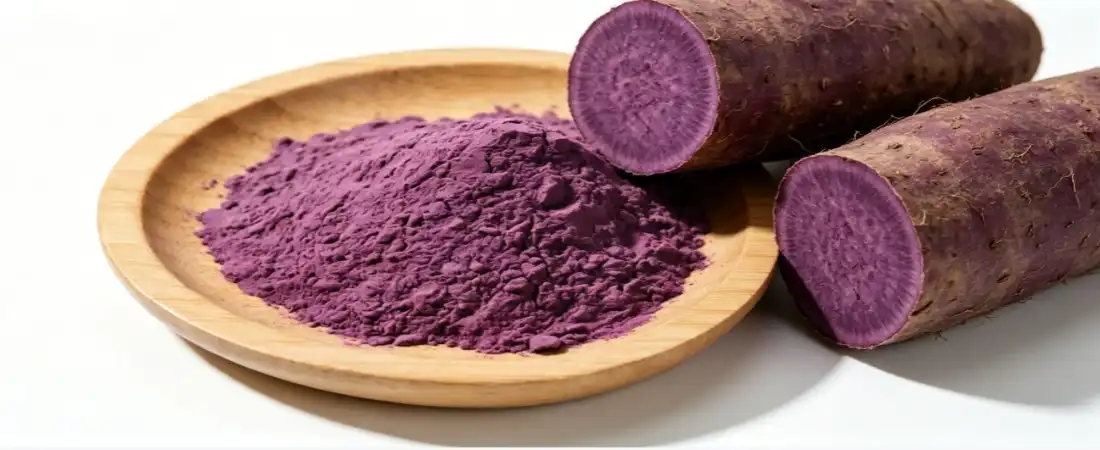
The pure purple yam powder is pure and milled from the tuber of Dioscorea alata L., the species marketed as ube, and its purple flesh contains anthocyanins, resistant starch, dietary fiber and a mineral profile that combined explain most of the purple yam nutritional advantages purchasers inquire about. But for sourcing managers and formulators, purple yam nutrition counts only if it makes it through processing, meets a specification and delivers on time. This guidance clarifies what published research truly supports, what a provider should be able to demonstrate, and where the health claims end. It’s written for procurement, R&D and brand teams certifying a botanical ingredient, not for medical advice.”
Understanding Purple Yam Ube Powder and Its Nutritional Profile
What Defines Pure Purple Yam Powder?
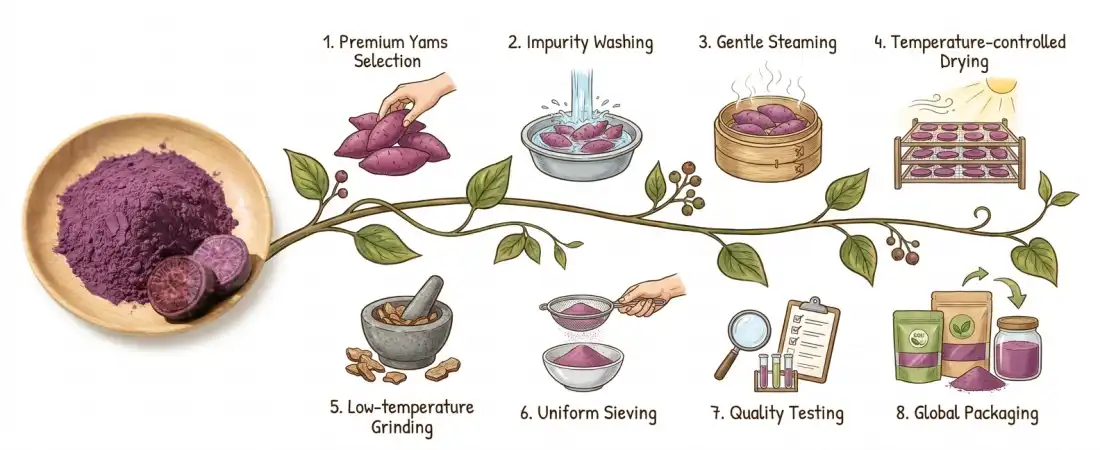
Real pure purple yam powder is only the dried and milled tuber of Dioscorea alata. No carrier, no added color, no sweet potato. The violet color is anthocyanin, in D. alata the pigments are cyanidin and peonidin based glycosides, with alatanin C, a cyanidin 3-(6-sinapoyl gentiobioside), as the main constituent (Srivichai & Hongsprabhas, 2020). Purple sweet potato powder is Ipomea batatas, a distinct species with a softer starch and a sweeter flavor. It is in processing that the two are muddled in the market, and that quality is earned or lost. Washing, low-temperature drying and milling to a specified particle size safeguard the pigment, vigorous drying does not. Write down the Latin name and the particle size on the technical data sheet and you’ve got a specification two vendors can truly be compared.
Comprehensive Nutritional Composition
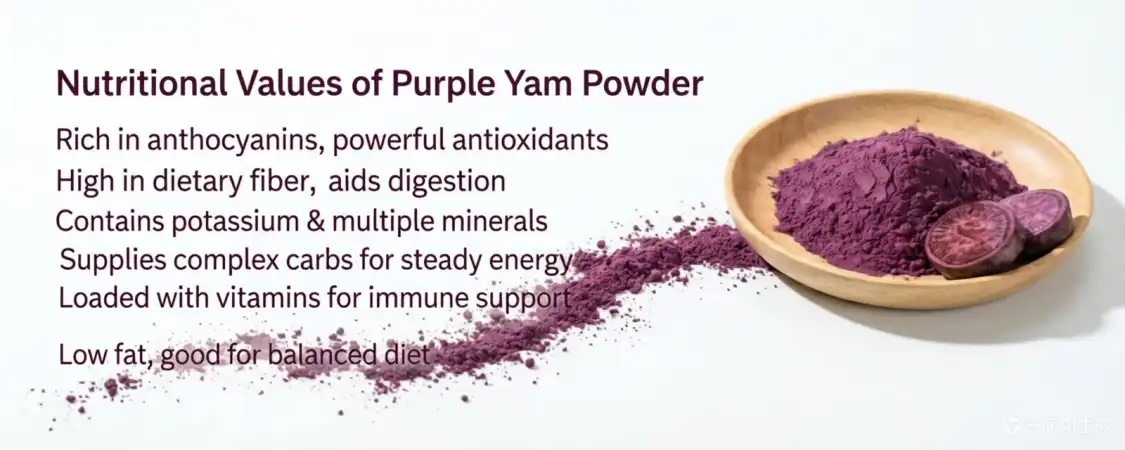
First, yam is a starch crop. Dioscorea landraces (n=25) from China showed starch contents ranging from 64.4% to 80.6% and protein contents ranging from 6.4% to 9.7% (dry weight basis), with magnesium and calcium being the highest minerals (Wu et al., 2016). But the parts that make product claims are the pigment and the resistant starch and they vary much more widely than the starch does.
| Component | Reported range | Basis | Source |
|---|---|---|---|
| Starch | 64.4–80.6% | dry weight, whole flour | Wu et al., 2016 |
| Protein | 6.4–9.7% | dry weight, whole flour | Wu et al., 2016 |
| Crude fibre | 0.67–1.19% | dry weight, whole flour | Wu et al., 2016 |
| Calcium | 316–453 mg/kg | dry weight | Wu et al., 2016 |
| Magnesium | 390–478 mg/kg | dry weight | Wu et al., 2016 |
| Total anthocyanin | 10–90 mg/100 g | dry weight, C3G equivalents | Srivichai & Hongsprabhas, 2020 |
| Total phenolics | 100–478 mg/100 g | dry weight, gallic acid equivalents | Srivichai & Hongsprabhas, 2020; Fang et al., 2011 |
| Dioscin (steroidal saponin) | 0.049–0.088% | dry weight | Wu et al., 2016 |
| Allantoin | 0.72–1.49% | dry weight | Wu et al., 2016 |
Table 1. Reported composition of Dioscorea alata tuber and flour. C3G = cyanidin-3-glucoside equivalents.
Three details in that table matter at the bench. First, every value is a dry-weight figure for whole flour: it is not a fresh-tuber value and not an extract value, so never reprint it as either. Second, anthocyanin content depends on cultivar and harvest maturity, which means one lot number tells you very little about the next. Third, the pigment is the most fragile fraction in the tuber. Blanching alone removed roughly 60% of total anthocyanin in a Chinese purple yam, and vacuum frying retained 60–69% of the phenolic fraction (Fang et al., 2011). Simple pre-treatments before drying, such as a brief soak, measurably improve the anthocyanin and phenolic content of the finished flour (Ratnaningsih et al., 2018).
Scientific Evidence Supporting Health Benefits
Evidence on purple yam benefits falls into three tiers, and the tier matters more than the headline.
- In vitro: resistant starch from purple yam supported the tolerance and proliferation of Bifidobacterium adolescentis in culture (Li et al., 2018b).
- Animal: in high-fat-fed hamsters, purple yam resistant starch lowered triglycerides, total cholesterol and LDL-cholesterol, raised HDL-cholesterol and shifted the gut community toward Bifidobacteria and Lactobacillus (Li et al., 2019).
- Human: no randomised controlled trial on pure purple yam powder at a defined dose has been published. Claims about blood sugar control, weight management or hormonal effects currently rest on cell and rodent work.
The explanation of fiber is widely known and it is worth saying explicitly. Resistant starch is not digested in the small intestine and is fermented in the colon to short-chain fatty acids. This is also why the above tests are conducted against particular microbial strains and not inferred from an antioxidant score, and why purple yam resistant starch is researched as a structurally unique fraction and not as regular starch (Li et al., 2018a). One common claim should be sent to the dustbin. Low or undetectable quantities of diosgenin are observed in D. alata (Obidiegwu et al., 2020) and it is a marker compound of other Dioscorea species like D. villosa and sold as a precursor of yam hormone. There is no established foundation for a steroid or hormone claim on this substance and product copy should not include one.
Sourcing teams, when shortlisting suppliers, may request the current batch paperwork (i.e. the Certificate of Analysis, anthocyanin value and moisture) to accompany the sample. Email requests to info@newthingsbiotech.com .
Enhancing Product Value: Applications of Purple Yam Powder in B2B Sectors
Food Manufacturing and Bakery Integration
The best documented application is Bakery. In a bread study, purple yam flour replacing 30% of wheat flour increased the enzyme-resistant starch from 34.9% to 41.3% and decreased the readily digested starch (Liu et al., 2019). The same research provides the practical ceiling: substitutes up to 20% left color, specific volume and texture similar to the wheat control, but at 30% and above crumb hardness and chewiness increased significantly. Assume 10-20% is the band where the result still acts like bread, budget in more water and a gluten correction vs assuming the flour swaps one to one.
Three process levers make the color withstand the process. The first is pH. As a system swings away from acidic, anthocyanins lose strength and trend toward blue. Keep acidic forms acidic where the color carries the claim. The second are heat and time, degradation is accelerated with both and this is how the frying study lost a third of the phenolic fraction in the fry itself (Fang et al., 2011). The third is dispersal. Combine the powder into the flour fraction rather than dropping it into wet batter, or you will chase streaks that no amount of mixing removes.
Functional Foods and Nutraceutical Development
Pure purple yam powder is used as a source of fiber and color in supplements and meal replacements. It’s not a protein, it’s not a stimulant, and text that says it is either invites a regulatory difficulty. The standard should specify anthocyanin (mg/100g) on the Certificate of Analysis and not depend on how deep the purple appears in a picture, providing a tiny absolute anthocyanin dosage (based on a flour with 10–90mg anthocyanin per 100g dry tuber) as a 10g portion is the reason why this is a specification.
The resistant starch is used as a slowly released carbohydrate in sports and pre-workout formulations. Disperses in water and plant-milk systems. Without carrier. Coarser material settles out. Powder, 80 mesh. Moisture is the primary failure mechanism, as the flour is hygroscopic. Set a moisture restriction, pack against a barrier film, and anticipate to consume an unsealed commercial pack in around two months rather than regard it as a one-year substance.
Natural Cosmetics and Skincare Applications
The substance functions as a natural colorant and an antioxidant-rich herb for both beauty-from-within and topical applications. Anthocyanins are the fraction of interest and also the fraction that oxidizes first therefore a topical system requires an antioxidant partner and opaque packaging to retain its color. Two claims should be excluded from the copy. A powder with particles around 180 µm across at 80 mesh is three orders of magnitude away from nanoscale, and particle size alone does not make a powder an exfoliant. Abrasiveness is a shape and hardness feature, not a fineness attribute. Place the substance as a source of pigment and antioxidant, and skin effectiveness claims are up to the formulator’s own testing.
Choosing the Right Purple Yam Powder for Procurement
Quality Benchmarks and Certification Requirements
Buy on documents. A supplier that can complete this set in one pass has earned a pilot lot.
- Per-batch Certificate of Analysis covering identity, moisture, ash, particle size, total anthocyanin in mg/100 g, total plate count, yeast and mould, and absence of E. coli and Salmonella.
- Heavy metals, namely lead, arsenic, cadmium and mercury, plus a pesticide residue screen reported against the limits of your destination market rather than a generic default.
- Identity evidence: an HPLC or LC-MS chromatogram showing cyanidin and peonidin glycosides and no synthetic colorant. A photograph of purple powder proves nothing.
- Certification scope rather than logos: ISO 9001 for quality management, a food-safety scheme such as ISO 22000, FSSC 22000 or GMP, and Kosher and Halal where those markets matter.
For clean-label and 100% pure claims, ask specifically about fillers, carriers and flow agents, and get the answer in writing. The absence of maltodextrin on a specification is a claim you may have to defend in a label review, and the supplier's written answer is what protects you.
Organic Versus Non-Organic Considerations
Organic certification alters paperwork and cost , not content . Certified organic flour will cost 20-30% more. Know what you’re paying for: a documented growing standard and auditable chain, not a higher anthocyanin number. Reported ranges of composition typically overlap across cultivars and lot-to-lot variance between two conventional landraces is often larger than the difference between an organic lot and a conventional one (Wu et al., 2016). Choose your market, choose your price cap and choose if your consumer truly requests for the logo, then purchase the matching specification rather than paying for a certificate nobody reads.
Supply Chain Stability and Volume Purchasing
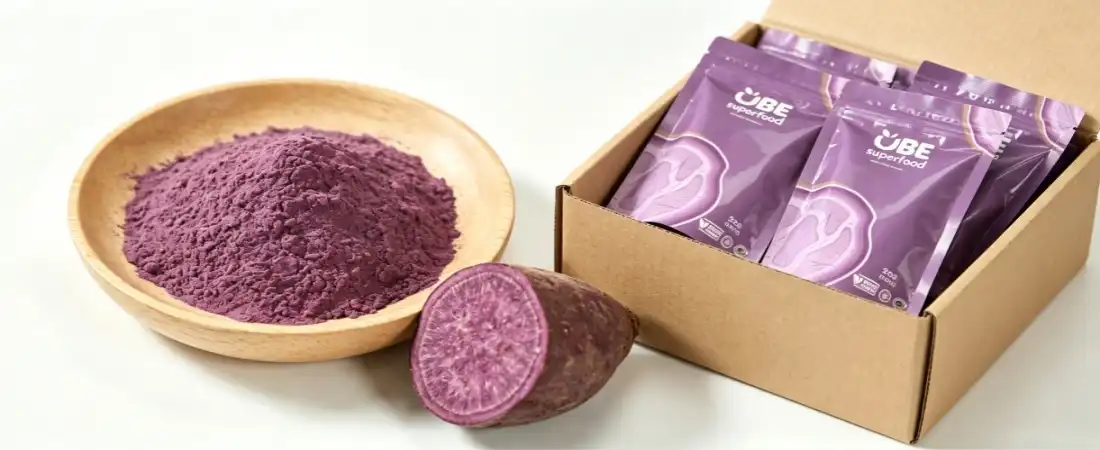
As Yam is a seasonal tuber continuity is a concern of contract not a warehouse. In-stock material ships in 1-3 business days. Minimum order of 10 kilogram for trial and pilot production. Graduated pricing for 100 kg, 500 kg and 1,000 kg tiers. Packaging from 1 kg sample packs to 10 kg industrial cartons. There are two conditions which are worth more than a discount on a long term deal. One is a quality hold window outlining how long you may test a lot before accepting it and the other is a defect replacement term. They are both challenged in a short harvest year And that is just when they matter.
If you would like an estimate based on your own specification rather than a catalog pricing, please submit that specification to info@newthingsbiotech.com and request the accompanying Certificate of Analysis with the quote.
Practical Guidance: Maximizing Nutritional Benefits with Purple Yam Powder
Industry-Specific Dosage and Application Protocols
Inclusion rates cluster tightly by format. The values below combine published trial conditions with normal practice in each category. Treat them as starting points for your own trial, not as a fixed specification.
| Format | Typical inclusion | What it delivers | Watch out for |
|---|---|---|---|
| Drinks and shakes | 2–5 g per serving | Colour, fibre top-up | Settling; specify 80 mesh |
| Bread, cake, muffin | 10–20% of flour weight | Colour, higher resistant starch | Crumb hardness above 30% |
| Extruded snacks, cereal | 5–15% | Clean-label colour | Pigment loss at extrusion heat |
| Capsules, gummies | 100–500 mg per dose | Colour plus a label claim | Low absolute anthocyanin per dose |
| Cosmetic masks, scrubs | 1–5% w/w | Pigment, antioxidant fraction | Oxidation; needs opaque packaging |
Table 2. Typical inclusion rates of purple yam powder by application format.
Storage is the part of the protocol that gets skipped. Keep the material below 25 °C and under 60% relative humidity, sealed against moisture and light, and plan to consume an opened industrial pack within about two months. Anthocyanin content and colour both decline from the moment the barrier film is broken, and no change to the specification will bring them back.
Avoiding Common Procurement Pitfalls
Three failures account for most incoming-goods complaints. The first is adulteration: maltodextrin, carriers and synthetic color boosters are inexpensive and the only reliable check is a chromatogram and a written carrier declaration. The second is species substitution, since D. alata and purple sweet potato are both advertised as purple, and the only valid proof is the Latin name on the technical data sheet. The third is sensory bluffing: real flour has an earthy, subtly sweet fragrance, so a chemical or noticeably dull smell indicates the batch was processed or kept poorly.
As for allergies, the ingredient is inherently gluten free and dairy free and D. alata is not a significant allergy source. The main danger is cross contamination, thus ask for isolated lines or a verified cleaning technique with swab results between manufacturing runs. One handling comment needs in your QA file: Raw yam might irritate mouth and throat in sensitive individuals, but thorough cooking or commercial processing eliminates it, thus final flour has no such problem.
Real-World Integration Success
A mid-sized bakery modified their signature muffin to increase the fiber and reduce the synthetic color by substituting 12% of the wheat flour with pure purple yam powder and adding around 3% additional water to account for the water absorption of the flour. In the buyer’s own internal sensory panels, 87% of tasters said the reformulated muffin was equal to or better than the original and the clean-label version could carry a 15% higher retail price. They are the customers own trial statistics and should be credited as such if repeated, since they are not from a peer reviewed research.
It is worth reproducing two procedural notes from the trial. Pre-hydrating the powder for roughly ten minutes before to mixing resulted in better dispersion and color evenness. A reduction in bake from 190 °C to 180 °C did not produce any noticeable difference in flavor, but did retain anthocyanin and increased the bake time by about four minutes.
Conclusion
There are three valid reasons to find a pure purple yam powder on a formulation sheet: a resistant starch and fiber fraction with documented in vitro and animal data; a natural anthocyanin color to substitute synthetic dye; and a specification that can be confirmed lot by lot. The purple yam health advantages you may post today are digestive and color related. There’s not a human study for the ones you can’t publish yet, such blood sugar control, hormonal impacts and weight management, and language that suggests otherwise is the quickest way to a rejected health claim. Purchase the specification, test the lot and put the claim in the proof.
FAQ
1. Is Purple Yam Powder Gluten-Free and Allergen-Safe?
Yes. Dioscorea alata contains no gluten proteins, so the flour suits gluten-free formulations, and it is not one of the major allergen sources. The realistic risk is cross-contact in a shared facility, so ask for dedicated lines or validated between-run cleaning with swab data. Raw yam can irritate the mouth and throat; cooking and commercial processing remove that, and the finished flour carries no such issue.
2. How Does Purple Yam Differ from Ube and Purple Sweet Potato Nutritionally?
Ube is the Philippine name for Dioscorea alata, so purple yam and ube are the same species, and ube yam nutrition values published under either name describe the same tuber. Purple sweet potato is Ipomoea batatas and an entirely different crop. The practical differences come down to pigment chemistry, starch behaviour, flavour, and how the ingredient has to be labelled.
| Attribute | Purple yam / ube (Dioscorea alata) | Purple sweet potato (Ipomoea batatas) |
|---|---|---|
| Latin name | Dioscorea alata L. | Ipomoea batatas (L.) Lam. |
| Dominant pigments | Cyanidin and peonidin glycosides; alatanin C dominant | Acylated cyanidin and peonidin glycosides |
| Starch behaviour | High amylose, more resistant starch, firm gel | Lower amylose, softer and sweeter paste |
| Flavour | Earthy, mildly sweet, fairly neutral | Distinctly sweet, sometimes vegetal |
| Typical application | Bread, ice cream, clean-label colour systems | Desserts, purées, fillings |
| Label declaration | Must be declared as yam | Must be declared as sweet potato |
Table 3. Purple yam and purple sweet potato compared.
Both are nutritious, and neither is a lawful substitute for the other on a label. Declaring one species as the other is a labelling failure rather than a marketing choice, which is why the Latin name belongs on every technical data sheet you accept.
3. Where Can I Source Trusted Bulk Suppliers for Pure Variants?
Qualify on documents, not on samples. A supplier worth a trial contract will provide a Certificate of Analysis per batch, an HPLC chromatogram confirming cyanidin and peonidin glycosides, heavy-metal and pesticide results reported against your market's limits, and certificates showing ISO 9001 plus a food-safety scheme such as ISO 22000 or FSSC 22000, with Kosher and Halal where relevant. Ask for the Latin name, the declared particle size and the moisture specification, and confirm the packaging formats from sample pack to pallet. Then run a pilot lot before committing to annual volume.
Partner with NT Biotech for Superior Purple Yam Powder Solutions
NT Biotech supplies pure purple yam powder milled from Dioscorea alata, processed to hold colour and resistant starch from lot to lot. Material is produced under ISO 9001 quality management with Kosher and Halal certification, and every batch ships with a Certificate of Analysis covering identity, anthocyanin content, moisture and microbiology. Because the colour fraction is the fragile one, anthocyanin is tested per lot rather than per season.
Send us your specification and we will quote against it at info@newthingsbiotech.com. Tell us your format, target inclusion rate and destination market, and we will return a sample together with the Certificate of Analysis and the matching chromatogram. In-stock material ships in 1–3 business days, the minimum order starts at 10 kg, and OEM formulation support is available for clean-label projects.
References
1. Truong, V.D., McFeeters, R.F., Thompson, R.T., Dean, L.L., and Shofran, B. (2007). "Phenolic Acid Content and Composition in Leaves and Roots of Common Commercial Sweetpotato Cultivars in the United States." Journal of Food Science, 72(6), C343-C349.
2. Teow, C.C., Truong, V.D., McFeeters, R.F., Thompson, R.L., Pecota, K.V., and Yencho, G.C. (2007). "Antioxidant Activities, Phenolic and β-Carotene Contents of Sweet Potato Genotypes with Varying Flesh Colours." Food Chemistry, 103(3), 829-838.
3. Benherlal, P.S. and Arumughan, C. (2007). "Chemical Composition and In Vitro Antioxidant Studies on Syzygium cumini Fruit." Journal of the Science of Food and Agriculture, 87(14), 2560-2569.
4. Afoakwa, E.O., Paterson, A., Fowler, M., and Ryan, A. (2008). "Flavor Formation and Character in Cocoa and Chocolate: A Critical Review." Critical Reviews in Food Science and Nutrition, 48(9), 840-857.
5. Mohanraj, R. and Sivasankar, S. (2014). "Sweet Potato (Ipomoea batatas [L.] Lam)—A Valuable Medicinal Food: A Review." Journal of Medicinal Food, 17(7), 733-741.
6. Padmaja, G. (2009). "Uses and Nutritional Data of Sweetpotato." In Loebenstein, G. and Thottappilly, G. (eds.), The Sweetpotato, Springer Netherlands, pp. 189-234.