- English
- French
- German
- Portuguese
- Spanish
- Russian
- Japanese
- Korean
- Arabic
- Greek
- German
- Turkish
- Italian
- Danish
- Romanian
- Indonesian
- Czech
- Afrikaans
- Swedish
- Polish
- Basque
- Catalan
- Esperanto
- Hindi
- Lao
- Albanian
- Amharic
- Armenian
- Azerbaijani
- Belarusian
- Bengali
- Bosnian
- Bulgarian
- Cebuano
- Chichewa
- Corsican
- Croatian
- Dutch
- Estonian
- Filipino
- Finnish
- Frisian
- Galician
- Georgian
- Gujarati
- Haitian
- Hausa
- Hawaiian
- Hebrew
- Hmong
- Hungarian
- Icelandic
- Igbo
- Javanese
- Kannada
- Kazakh
- Khmer
- Kurdish
- Kyrgyz
- Latin
- Latvian
- Lithuanian
- Luxembou..
- Macedonian
- Malagasy
- Malay
- Malayalam
- Maltese
- Maori
- Marathi
- Mongolian
- Burmese
- Nepali
- Norwegian
- Pashto
- Persian
- Punjabi
- Serbian
- Sesotho
- Sinhala
- Slovak
- Slovenian
- Somali
- Samoan
- Scots Gaelic
- Shona
- Sindhi
- Sundanese
- Swahili
- Tajik
- Tamil
- Telugu
- Thai
- Ukrainian
- Urdu
- Uzbek
- Vietnamese
- Welsh
- Xhosa
- Yiddish
- Yoruba
- Zulu
Every formulator knows the tradeoffs. Natural colorants may fade over time. Active is difficult to dose if it is powerful. More often, clean label represents a trade-off in visual appeal. One of the few things that relieves several of these stressors at once is marigolds extract. It gives goods a warm golden color, contains lutein that consumers recognize and works well in softgels, sweets, beverages, bread products, cosmetics and animal feed. This page talks about how a formulation is improved using marigold extract powder, which challenges it solves, how to pick the correct grade, how to keep it stable and its uses in different industries. Supplier of Marigold Extract Powder Bulk to Supplement, Food and Cosmetic Industries worldwide. Made by NT Biotech. For our bulk marigold extract powder we choose the Tagetes erecta flower petals graded for 5% to 90% lutein. All grades are HPLC or UV tested and sent with a batch specific Certificate of Analysis. info@newthingsbiotech.com for samples or wholesale prices.

Five Formulation Problems Marigold Extract Powder Solves
Natural Color Without Synthetic Dyes
Yellow and orange hues have typically been obtained from synthetic colors such as tartrazine and sunset yellow. Many buyers now shun these names on a label and some companies have eliminated them altogether. Marigold is a plant-based substitute for lutein. It is permitted as a food color in several markets and categorized as E161b in the European Union . In his analysis of natural colorants, Mortensen highlighted carotenoids as one of the most significant pigments accessible to the food sector since they produce hues from pale lemon to deep orange . A modest addition of marigold extract powder may change a pale gummy, pasta or sauce into a sunshiny, attractive product and the label remains clear and simple to read.
A Recognized Active in a Small Dose
Most colorants only add color. Lutein is functional as well. Lutein is one of the best known nutrients on the supplement aisle, thanks to decades of eye health studies, including the AREDS2 experiment. High purity grades are so concentrated that a typical 10mg dose takes up very little space in a capsule or tablet. That allows room for companion ingredients like zeaxanthin, bilberry or omega-3s. Marigold extract offers lutein and allows businesses to make a bona fide, research-supported claim without having to ramp up serving size.”
One Ingredient, Several Jobs
Its greatest benefit over other formulations is efficiency. Marigold extract may color a product, function as an antioxidant and support a health claim. That means the formulator needs to work with fewer substances to obtain, test and declare. It solves the typical problems listed in the following table.
| Formulation Challenge | How Marigold Extract Helps | Practical Outcome |
|---|---|---|
| Removing synthetic yellow dyes | Lutein provides natural yellow-orange color | Cleaner label, same visual appeal |
| Adding a functional claim | Delivers recognized eye and skin nutrient | Stronger marketing story |
| Limited capsule space | High-purity grades need tiny doses | Room for partner actives |
| Water-based products | Cold-water-dispersible beadlets available | Even color in drinks and gummies |
| Pale or uneven product color | Consistent standardized pigment | Batch-to-batch visual uniformity |
| Long ingredient lists | Color and function in one input | Simpler sourcing and QC |
Matching the Grade to Your Process
Free Lutein or Lutein Esters
Marigold petals naturally contain lutein linked to fatty acids, called lutein esters. The manufacturers may retain these esters or saponify the extract to liberate free lutein, the form present in human tissue. They’re both here. Brands that prefer ester forms may be reassured by the findings of Bowen et al. who discovered that esterified lutein was absorbed at least as well as free lutein in human volunteers. However, free lutein crystals provide a very high purity and a lesser dosage. They are the common option for small softgels and premium capsules. Your selection is based on label wording, target market, and how concentrated you want the final serving to be.
Oil-Soluble Powders vs Cold-Water-Dispersible Beadlets
Lutein is fat soluble and the common marigold extract powder disperses well in oils, fats and dry blends. This makes them ideal for use in softgels, tablets, foods containing fat and anhydrous cosmetics. Drinks, candy and fizzy tablets are a different story. Cold-water-dispersible (CWS) beadlets are small spheres of lutein surrounded by a matrix, commonly modified starch or gum acacia, that ensures it disperses evenly in water without spots or greasy rings. The beadlet shell also shields the pigment from oxygen, hence extending the shelf life in demanding forms.
A Practical Grade Guide
Choosing the proper concentration saves cost and reformulation later. Color-led products fit lower grades whereas dose-led supplements suit high-purity crystals. The guide below links each grade to the procedures it is best suited for.
| Lutein Grade | Physical Form | Best-Fit Process | Typical Use Level |
|---|---|---|---|
| 5% lutein | Orange-yellow powder | Tablets, dry mixes, bakery | Color plus moderate lutein |
| 10% lutein | Orange powder | Capsules, multivitamins | 100 mg delivers 10 mg lutein |
| 20% lutein | Concentrated powder | Premium capsules | 50 mg delivers 10 mg lutein |
| 80%–90% lutein | Free lutein crystals | Softgels in oil suspension | Smallest possible dose |
| 5%–10% CWS beadlets | Water-dispersible beadlets | Beverages, gummies, effervescents | Even color in water systems |

Engineering Stability and Absorption Into the Formula
Why Carotenoids Fade
Lutein’s color comes from a lengthy chain of conjugated double bonds. The very structure renders it susceptible. Boon and colleagues who reviewed carotenoid stability in foods noted that oxygen, light, heat, metal ions and low pH all accelerate carotenoid breakdown and these elements frequently operate in concert to enhance the rate of deterioration. A beverage in a transparent container under the lights of a store, or a gummy fried at a high temperature, might lose color long before the date it expires. Understanding the triggers is the first step toward a product that looks and operates the same on its final day as its first.
Protection Strategies That Work
Practical techniques maintain lutein bright in several ways. The pigment is protected by sacrificial antioxidants, such as mixed tocopherols or ascorbyl palmitate. The bottles and sachets are purged with nitrogen to eliminate oxygen. Trace metals that accelerate oxidation are sequestered by chelating agents. Adding the extract later in the process — after the hottest phases — cuts down on heat damage. Opaque bottles, foil blisters and colored packaging restrict light. Another layer of protection is provided by microencapsulated beadlets. Together, these methods allow a well-selected marigold extract powder bulk grade to maintain color and potency for a shelf life of 24 months.
Helping the Body Absorb Lutein
A formula is only as good as the nutrient enters the body. In their review on dietary lutein and zeaxanthin, Abdel-Aal et al. reported that the food matrix as well as the presence of fat had a major impact on the absorption of carotenoids. That understanding may be used by formulators. Absorption is enhanced by suspending lutein in oil in a softgel, adding some medium chain triglycerides to a powder mix or combining it with fish oil. Label guidelines that tell you to take the product with food also are helpful. “These are small decisions that can have a big impact on the consumer experience of the product.
Not sure whether free lutein, esters or CWS beadlets are best for your manufacturing line? Email info@newthingsbiotech.com your intended dosage and format. Our technical staff will return to you within two hours with a grade suggestion, some recommendations on stability and a free sample with its batch CoA.
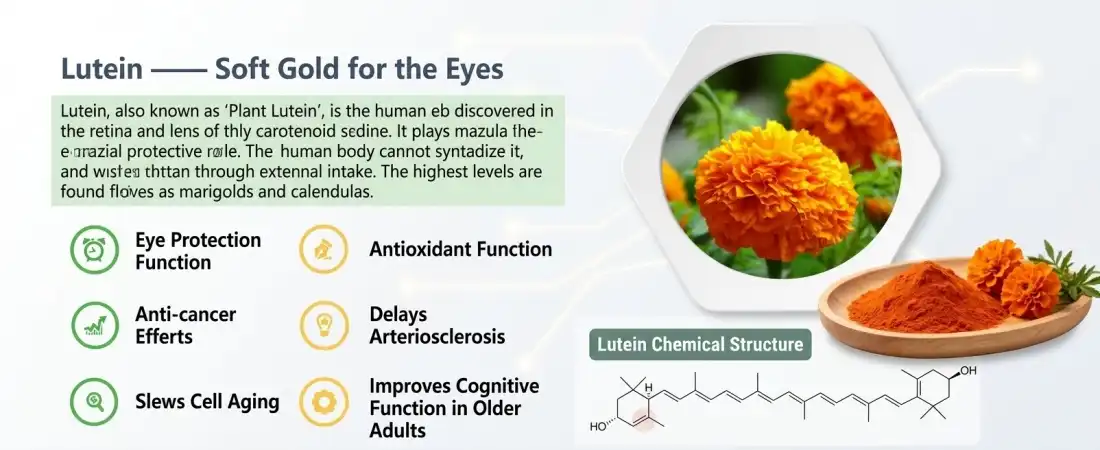
A Category-by-Category Playbook
Dietary Supplements
Lutein remains the biggest in the supplements industry. High-purity lutein in oil-suspended softgels is the traditional eye health formulation. 10% or 20% powders for capsules and tablets that flow easily through filling and compression machinery. Gummies are taking off. CWS beadlets provide a natural golden hue and a significant dosage. Lutein in a marigold extract also enhances multivitamin potency, particularly multivitamins designed for people who spend long hours in front of screens.
Foods and Beverages
In meals, marigold extract is generally used initially as a colorant. Its warm yellow color suits pasta, noodles, sauces, salads, cheese analogs, bakery fillings and confectionary. In plant-based cuisine it is used to mimic the hue of egg or butter. In beverages CWS grades provide vivid sun-yellow juices, sports drinks and functional fluids. The same ingredient may support a nutrition message, and businesses can turn a simple color change into a “with marigold extract with lutein” claim if local restrictions permit.
Cosmetics and Skin Care
Lutein is also increasingly featuring in beauty products. In a double-blind, placebo-controlled research, Palombo et al. showed that combined oral and topical lutein and zeaxanthin enhanced skin hydration, suppleness, and surface lipids, with best outcomes in the combination group . Formulators employ marigold extract powder in creams, serums and sun-care boosters and in beauty-from-within capsules. Its golden tint also adds a natural, botanical aspect to balms and oils.
Animal Nutrition
Marigold extract is a traditional feed additive. Commonly used to enhance the color of egg yolk and chicken skin. Hencken’s work with feed carotenoids, which documented the deposition of dietary xanthophylls like as lutein in yolks and tissues to provide the rich color that customers want. Marigold extract is also used in aquaculture and luxury pet feeds for color and nutritional positioning. Bulk feed grades are an economical, natural alternative to manufactured pigments.

Working with a Marigold Extract Powder Bulk Supplier You Can Trust
Read the Specification Before You Buy
The foregoing advantages are dependent on uniform raw material. Request a comprehensive specification sheet, a batch specific CoA, and verify the technique utilized for the lutein test. The following is the normal profile of NT Biotech’s marigold extract, validated on each manufacturing batch.
| Item | Specification | Test Method |
|---|---|---|
| Botanical Source | Tagetes erecta L. (flower) | TLC |
| Active Compound | Lutein 5%, 10%, 20%, 80%, 90% | HPLC / UV |
| Lutein CAS No. | 127-40-2 | — |
| Molecular Formula / Weight | C₄₀H₅₆O₂ / 568.87 | — |
| Appearance | Orange-yellow to orange-red fine powder | Visual |
| Particle Size | 100% pass 80 mesh | Sieve |
| Loss on Drying | ≤ 5.0% | USP |
| Heavy Metals | ≤ 10 ppm | ICP-MS |
| Microbiology | TPC ≤ 1,000 cfu/g; E. coli and Salmonella negative | USP |
| Storage and Shelf Life | Sealed, cool, dry, away from light; 24 months | — |
Speed, Stock, and Logistics
Formulation timeframes change rapidly. So do we. NT Biotech promises a first response to all inquiries within two hours. Popular grades are in stock and sent within 1-3 working days following purchase confirmation. Production orders often need 3 to 10 working days. This includes raw material procurement, proprietary extraction, laboratory testing and packaging. Samples and smaller purchases are sent straight from our manufacturer using our FedEx & UPS accounts. For bulk order we use air or sea freight from reputable freight forwarders selected according to your requirements for speed, volume and cost.
Certifications, OEM Support, and Easy Payment
We have ISO9001 quality management accreditation and are KOSHER and HALAL certified. Each shipment is accompanied with HPLC or UV data and CoA. Our OEM & ODM services can customize the lutein concentration, ester or free form, beadlet type, particle size and final softgels, gummies or powders for diverse markets. We also accept payment in the currency of the purchasing country.

Conclusion
Marigold extract is a formulation improver, killing two birds with one stone. It substitutes manufactured yellow hues, is a well-known lutein that is active at low dosages, works in oil or water systems with varied grades and is suitable for supplements, meals, cosmetics and animal feed alike. Smart stability and absorption measures make sure it works dependably until the last serving. Shaanxi New Things Biotech is a reliable provider of plant derivatives, providing marigold extract powder bulk with lutein from 5% to 90%. Each batch is backed by proprietary extraction, comprehensive HPLC and CoA documentation, and ISO9001, KOSHER and HALAL certifications. We allow businesses to produce better goods in a natural and reliable way with rapid stock delivery and adaptable OEM options. Start to shape with us today.
FAQ
Q1: How does marigold extract improve a formulation?
It adds natural color, a recognized lutein active, and antioxidant value in one ingredient.
Q2: Can it replace synthetic yellow dyes?
Yes. Lutein provides natural yellow-orange shades and is approved as a food color in many markets.
Q3: Which grade suits beverages and gummies?
Cold-water-dispersible beadlets give even color in water-based products.
Q4: How do I keep lutein stable?
Use antioxidants, limit heat and oxygen, and choose opaque packaging.
Q5: What lutein grades does NT Biotech supply?
Lutein 5%, 10%, 20%, 80%, and 90%, verified by HPLC or UV.
Upgrade Your Formulas with NT Biotech Marigold Extract
Better formulations start with multi-tasking chemicals. NT Biotech sells marigold extract powder bulk with standardized lutein grades from 5% - 90% taken from the petals of Tagetes erecta and documented with a CoA for each batch. Whatever your needs for natural color for foods, clinical dosage for softgels, water dispersible beadlets for gummies, or a feed grade pigment, we have a grade to meet your process. We respond within 2 hours, ship stock grades within days, accept payment in your local currency, and give complete OEM and ODM assistance. Let our technical staff assist you to develop goods that seem brighter and function better. Reach out to info@newthingsbiotech.com immediately to get a free sample, complete specs and a competitive quote.
References
1. Mortensen A. Carotenoids and other pigments as natural colorants. Pure and Applied Chemistry. 2006;78(8):1477–1491.
2. Boon CS, McClements DJ, Weiss J, Decker EA. Factors influencing the chemical stability of carotenoids in foods. Critical Reviews in Food Science and Nutrition. 2010;50(6):515–532.
3. Bowen PE, Herbst-Espinosa SM, Hussain EA, Stacewicz-Sapuntzakis M. Esterification does not impair lutein bioavailability in humans. Journal of Nutrition. 2002;132(12):3668–3673.
4. Abdel-Aal ESM, Akhtar H, Zaheer K, Ali R. Dietary sources of lutein and zeaxanthin carotenoids and their role in eye health. Nutrients. 2013;5(4):1169–1185.
5. Palombo P, Fabrizi G, Ruocco V, et al. Beneficial long-term effects of combined oral/topical antioxidant treatment with the carotenoids lutein and zeaxanthin on human skin: a double-blind, placebo-controlled study. Skin Pharmacology and Physiology. 2007;20(4):199–210.
6. Hencken H. Chemical and physiological behavior of feed carotenoids and their effects on pigmentation. Poultry Science. 1992;71(4):711–717.