- English
- French
- German
- Portuguese
- Spanish
- Russian
- Japanese
- Korean
- Arabic
- Greek
- German
- Turkish
- Italian
- Danish
- Romanian
- Indonesian
- Czech
- Afrikaans
- Swedish
- Polish
- Basque
- Catalan
- Esperanto
- Hindi
- Lao
- Albanian
- Amharic
- Armenian
- Azerbaijani
- Belarusian
- Bengali
- Bosnian
- Bulgarian
- Cebuano
- Chichewa
- Corsican
- Croatian
- Dutch
- Estonian
- Filipino
- Finnish
- Frisian
- Galician
- Georgian
- Gujarati
- Haitian
- Hausa
- Hawaiian
- Hebrew
- Hmong
- Hungarian
- Icelandic
- Igbo
- Javanese
- Kannada
- Kazakh
- Khmer
- Kurdish
- Kyrgyz
- Latin
- Latvian
- Lithuanian
- Luxembou..
- Macedonian
- Malagasy
- Malay
- Malayalam
- Maltese
- Maori
- Marathi
- Mongolian
- Burmese
- Nepali
- Norwegian
- Pashto
- Persian
- Punjabi
- Serbian
- Sesotho
- Sinhala
- Slovak
- Slovenian
- Somali
- Samoan
- Scots Gaelic
- Shona
- Sindhi
- Sundanese
- Swahili
- Tajik
- Tamil
- Telugu
- Thai
- Ukrainian
- Urdu
- Uzbek
- Vietnamese
- Welsh
- Xhosa
- Yiddish
- Yoruba
- Zulu
Gluten-free baking is known for dry cakes, gritty biscuits and pale loaves nobody wants to photograph. Ube can fix that one. Naturally gluten free, this purple yam adds delicate moisture, mild vanilla-nut flavor and a violet hue that makes any bake appear spectacular. When used correctly, it may take an average gluten-free dish and make it something that people would seek for by name. This lesson discusses why ube works in gluten-free formulations and how to develop a flour mix around it. It also provides techniques for each kind of bake, frequent difficulties and cures, and what to look for in professional bakeries when sourcing. Written by NT Biotech, an experienced supplier of ube starch powder to bakers, food manufacturers and beverage companies all over the globe. Our ube starch powder comes from handpicked Dioscorea alata tubers that are carefully dried and processed to pass 80 mesh. That fine texture easily combines with gluten-free flours, and the powder has no artificial colors or additives. All batches are tested and sent with a Certificate of Analysis. Email info@newthingsbiotech.com for samples or bulk pricing.
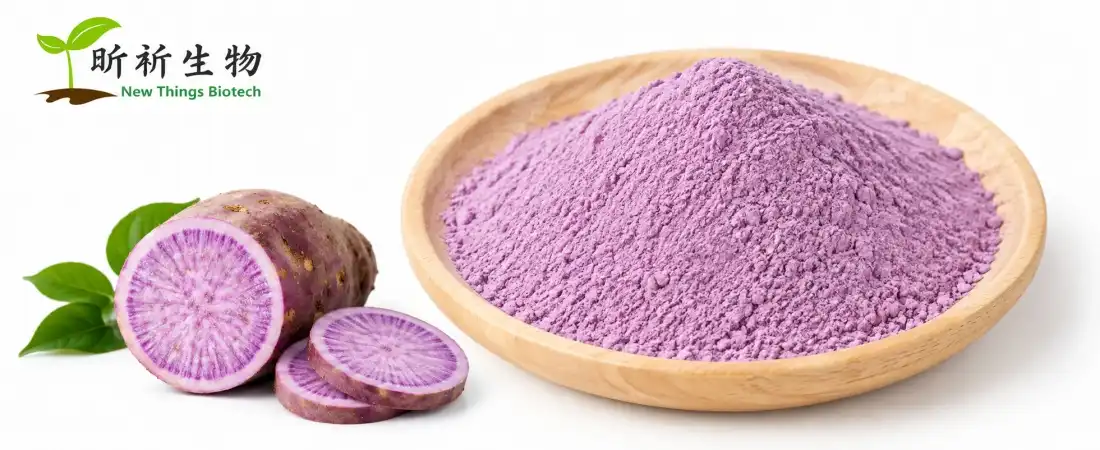
Why Ube Starch Powder Belongs in Your Gluten-Free Pantry
Naturally Gluten-Free, Naturally Purple
Gluten is a network of proteins that are in wheat, barley and rye. Ube comes from a completely different family of plants. So pure purple yam ube powder contains no gluten forming proteins at all. Dioscorea alata is a tropical yam. This makes it a sensible alternative for bakers serving folks with celiac disease, gluten sensitivity or just preference. There aren’t a lot of gluten-free items that have color and flavor and structure, so ube really fills a hole in the cupboard.”
Moisture and Softness Where Gluten-Free Bakes Struggle
The major issue of gluten free baked items is dryness. Many starches and rice flours do not absorb water uniformly, and lose water rapidly during baking and storage, resulting in a dry and crumbly product. Ube powder is derived from yam starch that swells and becomes thick when heated with water. Yam starch was evaluated by Zhu who observed strong gelling and thickening behavior. This propensity in a cake or muffin locks in moisture to the crumb to provide a softer, more delicate flavor.
Color and Flavor That Sell Themselves
Many gluten-free items compete solely on the strength of their “free-from” claims. That gives them an excellent reason to be chosen. It is naturally colored in shades of light purple to deep violet by its anthocyanins and needs no synthetic colors. Its mellow vanilla-like taste pairs nicely with coconut, white chocolate, cream cheese and pandan. A purple gluten-free cake on a café counter or store shelf is hard to miss.
The Gluten Gap: What Ube Can and Cannot Replace
What Gluten Does in Dough
To be a good gluten-free baker, it helps to know what you’re missing out on. Gluten is created when water and wheat flour combine to make a web of flexibility . This traps gas , expands as the dough rises and sets into a bouncing crumb . In their work on gluten-free formulation, Gallagher, Gormley and Arendt noted that the elimination of gluten reduces this viscoelastic structure. "Bakers need a combination of starches, proteins and hydrocolloids to replicate it.
Where Yam Starch Steps In
Ube yam starch powder accomplishes part of the job. Starch gelatinizes during baking to aid set, bind and retain moisture in the crumb. Jiang et al. studied the starches of five species of Dioscorea and found substantial differences in granule structure, amylose content and gelatinization behavior. That is why the starches of the yam act differently in recipes than those of maize or potato. In fact, ube lends body and softness and is best utilized as a component of a well-rounded flour blend, not the whole flour.
Why You Still Need a Binder
Starch gives structure, but it can’t stretch or trap gas as gluten can. Gluten-free bakers use hydrocolloids such as xanthan gum, psyllium husk or HPMC for this purpose . Hager and Arendt evaluated the impact of the binders on loaf volume and crumb hardness in gluten-free loaves, and found that the results were highly dependent on the base flour. HPMC tended to boost volume whereas xanthan gum tended to offer a firmer crumb. The trick to nailing it is pairing ube with the correct binder for the specific bake.
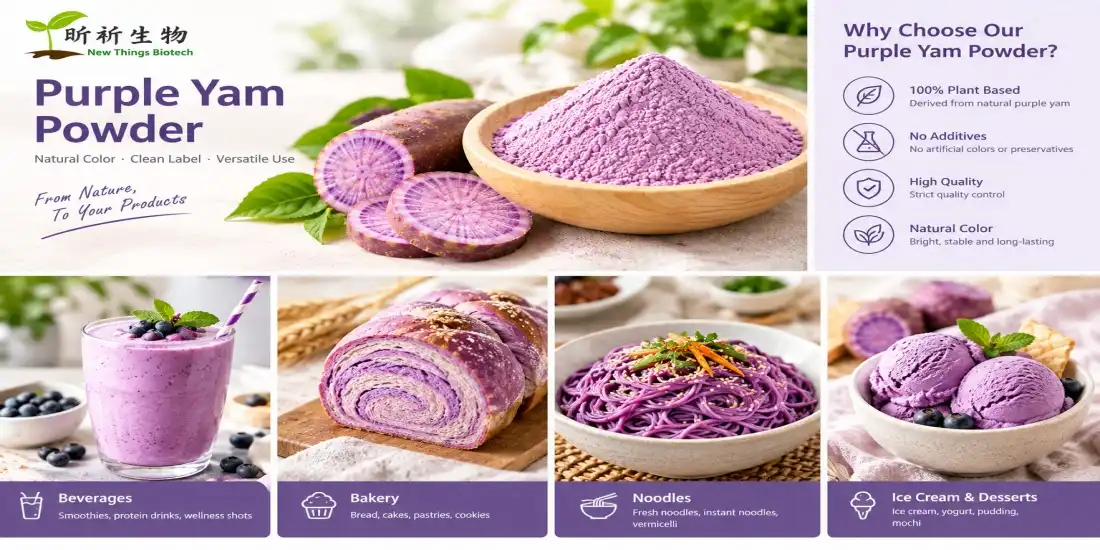
Building Your Ube Gluten-Free Flour Blend
Starting Ratios by Bake
A good way to do this is to substitute some of the normal gluten free mix you use with ube powder and take it from there. The table below provides useful beginning points. Percentages are based on the total flour weight.
| Bake | Ube Starch Powder | Suggested Base Flours | Binder per 100 g Blend | Key Tip |
|---|---|---|---|---|
| Chiffon and sponge cakes | 15–20% | Superfine rice flour, tapioca starch | 0.3–0.5 g xanthan gum | Whipped eggs provide lift |
| Cookies and crinkles | 15–25% | Rice flour, almond flour | 0.25 g xanthan gum | Chill dough before baking |
| Muffins and quick breads | 10–20% | Rice flour, sorghum flour | 0.5 g xanthan gum | Use baking powder, not soda |
| Yeast breads and pandesal | 10–15% | Rice, sorghum, tapioca | 3–5 g psyllium husk or 2 g HPMC | Expect a soft, batter-like dough |
| Pancakes and waffles | 15–20% | Rice flour, certified gluten-free oat flour | None needed | Rest batter for 10 minutes |
| Mochi and steamed cakes | 10–20% | Glutinous (sweet) rice flour | None needed | Glutinous rice is gluten-free |
Hydration and the Pre-Soak Trick
Powders heavy in starch need time and fluids to operate. Whisk the ube powder into the warmed milk, coconut milk or water in the recipe and set aside for 10 to 15 minutes before adding to the batter. This pre-soak helps to hydrate the starch, enhance the color and get rid of any powdery taste. Gluten-free batters can benefit from a 20- to 30-minute rest after mixing. In this time the rice flour breaks down, making the crumb less gritty and smoother in the end.
Protecting the Purple
Anthocyanins are pH sensitive, changing color with pH. This behavior was studied in depth by Castañeda-Ovando et al. , who showed that anthocyanins are reddish violet under acid circumstances and blue or gray under alkaline settings. That’s why baking soda may make an ube cake a dreary green gray. Where feasible, use baking powder for soda, counteract the alkalinity with a teaspoon of lemon juice or a little buttermilk and bake at moderate temperatures. Foil tenting in the latter stages of baking may protect the top from becoming too dark.
Need assistance with blend ratios for a gluten-free ube cake mix, cookie line or bakery menu? Email us at info@newthingsbiotech.com with your recipe objectives. Our technical staff will provide you with formulation ideas and a free sample with its batch CoA within two hours.
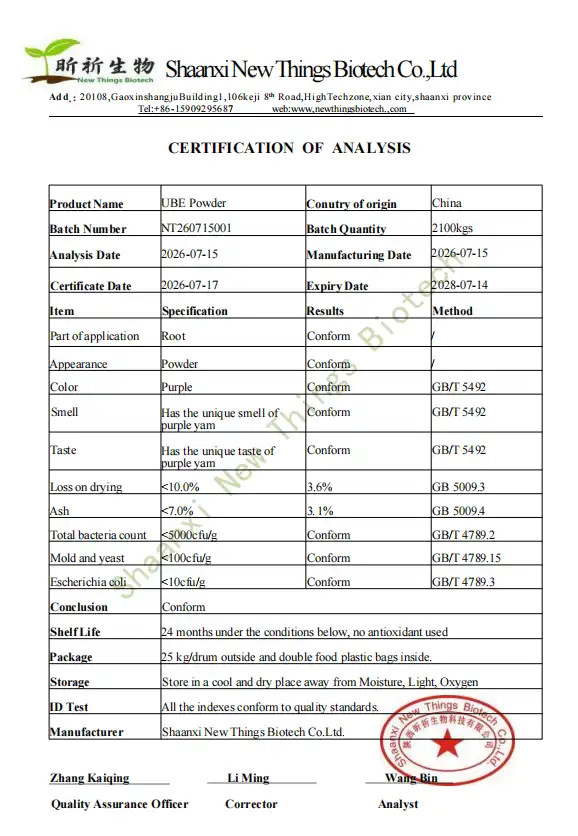
Technique by Bake: From Chiffon to MochiChiffon and Layer Cakes
The texture is mostly from the beaten egg whites and the ube chiffon is traditional. That makes it an ideal gluten free bake. Add the pre-soaked ube starch powder to the yolk batter and mix well. Gently fold in the stiff meringue so you don’t knock the air out. Bake in an ungreased tube pan so the batter may crawl up the sides; cool the cake upside down so it doesn't collapse. Layer cakes: Enhances the nutty taste of ube with a cream cheese or coconut frosting.
Cookies and Crinkles
Ube crinkle cookies are a famous Filipino dessert that adapt nicely to gluten free baking. Almond flour adds richness and helps bind the dough. Chill dough for an hour to firm up, then roll balls in powdered sugar before baking. These amazing cookies are covered in white with bright violet cracks. Remove from oven while centers are still mushy, gluten free cookies will set up as they cool.
Yeast Breads and Pandesal
Gluten free yeast dough is more like a thick batter than a kneaded dough and that is acceptable. The psyllium husk gives it a bread-like feel and helps it hold its shape. Give it a thorough hydration then let it rise in a warm area and bake till the internal temperature is somewhere about 96-98C so it is set all the way through. Capriles and Arêas said many gluten-free breads are created using processed carbs. The use of a tuber ingredient like purple yam ube powder gives the bread fiber, natural colors and a more special flavor.
Mochi and Steamed Treats
Do not be fooled by the name, glutinous rice is gluten-free. It’s called that because it feels sticky. You may use ube powder with sticky rice flour to produce bright, chewy ube mochi, butter mochi and steaming puto without any binders. Steaming works nicely on the anthocyanins thus they often are the brightest purple of all.
Quick Troubleshooting Guide
It's not easy, even for professional bakers. This table lists the most frequent problems and how to solve them.
| Problem | Likely Cause | Fix |
|---|---|---|
| Dry, crumbly texture | Too little liquid or binder | Pre-soak ube powder; add binder |
| Gummy center | Too much starch or underbaking | Reduce ube share; bake lower and longer |
| Gray-green color | Alkaline batter from baking soda | Switch to baking powder; add lemon juice |
| Faded purple | High heat or overbaking | Lower oven temperature; tent with foil |
| Dense loaf | Dough too stiff | Increase water; add psyllium husk |
| Gritty mouthfeel | Coarse rice flour | Use superfine rice flour; rest batter |
Sourcing Ube Yam Starch Powder for Commercial Gluten-Free Lines
What to Check on the Specification
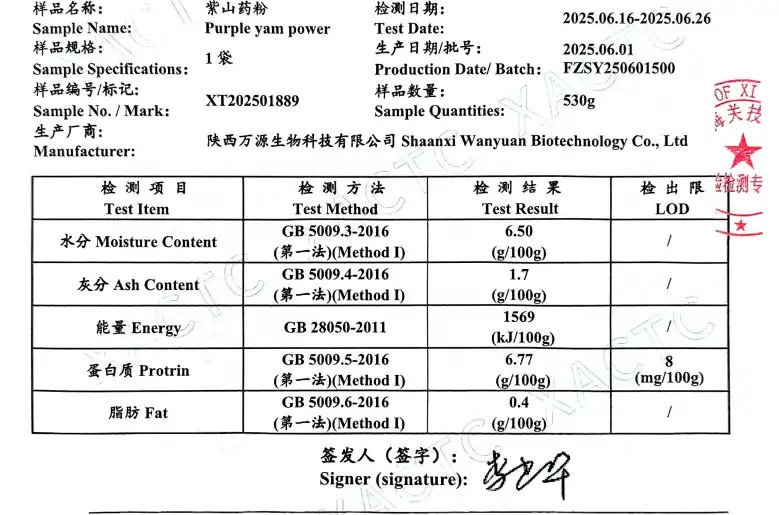
Commercial bakeries have to achieve the same color, texture and performance in every batch they make. Order only after requesting a comprehensive spec sheet and a batch-specific CoA. The usual profile of NT Biotech’s ube yam starch powder is shown in the table below and is validated on every manufacturing batch.
| Item | Specification | Test Method |
|---|---|---|
| Botanical Source | Dioscorea alata L. (tuber) | Organoleptic |
| Appearance | Light to deep purple fine powder | Visual |
| Odor and Taste | Characteristic, mildly sweet and nutty | Organoleptic |
| Particle Size | 100% pass 80 mesh | Sieve |
| Loss on Drying | ≤ 8.0% | USP |
| Ash | ≤ 5.0% | USP |
| Heavy Metals | ≤ 10 ppm | ICP-MS |
| Total Plate Count | ≤ 10,000 cfu/g | USP |
| Yeast and Mold | ≤ 100 cfu/g | USP |
| E. coli / Salmonella | Negative | USP |
| Storage and Shelf Life | Sealed, cool, dry, away from light; 24 months | — |
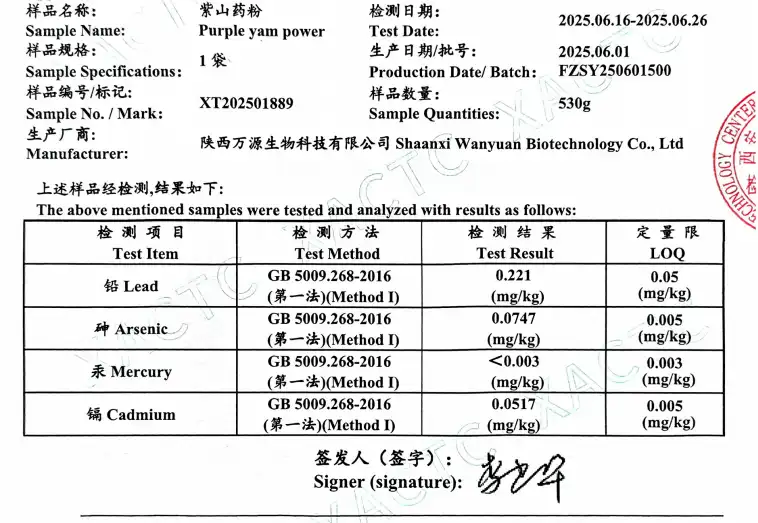
Cross-Contact and Gluten-Free Labeling
Ube itself is gluten free however a “gluten free” claim on your completed product will rely on your whole supply chain and manufacturing environment. Talk to your suppliers about policies at their facilities and test results for gluten. Make sure your method fulfills the labeling requirements of your target market, which in the U.S. and European Union is 20 ppm. Keep everything in your quality system so audits happen easily.
Why Bakeries Choose NT Biotech as Their Ube Starch Powder Supplier
NT Biotech guaranties an initial response to all inquiries within two hours. Popular grades are stocked and delivered 1-3 working days following order confirmation. Production orders usually require 3-10 working days for raw material acquisition, processing, laboratory testing and packaging. We send samples on our own FedEx and UPS accounts and big shipments by air or sea via our trusted freight forwarders. ISO9001 quality management, KOSHER and HALAL certified. OEM and ODM service for custom mesh sizes and ready-to-bake premixes. Local currency payment in the buyer’s country.
Conclusion
Ube starch powder provides gluten-free baking with color, character and softness. The yam starch helps to retain moisture and solidify the crumb, the anthocyanins give it a natural violet hue and the mild taste makes it appropriate for cakes, cookies, breads and mochi. Use the correct binder, pre-soak and manage pH and you should obtain solid results. Shaanxi New Things Biotech is a reliable provider of plant-derived products. We offer ube starch powder that is batch tested and comes with a CoA. The company has ISO9001, KOSHER and HALAL certifications. We assist bakeries and food brands from plant source to completed product with rapid stock delivery flexible logistics and customized OEM solutions. Bring nature's most gorgeous purple to your gluten free range and start baking with us now.
FAQ
Q1: Is ube starch powder gluten-free?
Yes. It comes from purple yam (Dioscorea alata), which contains no gluten.
Q2: Can ube powder replace all the flour in a recipe?
No. It works best at 10–25% of a gluten-free flour blend.
Q3: Do I still need xanthan gum or psyllium?
For most cakes and breads, yes. Mochi and pancakes usually do not need a binder.
Q4: Why did my ube cake turn gray?
Baking soda made the batter alkaline. Use baking powder and add a little acidity.
Q5: How fast can NT Biotech ship?
Stock grades ship within 1–3 working days. Production orders take 3–10 working days.
Bake Brighter Gluten-Free Products with NT Biotech
Gluten-free clients want products that are just as good-looking and tasty as conventional ones, and ube lets you do both. NT Biotech offers authentic ube starch powder manufactured from selected Dioscorea alata tubers. It is a fine powder for seamless blending and is naturally purple and comes with a CoA for each batch. We respond within 2 hours, ship stock grades within days, take payment in your local currency and provide OEM and ODM assistance for gluten free cake mixes, cookie premixes and bakery blends. If you operate a café kitchen or a huge manufacturing line, our expertise can help you perfect the color, texture and taste. Write to info@newthingsbiotech.com immediately for free sample, complete specs and competitive bulk quote.
References
1. Gallagher E, Gormley TR, Arendt EK. Recent advances in the formulation of gluten-free cereal-based products. Trends in Food Science & Technology. 2004;15(3–4):143–152.
2. Hager AS, Arendt EK. Influence of hydroxypropylmethylcellulose (HPMC), xanthan gum and their combination on loaf specific volume, crumb hardness and crumb grain characteristics of gluten-free breads based on rice, maize, teff and buckwheat. Food Hydrocolloids. 2013;32(1):195–203.
3. Capriles VD, Arêas JAG. Novel approaches in gluten-free breadmaking: interface between food science, nutrition, and health. Comprehensive Reviews in Food Science and Food Safety. 2014;13(5):871–890.
4. Zhu F. Isolation, composition, structure, properties, modifications, and uses of yam starch. Comprehensive Reviews in Food Science and Food Safety. 2015;14(4):357–386.
5. Jiang Q, Gao W, Li X, et al. Characterizations of starches isolated from five different Dioscorea L. species. Food Hydrocolloids. 2012;29(1):35–41.
6. Castañeda-Ovando A, Pacheco-Hernández ML, Páez-Hernández ME, Rodríguez JA, Galán-Vidal CA. Chemical studies of anthocyanins: a review. Food Chemistry. 2009;113(4):859–871.