- English
- French
- German
- Portuguese
- Spanish
- Russian
- Japanese
- Korean
- Arabic
- Greek
- German
- Turkish
- Italian
- Danish
- Romanian
- Indonesian
- Czech
- Afrikaans
- Swedish
- Polish
- Basque
- Catalan
- Esperanto
- Hindi
- Lao
- Albanian
- Amharic
- Armenian
- Azerbaijani
- Belarusian
- Bengali
- Bosnian
- Bulgarian
- Cebuano
- Chichewa
- Corsican
- Croatian
- Dutch
- Estonian
- Filipino
- Finnish
- Frisian
- Galician
- Georgian
- Gujarati
- Haitian
- Hausa
- Hawaiian
- Hebrew
- Hmong
- Hungarian
- Icelandic
- Igbo
- Javanese
- Kannada
- Kazakh
- Khmer
- Kurdish
- Kyrgyz
- Latin
- Latvian
- Lithuanian
- Luxembou..
- Macedonian
- Malagasy
- Malay
- Malayalam
- Maltese
- Maori
- Marathi
- Mongolian
- Burmese
- Nepali
- Norwegian
- Pashto
- Persian
- Punjabi
- Serbian
- Sesotho
- Sinhala
- Slovak
- Slovenian
- Somali
- Samoan
- Scots Gaelic
- Shona
- Sindhi
- Sundanese
- Swahili
- Tajik
- Tamil
- Telugu
- Thai
- Ukrainian
- Urdu
- Uzbek
- Vietnamese
- Welsh
- Xhosa
- Yiddish
- Yoruba
- Zulu
Ask a salmon buyer what they look for initially, and color is always the response. Ask a shrimp farmer what’s on their mind, and the response is molting and transfer survival. Both issues rest on the same carotenoid. Astaxanthin is not a cosmetic ingredient added to a feed mix, but a vital nutrient that farmed animals cannot synthesize and have to get from their food. NT Biotech offers astaxanthin powder bulk from Haematococcus pluvialis, manufactured by its patented extraction process, confirmed by HPLC, with a Certificate of Analysis for each lot, and certified ISO 9001, KOSHER and HALAL. Enquiries reach the technical team at info@newthingsbiotech.com, with initial replies guaranteed within two hours.

The Commercial Case: Colour Is Money
Pigmentation Determines Market Price
In salmonid production, flesh colour is graded against standardised colour fans, and price brackets follow those grades directly. A fillet that scores below the target band loses value regardless of its nutritional quality, size or freshness. This is why astaxanthin represents one of the largest single ingredient costs in a salmon diet and simultaneously one of the highest-return investments in the formula. Feed producers who under-dose to save on raw material typically hand that saving back, and more, at harvest grading.
Consumers Buy With Their Eyes First
Retail behaviour reinforces the commercial logic. Shoppers associate deep pink-orange salmon and vividly coloured shrimp with freshness and quality, whether or not that association holds nutritionally. Processors therefore specify colour targets to their farming suppliers, and farms specify them to feed mills. Sourcing a consistent astaxanthin powder bulk becomes a contractual requirement rather than a formulation preference once a producer is supplying branded retail programmes.
Natural Sourcing Opens Premium Channels
Positioning matters increasingly. Natural astaxanthin from Haematococcus pluvialis is predominantly the 3S,3'S stereoisomer, the same configuration found in wild salmon diets, whereas synthetic material is a racemic mixture. Organic aquaculture standards and many premium retail programmes specify natural sourcing explicitly. Choosing an algal-derived astaxanthin powder bulk therefore unlocks market channels that a synthetic equivalent cannot access, which changes the economics well beyond the ingredient cost line.
| Commercial Driver | Impact on Producer |
|---|---|
| Flesh colour grade | Direct effect on price bracket at harvest |
| Shell colouration | Buyer acceptance in shrimp and prawn markets |
| Natural sourcing | Access to organic and premium retail programmes |
| Batch consistency | Predictable grading, fewer rejected lots |
| Documentation | Faster customs clearance and audit compliance |
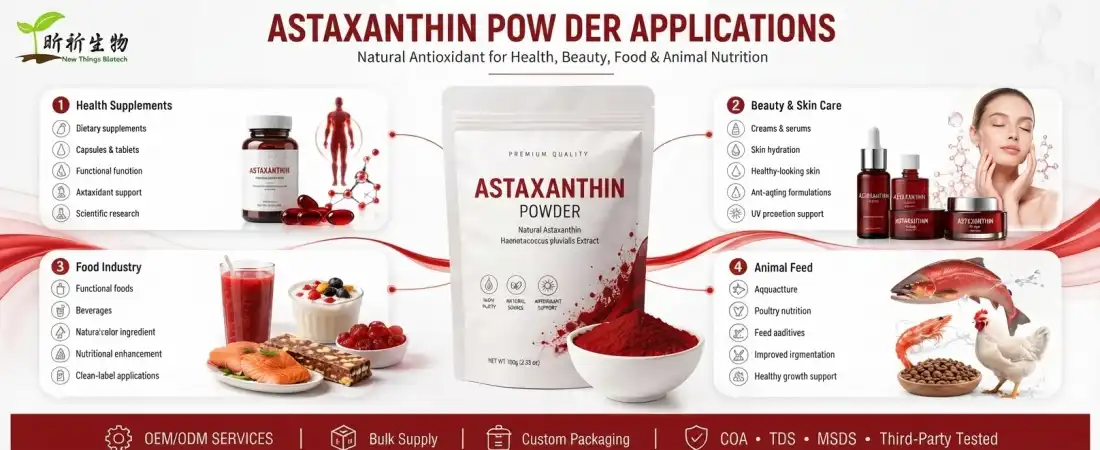
Beyond Colour: What Astaxanthin Does Physiologically
A Powerful Lipid-Soluble Antioxidant
Astaxanthin's molecular structure allows it to span the cell membrane, with the polar end groups anchored at both surfaces. This positioning is why it is studied so extensively as a membrane antioxidant, and why interest in it extends well past pigmentation. In farmed species subjected to handling, grading, transport, and variable water quality, oxidative pressure is a constant background stressor rather than an occasional event.
Support During Stress and Moulting
Crustaceans face particular vulnerability during moulting, when the exoskeleton is soft, and the animal is metabolically stretched. Astaxanthin accumulates in crustacean tissue and has been associated in research literature with stress tolerance during these transitions. For shrimp producers, this dual role means a wholesale astaxanthin powder bulk delivers both the visual outcome buyers demand and physiological support during the riskiest phases of the production cycle.
Broodstock, Egg Quality and Early Development
Hatchery operations use astaxanthin differently from grow-out farms. Carotenoid content in broodstock diets influences egg pigmentation, and the deposited carotenoid remains available to the developing embryo and early larval stages. Hatcheries running high-value species therefore treat astaxanthin as a broodstock conditioning nutrient, specifying it months before any fish reaches a grow-out pond, which extends demand across the full production chain.
Selecting the Right Grade for Your Operation
Concentration and Physical Form
Astaxanthin is dosed in parts per million, so raw material concentration determines how precisely you can weigh it. Encapsulated beadlets protect the carotenoid during mixing and thermal processing and handle well in dry blending. Cold water dispersible grades suit liquid dosing, post-pellet application, and ornamental fish products. Oleoresin-based powders deliver high payload for concentrated premix work. An experienced astaxanthin powder bulk supplier should ask about your mixer, your process temperature, and your batch size before recommending a specification.
Matching Grade to Species and Process
A shrimp feed extruded at high temperature with long water immersion has entirely different requirements from a koi pellet coated after drying. Water stability, leaching resistance, thermal survival, and oil compatibility all shift the optimal choice. Buying the wrong grade rarely shows up as an obvious failure; it shows up as inconsistent colour development three months later, which is expensive to diagnose and more expensive to correct mid-cycle.
Requesting Samples and Technical Assessment
Grade selection is far easier to settle with real material and real process data than with catalogue descriptions. To request a sample of astaxanthin powder bulk together with the batch Certificate of Analysis, HPLC documentation and a formulation recommendation matched to your species and processing route, write to info@newthingsbiotech.com. The technical team responds within two hours and can review your conditioning temperature, mixing sequence, and target inclusion before you run a pilot batch.
| Species | Primary Objective | Suggested Format | Critical Process Factor |
|---|---|---|---|
| Atlantic salmon | Flesh pigmentation | Encapsulated beadlet | Extrusion survival, long feeding period |
| Rainbow trout | Flesh pigmentation | Encapsulated beadlet | Deposition efficiency with fish size |
| Shrimp and prawns | Shell colour, stress support | High-stability encapsulated | Water stability, leaching control |
| Ornamental koi | Visual colour grading | Cold water dispersible | Higher inclusion, seasonal feeding |
| Broodstock | Egg quality and pigmentation | Encapsulated or oil-dispersible | Conditioning period length |
| Sea bream and bass | Skin colour | Encapsulated beadlet | Coating or extrusion compatibility |

Building It Into the Feed Without Losing Value
Premixing Is Not Optional
Adding a few grams of concentrated material directly to a tonne of feed guarantees uneven distribution, and uneven distribution shows up as variable pigmentation across a harvest batch. The reliable method is stepwise dilution: blend the bulk astaxanthin powder into a small carrier volume such as rice bran or a mineral base, mix thoroughly, then dilute progressively before the final batch. Two or three stages produce dramatically better homogeneity than a single direct addition.
Processing Losses and Building Overage
Carotenoids are sensitive to heat, shear, and oxygen, all of which extrusion supplies simultaneously. Retention depends on temperature, moisture, residence time, and the quality of the encapsulation matrix. Rather than assuming full survival, measure retention in your own process and build a calculated overage into the formula. Producers running at the upper end of the temperature range often find that a post-pellet vacuum coating route preserves more activity than pushing higher inclusion through the die.
Storage Discipline Protects What You Paid For
Oxygen, light, and heat degrade astaxanthin, both in the drum and in the finished pellet. Keep containers sealed, store cool, dry, and dark, reseal inner liners properly after opening, and record opening dates. Ordering pack sizes matched to consumption rate preserves more activity than buying a year's supply that sits half-open. Advising farm customers on feed storage conditions protects your product performance after it leaves the mill.

Supply Reliability and Documentation
What Every Batch Should Carry
A generic specification sheet is not a Certificate of Analysis. Each lot from NT Biotech ships with batch-specific HPLC and UV documentation alongside a CoA, which is the minimum a feed manufacturer should accept from any astaxanthin powder bulk supplier. Verify the assay, the analytical method, the contaminant screen, and the batch number against the material delivered. Suppliers unable to produce lot-specific paperwork within a working day represent a compliance risk irrespective of unit price.
Certification for Export and Audit
Feed additive regulation differs between jurisdictions, and documentation determines how smoothly material clears customs and satisfies third-party audits. Production runs under ISO 9001 quality management, with KOSHER and HALAL certification available. Proprietary processing delivers verified purity and superior stability, which translates into consistent performance in finished feed rather than batch-to-batch variability that formulators have to compensate for.
Lead Times, Shipping and Payment Flexibility
Production schedules do not wait for raw material. Stocked standardised extracts ship within one to three working days of order confirmation, while production orders typically run three to ten working days covering procurement, extraction, laboratory testing and packing. Shipments travel on the company's own FedEx and UPS accounts for speed, or through trusted freight forwarders for bulk air and sea consignments. Payment in the buyer's local currency is accepted, and OEM customisation is available for market-specific requirements.
| Supply Factor | NT Biotech Provision |
|---|---|
| Response time | Initial reply within two hours |
| Stocked items | Shipment within 1–3 working days |
| Production orders | 3–10 working days, full cycle |
| Documentation | Batch CoA with HPLC and UV data |
| Certification | ISO 9001, KOSHER, HALAL |
| Shipping | Express, air or sea; own FedEx/UPS accounts |
| Customisation | OEM specification and packaging |
| Payment | Buyer's local currency accepted |

Conclusion
Astaxanthin powder bulk has a place in aquaculture feed for two reasons: the farmed species can’t produce it, and the purchasers pay directly for the outcome. Pigmentation determines the grade of the harvest and acceptability by the retailer. The same molecule is a membrane antioxidant that supports animals during molting, handling, and transport stress. The natural Haematococcus-based substance also opens organic and premium channels that are closed for synthetic alternatives. NT Biotech backs this up with HPLC-validated astaxanthin powder in bulk, ISO 9001, KOSHER and HALAL paperwork, fast dispatch from stock, and OEM flexibility for species-specific formulation demands.
FAQ
Q1: Why can't farmed fish make their own astaxanthin?
Fish and crustaceans lack the biosynthetic pathway. Wild animals obtain it through the food chain from microalgae, so farmed stock depends entirely on dietary supplementation.
Q2: Does natural astaxanthin matter for organic certification?
Yes. Natural Haematococcus-derived material is predominantly the 3S,3'S isomer and is generally required by organic aquaculture standards and premium retail programmes.
Q3: How do I add such a small dose evenly?
Use stepwise dilution through a carrier such as rice bran or a mineral base, mixing thoroughly across two or three stages before the final batch.
Q4: Which grade suits extruded shrimp feed?
A high-stability encapsulated grade, chosen for thermal survival and resistance to leaching during extended water immersion.
Q5: How fast can material be delivered?
Stocked specifications ship within one to three working days; production orders typically take three to ten working days.
Partner With NT Biotech for Aquaculture-Grade Astaxanthin
Ready to secure a colour ingredient that performs consistently from mixer to harvest? NT Biotech supplies natural Haematococcus pluvialis astaxanthin powder in bulk across multiple standardised concentrations and physical formats, each batch verified by HPLC and shipped with full documentation under ISO 9001, KOSHER and HALAL certification. Stocked grades of astaxanthin powder bulk leave within one to three working days; production orders run three to ten working days, and consignments move on our own FedEx and UPS accounts or through trusted freight forwarders for bulk volumes. OEM customisation and local-currency payment are both supported. Send your species, target inclusion, and processing route to info@newthingsbiotech.com for a sample, CoA, and quotation.
References
1. Lorenz, R. T., & Cysewski, G. R. (2000). Commercial potential for Haematococcus microalgae as a natural source of astaxanthin. Trends in Biotechnology, 18(4), 160–167.
2. Torrissen, O. J., Hardy, R. W., & Shearer, K. D. (1989). Pigmentation of salmonids: Carotenoid deposition and metabolism. CRC Critical Reviews in Aquatic Sciences, 1(2), 209–225.
3. Ambati, R. R., Phang, S. M., Ravi, S., & Aswathanarayana, R. G. (2014). Astaxanthin: Sources, extraction, stability, biological activities and its commercial applications — A review. Marine Drugs, 12(1), 128–152.
4. Higuera-Ciapara, I., Félix-Valenzuela, L., & Goycoolea, F. M. (2006). Astaxanthin: A review of its chemistry and applications. Critical Reviews in Food Science and Nutrition, 46(2), 185–196.
5. Lim, K. C., Yusoff, F. M., Shariff, M., & Kamarudin, M. S. (2018). Astaxanthin as feed supplement in aquatic animals. Reviews in Aquaculture, 10(3), 738–773.
6. Shahidi, F., & Brown, J. A. (1998). Carotenoid pigments in seafoods and aquaculture. Critical Reviews in Food Science and Nutrition, 38(1), 1–67.