- English
- French
- German
- Portuguese
- Spanish
- Russian
- Japanese
- Korean
- Arabic
- Greek
- German
- Turkish
- Italian
- Danish
- Romanian
- Indonesian
- Czech
- Afrikaans
- Swedish
- Polish
- Basque
- Catalan
- Esperanto
- Hindi
- Lao
- Albanian
- Amharic
- Armenian
- Azerbaijani
- Belarusian
- Bengali
- Bosnian
- Bulgarian
- Cebuano
- Chichewa
- Corsican
- Croatian
- Dutch
- Estonian
- Filipino
- Finnish
- Frisian
- Galician
- Georgian
- Gujarati
- Haitian
- Hausa
- Hawaiian
- Hebrew
- Hmong
- Hungarian
- Icelandic
- Igbo
- Javanese
- Kannada
- Kazakh
- Khmer
- Kurdish
- Kyrgyz
- Latin
- Latvian
- Lithuanian
- Luxembou..
- Macedonian
- Malagasy
- Malay
- Malayalam
- Maltese
- Maori
- Marathi
- Mongolian
- Burmese
- Nepali
- Norwegian
- Pashto
- Persian
- Punjabi
- Serbian
- Sesotho
- Sinhala
- Slovak
- Slovenian
- Somali
- Samoan
- Scots Gaelic
- Shona
- Sindhi
- Sundanese
- Swahili
- Tajik
- Tamil
- Telugu
- Thai
- Ukrainian
- Urdu
- Uzbek
- Vietnamese
- Welsh
- Xhosa
- Yiddish
- Yoruba
- Zulu
That same morning three quotations for phycocyanin powder arrive in your mailbox. One is half the price of the others. One offers "blue spirulina" but doesn't define a color value. One provides a Certificate of Analysis before you ask. Which is the better buy? This guide addresses that issue by translating the figures, doing a few fast tests, and asking vendors the questions that indicate genuine quality. Throughout this guide, we’ll illustrate how NT Biotech’s spirulina extract phycocyanin, standardized to color values E10, E18 and E25 and confirmed by UV-Vis on each batch, and certified under ISO 9001, Kosher and Halal, measures up to each requirement. For specs or a sample contact info@newthingsbiotech.com.
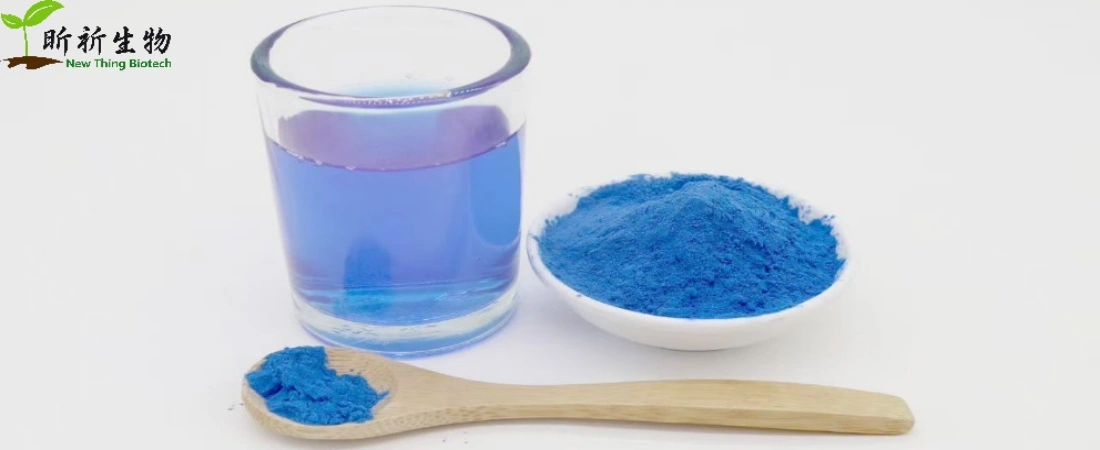
What Separates the Best Phycocyanin Powder From an Average One
Color Value Sets the Price, So Learn to Read It
All good quotes for phycocyanin powder will include a color value, in units of E 1%/1cm at 618 nm. It tells you how much pigment a gram really contains – which is why an E18 powder should cost more than an E10, and why a quotation with no color value should be viewed as no quote at all. NT Biotech standardizes spirulina extract phycocyanin at E10, E18 and E25, each measured on a calibrated spectrophotometer so a customer may convert price per kilogram to price per unit of color and compare providers on an equal footing.
Purity Ratio Reveals What Color Value Hides
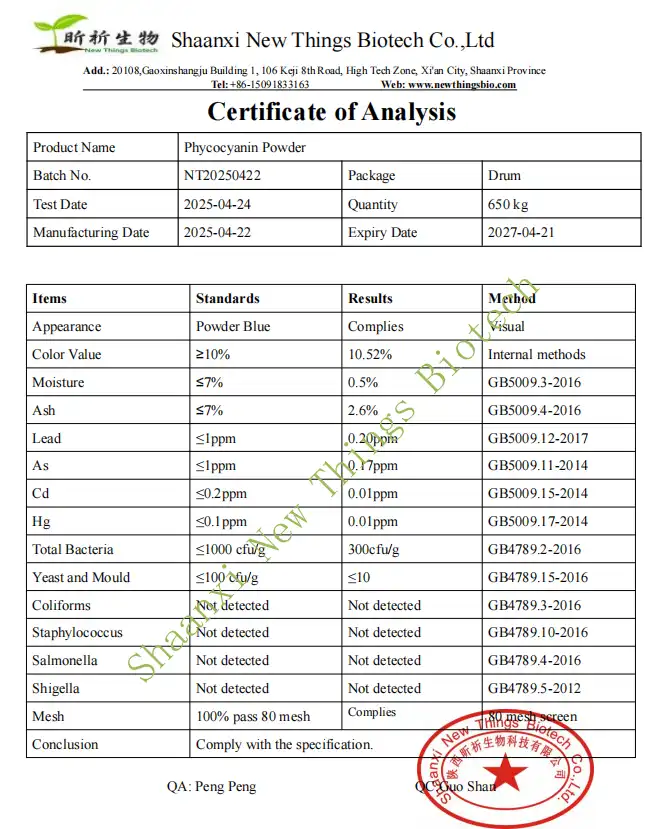
The color value counts pigment and ignores anything in the drum. So two powders may have a color value and be quite different in quality. The purity ratio is the ratio of phycocyanin to total protein concentration (absorbance at 620 nm/absorbance at 280 nm). The ratio of 0.7 is food grade, with a cleaner extraction, fewer off notes and more clarity in the liquids. NT Biotech puts this ratio on every Certificate of Analysis. The E18 material is 1.2 or more and the E25 is 1.8 or more. So the blue you buy is a pigment, not a cell waste.
Source and Process Decide Whether the Blue Survives
The term blue spirulina phycocyanin is misleading for many first-time customers. Blue spirulina types don’t exist, it’s only the moniker for the phycocyanin extracted from green arthrospira platensis. The process is the distinction between providers. NT Biotech produces its own algae and ruptures the cells by freeze-thawing and water extraction without the use of chemical solvents. The pigment is concentrated via membrane filtration and lightly spray dried on a food grade carrier. Every step protects a heat-labile protein. That is why the powder dissolves rapidly and retains its shade 24 months in tight packaging.
Table 1. Decoding an NT Biotech phycocyanin powder Certificate of Analysis (CAS 11016-15-2)
| CoA Line | Specification | What It Tells a Buyer |
|---|---|---|
| Color value (E 1%/1cm, 618 nm) | ≥100 / ≥180 / ≥250 (E10 / E18 / E25) | Pigment concentration; the basis for price comparison |
| Purity ratio (A620/A280) | ≥0.7 / ≥1.2 / ≥1.8 | Cleanliness of extraction, clarity, neutral taste |
| Appearance | Blue fine powder | A green cast points to whole-cell spirulina, not extract |
| Loss on drying | ≤8% | Prevents caking and spoilage |
| Heavy metals / arsenic | ≤10 ppm / ≤1 ppm | Safety across food, supplement, and cosmetic use |
| Microbiology | TPC ≤1,000 cfu/g; E. coli and Salmonella negative | Hygienic processing; mandatory for food lines |
How to Tell if a Blue is Fake or Fading Before It Lands on Your LineThree Kitchen Tests for Anyone
You don’t need a lab to detect the most prevalent fraud: synthetic Brilliant Blue FCF sold as phycocyanin powder. Dissolve a pinch in water and heat it to near boiling; the real spirulina extract phycocyanin is a protein so it denatures, becomes grayish and settles away, while the synthetic color remains blue. Add some lemon juice to a new sample. The natural phycocyanin fades and clouds below ph 4.5. The synthetic blue does not. Then light a green laser pointer or a powerful UV lamp through a diluted solution. Blue spirulina phycocyanin fluoresces red-orange, smells of authenticity, and synthetic colorants cannot replicate this.
The "Blue Spirulina" Label Trap
Online markets are rife with postings that utilize blue spirulina phycocyanin as a term, while offering something else: common green spirulina behind a blue-tinted imagery, or extract so diluted with maltodextrin that its color value lies much below E10. You may have faith in a label that says the botanical origin, Arthrospira platensis, the color value and carrier, and a batch number that can be traced back to a Certificate of Analysis. If the vendor cannot provide a UV-Vis scan showing the typical peak at 618 to 620 nm, then the product should be considered as unconfirmed spirulina extract phycocyanin at best.
What a Good Sample Should Do in Your Hands
Try a sample before ordering a pallet. For example, a gram of excellent quality phycocyanin powder will dissolve in 100mL of water in seconds leaving a vibrant pure blue, no sediment, no froth, no haze. The dry powder should flow freely and not be lumpy, suggesting that the moisture is within the 8% limit, and it should smell somewhat of the sea, not of fish. Then examine the shade at the supplier’s recommended dose, since the primary metric of standardization is homogeneity between sample and bulk.
Want to do these checks yourself? Please send an email to info@newthingsbiotech.com to request a sample of spirulina extract phycocyanin NT Biotech, specifying the grade and intended use. Our technical staff will respond to you within 2 hours and provide the corresponding batch CoA.
Matching Grade to Application Without Overpaying
The Cost-Per-Color-Unit Rule
The cheapest hue is not always the cheapest kilo. Since color strength increases with pigment load, a gram of E18 yields 1.8 times the blue of a gram of E10; a gram of E25, 2.5 times. Divide each offered price by its color value and you have a cost per unit of color, the sole statistic that makes quotations comparable. In fact, the customer paying 70% more for E18 than for E10 is saving money, as the dosage falls by practically half and freight, storage and carrier shrink with it. Table 2 converts the math into a fast choice tool for buying phycocyanin powder.
Table 2. Economics of grades for NT Biotech phycocyanin powder: pigment per g and dosage equivalency
| Grade | Color Value (E 1%/1cm) | Pigment per Gram vs. E10 | Dose for the Same Shade | Best Fit |
|---|---|---|---|---|
| E10 | ≥100 | 1.0× | 100% (reference) | Beverages, confectionery, frozen desserts |
| E18 | ≥180 | 1.8× | About 56% | Nutraceuticals, cosmetics, premium foods |
| E25 | ≥250 | 2.5× | About 40% | Analytical and fluorescence applications |
Where E10, E18 and E25 Earn Their Keep
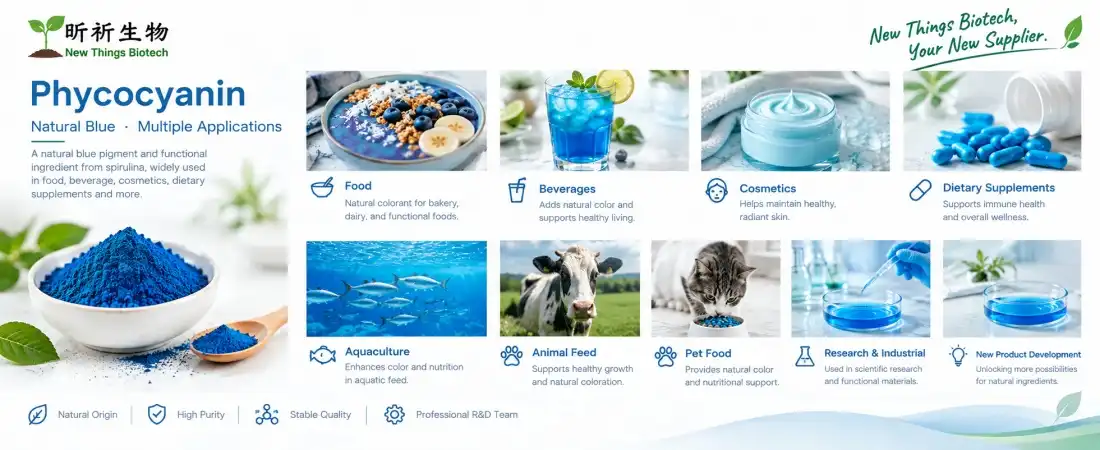
Processing also influences choice of grade. E10 spirulina extract phycocyanin imparts a sky blue hue to a cold-filled smoothie or candy at 0.02 to 0.3% without costing the earth. E18 is preferred in capsules and beauty drinks when a specific amount of phycocyanin is required, since the higher concentration means smaller capsules and less carrier to include on the label; cosmetic formulators also choose it for this reason at 0.1 to 1% in masks and serums. E25 is for analytical work & fluorescent probes. There the premium pays for spectral purity. Blue spirulina phycocyanin, regardless of the grade, is best at temperatures below 50 °C and pH 5–7.5.
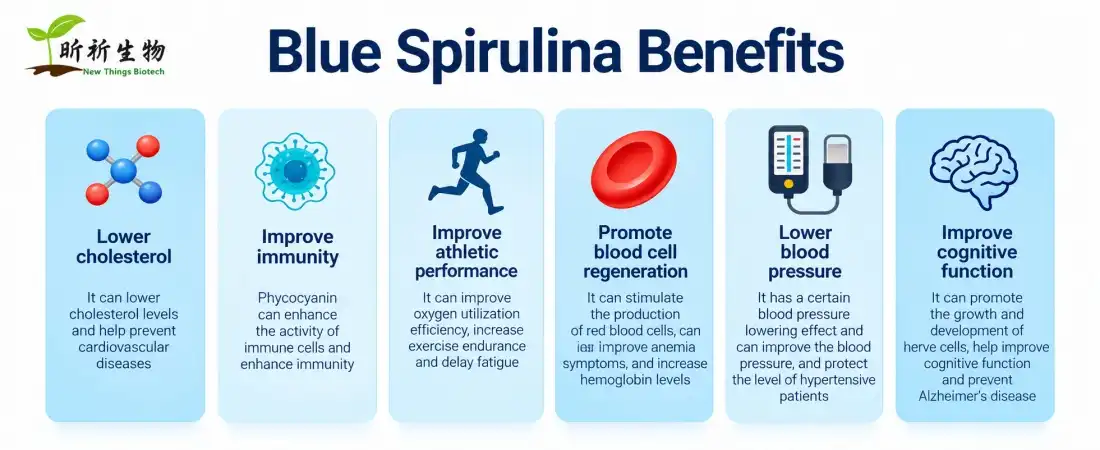
Vetting a Phycocyanin Powder Supplier: Questions That Reveal Everything
Ask for Paperwork Before Prices
The best provider of phycocyanin powder will supply paperwork without you having to ask for it. Instead of a typical-values sheet, check for a Certificate of Analysis with every batch, an ISO 9001 quality system and Kosher and Halal certificates. NT Biotech satisfies all three requirements, and additionally offers UV-Vis data, microbiological results and a safety data sheet for each batch of spirulina extract phycocyanin plus regulatory help for FDA color-additive and EU coloring-food compliance. It is the true quality the buyer is paying for . The unique procedure assures potency and stability lot to lot .
Test Their Speed With a Real Inquiry
Answer a short, pointed question. If you’re responsive before the sale, it predicts how you’ll behave after the sale. Initial response within 2 hours Stocks of typical phycocyanin powder grades are ready for distribution within 1-3 working days following order confirmation Production within 3-10 working days including raw material procurement, extraction, laboratory release and packing Samples are sent directly from the manufacturer utilizing business accounts Fedex and UPS. Pallet amounts are sent by air or sea with reputable freight forwarders in 1 kilogram foil bags or 25 kg double-lined drums.
Check How Far They Will Bend for You
And probe flexibility finally. A beverage firm would want blue spirulina phycocyanin pre-blended with a stabilizing sugar for a low-pH drink; a supplement company might want a private-label capsule; a cosmetics house might want a finer particle size and documentation created for its regulator. NT Biotech does OEM and ODM development for all of these, customizes packaging and paperwork for the target market and takes payment in the buyer’s native currency. Hold on to the supplier who is ready to mold the product to your process and not the other way around.
Conclusion
The greatest phycocyanin powder isn’t the cheapest or bluest on screen, it’s the one with documented color value, purity ratio, and safety data for every batch, passes heat, acid and fluorescence tests, and from a responsive, flexible partner. Shaanxi New Things Biotech (NT Biotech) is a technology-driven provider of plant derivatives, providing clean and active raw materials for the nutritional supplement, functional food, high-end cosmetics and animal nutrition industries, with a comprehensive value chain from cultivation to application. Our spirulina extract phycocyanin is available in E10, E18 and E25 grades and is ISO 9001, Kosher and Halal certified. We provide batch UV-Vis documentation and delivery in 1-3 days. We also provide flexible OEM assistance. Buy on the proof and the blue will take care of itself.
FAQ
Q1: What makes a phycocyanin powder the "best"?
A: Documented color value and purity ratio, verified safety data, and batch-to-batch consistency.
Q2: Is blue spirulina phycocyanin different from spirulina extract phycocyanin?
A: No; both describe the same pigment from Arthrospira platensis, differing only in grade and process.
Q3: How do I detect synthetic dye in a sample?
A: Heat or acidify a solution; genuine phycocyanin fades and clouds, synthetic Brilliant Blue stays blue.
Q4: Which grade is the most economical?
A: Compare price divided by color value; E18 often costs less per unit of color than E10.
Q5: What documents should come with each order?
A: A batch Certificate of Analysis with UV-Vis and microbial results, plus ISO 9001, Kosher, and Halal certificates.
Source Your Best Phycocyanin Powder From NT Biotech Today
Now you know how to tell whether a blue is worth purchasing. Shaanxi New Things Biotech is a reliable plant derivatives supplier providing the finest extracts to the food, supplement, and cosmetic sectors with adaptable OEM solutions to help your next product grow organically and reliably. Our phycocyanin powder is standardized at E10, E18 or E25, tested by UV-Vis and microbiological testing on each batch, certified under ISO 9001, Kosher and Halal, and can ship out of the facility in 1 to 3 working days on our own FedEx and UPS accounts. Desired shade, application and volume? Send to info@newthingsbiotech.com and you will be contacted within two hours with cost, paperwork and a sample. Your next formulation deserves a blue you can prove.
References
1. Jespersen L, Strømdahl LD, Olsen K, Skibsted LH. Heat and light stability of three natural blue colorants for use in confectionery and beverages. European Food Research and Technology. 2005;220(3–4):261–266.
2. Martelli G, Folli C, Visai L, Daglia M, Ferrari D. Thermal stability improvement of blue colorant C-phycocyanin from Spirulina platensis for food industry applications. Process Biochemistry. 2014;49(1):154–159.
3. Bennett A, Bogorad L. Complementary chromatic adaptation in a filamentous blue-green alga. Journal of Cell Biology. 1973;58(2):419–435.
4. Newsome AG, Culver CA, van Breemen RB. Nature's palette: the search for natural blue colorants. Journal of Agricultural and Food Chemistry. 2014;62(28):6498–6511.
5. Sarada R, Pillai MG, Ravishankar GA. Phycocyanin from Spirulina sp.: influence of processing of biomass on phycocyanin yield, analysis of efficacy of extraction methods and stability studies on phycocyanin. Process Biochemistry. 1999;34(8):795–801.
6. U.S. Food and Drug Administration. Listing of color additives exempt from certification; spirulina extract. Final rule. Federal Register. 2013;78(156):49117–49122.