- English
- French
- German
- Portuguese
- Spanish
- Russian
- Japanese
- Korean
- Arabic
- Greek
- German
- Turkish
- Italian
- Danish
- Romanian
- Indonesian
- Czech
- Afrikaans
- Swedish
- Polish
- Basque
- Catalan
- Esperanto
- Hindi
- Lao
- Albanian
- Amharic
- Armenian
- Azerbaijani
- Belarusian
- Bengali
- Bosnian
- Bulgarian
- Cebuano
- Chichewa
- Corsican
- Croatian
- Dutch
- Estonian
- Filipino
- Finnish
- Frisian
- Galician
- Georgian
- Gujarati
- Haitian
- Hausa
- Hawaiian
- Hebrew
- Hmong
- Hungarian
- Icelandic
- Igbo
- Javanese
- Kannada
- Kazakh
- Khmer
- Kurdish
- Kyrgyz
- Latin
- Latvian
- Lithuanian
- Luxembou..
- Macedonian
- Malagasy
- Malay
- Malayalam
- Maltese
- Maori
- Marathi
- Mongolian
- Burmese
- Nepali
- Norwegian
- Pashto
- Persian
- Punjabi
- Serbian
- Sesotho
- Sinhala
- Slovak
- Slovenian
- Somali
- Samoan
- Scots Gaelic
- Shona
- Sindhi
- Sundanese
- Swahili
- Tajik
- Tamil
- Telugu
- Thai
- Ukrainian
- Urdu
- Uzbek
- Vietnamese
- Welsh
- Xhosa
- Yiddish
- Yoruba
- Zulu
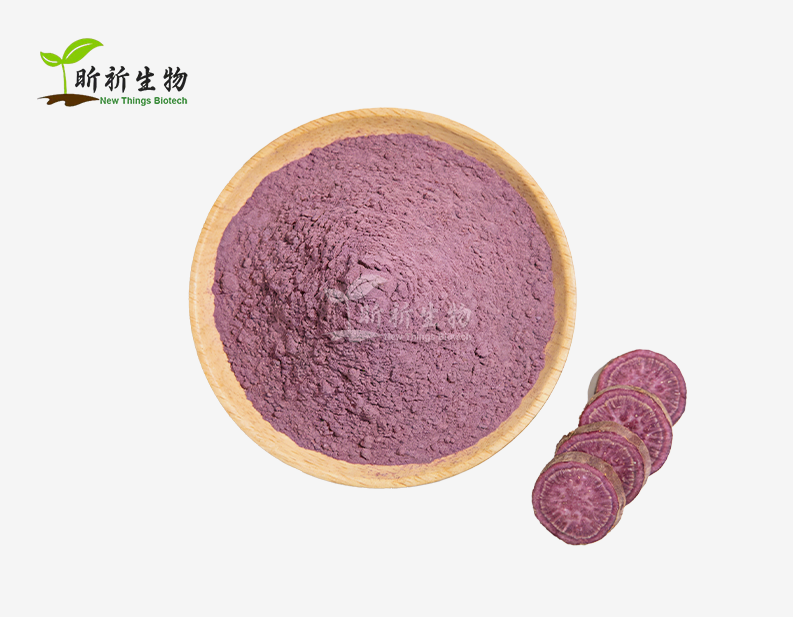
Natural ube powder is a convenient ingredient for food makers who want to add the distinctive purple color and taste of ube to finished goods. It is made from purple yam (Dioscorea alata) and may be used in baked products, drinks, desserts, powdered mixes and other food compositions. Its performance is affected by the raw material, the processing technique, the dose, the pH, the moisture and the properties of the completed product.
The biggest benefit for product makers of adopting a whole-food powder is that it may provide more than just color. Purple yam naturally includes carbohydrates and other plant chemicals, and its pigments are responsible for its signature purple color. However, the nutritional and functional profile is dependent on the raw material and the production technique. Thus, the purchaser should verify the supplier’s specifications and test the ingredient in the food matrix for which it is designed before commercial manufacturing.
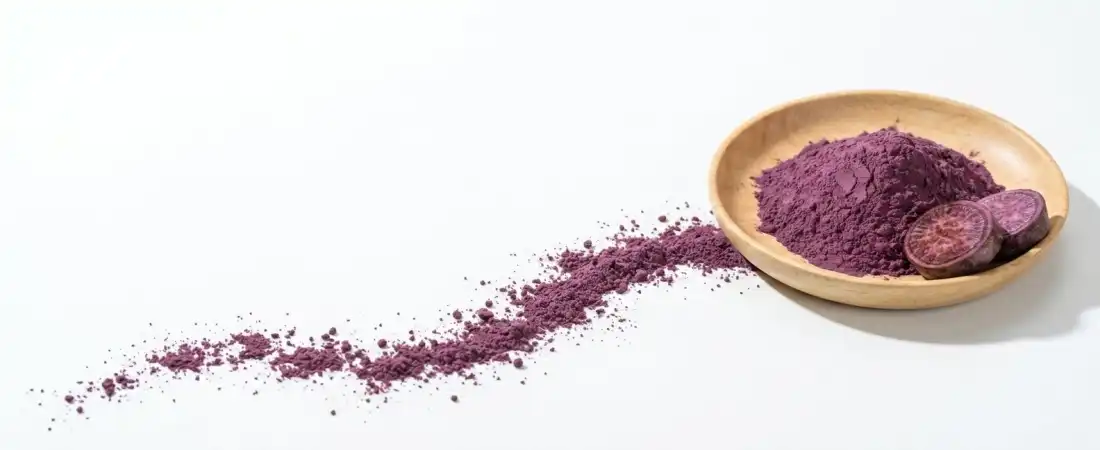
Understanding Natural Ube Powder: Origins, Composition & Benefits
Botanical Heritage and Traditional Use
Ube is the popular name for purple yam, a root vegetable associated with the Philippines and other Asian cuisines. Ube is most widely known as Dioscorea alata, a botanical species.
Ube is used in desserts and other meals because of its unusual purple colour and mild, earthy-sweet flavour. Commercial natural ube powder offers a more practical option for producers since the dried ingredient can be weighed and added into standardised formulas.
Its culinary heritage may also be used for product narrative, especially for firms producing Asian-inspired sweets, plant-based cuisine, and items using recognisable botanical ingredients. However, traditional usage should not be taken as evidence of a particular health advantage.
Ube is the purple yam (Dioscorea alata), a root vegetable and hence contains no animal derived ingredients. Natural ube powder is therefore fundamentally plant-based and ideally suited to vegan ube powder positioning. The vegan status is not just about the raw material, but the whole manufacturing process. Buyers developing vegan or plant-based finished goods should nevertheless verify that no animal-derived processing aids were used and check the supplier’s allergy and cross-contact controls.
Composition and Nutritional Profile
Purple yam is high in carbs and dietary fibre and derives its purple colour from anthocyanin pigments. The actual concentration of these chemicals may vary according to variety, growth circumstances, maturity, processing and storage.
This difference is significant when comparing suppliers. Just because a product is labelled “ube powder” doesn’t mean it has the same colour intensity, moisture, particle size or nutritional profile as another.
B2B buyers value a product specification and Certificate of Analysis more than a generic nutritional statement. They may assist formulation teams decide if the ingredient is suitable for a certain recipe and whether batch-to-batch consistency will be acceptable for their purposes.
Processing Technology and Quality Retention
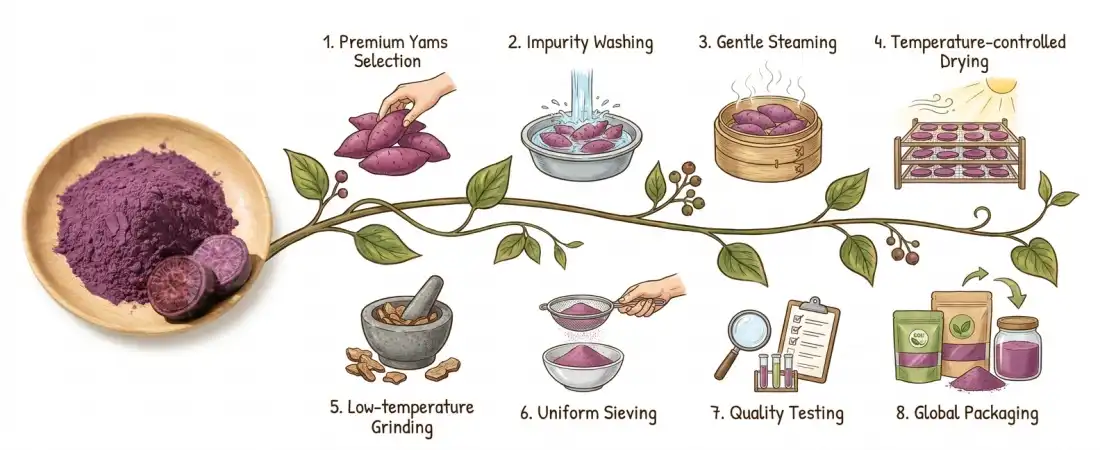
The production of a useful yam powder comprises several fundamental steps such as processing of the raw material, drying and milling. Each step affects the colour, the flavour, the moisture, the particle size and the final handling qualities of the powder.
Drying is especially crucial since the excessive heat or improper processing conditions might damage the heat sensitive plant chemicals and sensory properties. Then milling controls particle size and ease of dispersion of the powder or blending with other dry materials.
Manufacturers should analyse the final Natural ube powder based on their formulation needs, instead of assuming one processing procedure is appropriate for all applications. A dry baking mix powder could have different specs than a beverage or dessert use.
Shelf Life and Storage Parameters
Botanicals in powdered form need to be protected against moisture, high heat, oxygen and improper storage. Therefore, the shelf life should be determined based on the supplier's specification and stability data and not a single storage duration for all types of ube powder.
For commercial storage the product should be stored in the original sealed packing or other appropriate moisture resistant packaging in a clean dry environment. Once opened, it’s crucial to limit exposure to humidity since powders may absorb moisture and develop clumping or other quality concerns.
Buyers should check the recommended storage conditions, shelf life, packing type and any handling recommendations specified on the product specification before buying in bulk.
How to Use Natural Ube Powder: Practical Tips for Baking and Beyond
Recommended Usage Ratios for Baked Applications
There is no standard dose for every cake, bread, cookie or pastry recipe. The right quantity of Natural ube powder depends on the colour and flavour you want, the amount of flour or other dry ingredients, the moisture level and the features of the whole formulation.
A realistic technique is to start out by using a tiny laboratory batch, and to raise the dose slowly. This enables the development team to assess colour intensity, ube flavour, texture, water absorption and overall look before proceeding to pilot production.
The same thing happens when substituting another powdered ingredient. Any change in dry solids might alter the structure of baked products, therefore the recipe may need to be adjusted rather than just adding ube powder on top of the current mix.
Replacing Artificial Colorants
Ube powder may produce purple colouring from naturally occurring plant pigments, desirable to marketers seeking a recognisable botanical element in their product narrative. But the colouring behaviour is different from that of a highly concentrated synthetic colour.
pH, heat, light, oxygen and other components in the food matrix influence the anthocyanin pigments. Consequently, the final colour may vary from product to product. A formulation that yields a bright purple colour in one recipe may yield something quite different in an acidic beverage or a heat-processed meal.
Manufacturers should also consult the legislation in their target market before identifying an ingredient particularly as a “colorant” or making a corresponding labelling claim.
Applications Beyond Traditional Baking
Natural ube powder is not just used for cakes and pastries. Manufacturers may test the powder for use in beverage powders, smoothies, dessert mixes, ice cream, confectionary, breakfast items and other culinary ideas based on the specifications and the needs of the completed product.
Beverages: Evaluate stability for dispersion, sedimentation, flavour and colour. In dairy and plant-based goods, the interaction of powder with the pH of the product, as well as the fat, protein and processing conditions, may impact the final look and texture.
Particle size and moisture are particularly important for dry mixes. Hence, the safest technique to determine a dose is to pilot test rather than to use a universal proportion for a given application.
Handling and Storage Best Practices for Bulk Procurement
Bulk customers should preserve ube powder in a sealed package and avoid moisture, heat and direct light. Storage spaces should be clean and dry to limit the danger of contamination.
In packaging evaluation you should consider projected storage time, shipping circumstances, order size and frequency of opening. It also helps the producer who has many batches in production to keep track of his inventory and rotate his stocks.
Before approving a large purchase, the procurement teams should check with the supplier for the available packing alternatives and the recommended storage. This information should be consistent with the company’s warehousing and manufacturing operations.
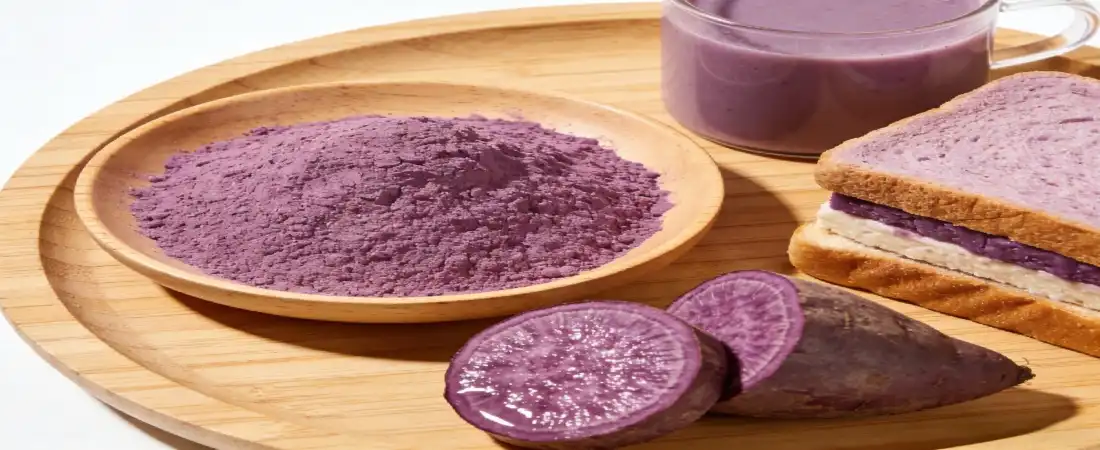
Comparing Natural Ube Powder with Alternatives: Making the Right Choice for Your Business
Freeze-Dried Powder versus Spray-Dried Powder
Freeze drying and spray drying are separate processing methods, and the powders produced by them might have varied physical and sensory characteristics. Freeze drying is a process where water is removed from a substance under regulated low temperature circumstances. Spray drying is a process where a liquid feed is atomized and dried to make powder.
Neither format should be immediately assumed to be preferable for every application. Freeze-dried powders may be desirable when preservation of a specific raw-material profile is critical and spray-dried powders might be advantageous where powder handling and large scale dry mixing are concerns.
The choice of the proper one relies on the formulation, processing circumstances, intended sensory profile, and commercial considerations. When buying, you should evaluate the real product specs and not only choose a procedure based on the name of the drying technique.
Extract and Paste Formulations
Different formulation aims may be fulfilled using ube powder, ube paste and liquid extract. A paste has a lot more moisture in it and may provide a distinct flavour and texture. Liquid extracts may be simpler to add to certain liquid systems but need various storage and handling requirements.
Powder is quite useful for a producer who wants a dry ingredient that is easy to weigh properly and can be mixed into a dry mixture.
The selection should depend on the manufacturing process and finished-product requirements for OEM projects. A powdered ingredient may be more appropriate for a dry beverage mix whereas a paste may be considered for items where moisture and texture are already included in the formulation.
Organic Certification Considerations
For firms whose completed product is based on certified organic materials, organic certification may be quite crucial. But consumers need to be able to discern between an ingredient that is plant-based or organically produced and one that has a recognised organic certification.
If organic is vital to the completed product, procurement teams should acquire the supplier’s current certification paperwork and validate that the certification applies to the exact ingredient and supply chain being bought.
The same applies to Kosher, Halal and other certifications. Claims of certifications should be verified against real product and destination market needs, rather being inferred from generic supplier assertions.
Quality Evaluation Criteria for OEMs
OEMs and private label producers must go beyond colour. Important assessment factors might include botanical identification, appearance, odour, moisture, particle size, microbiological quality, heavy metals, pesticide residues and other characteristics pertinent to the target market.
The choice of analytical techniques and acceptability limits is determined by the product specification and target market. Therefore there should not be a single set of universal restrictions for all ube powders.
A recent Certificate of Analysis may help buyers evaluate providers and set incoming-quality standards. Application testing is equally crucial since a raw material that fulfils its specification may react differently in various food matrices.
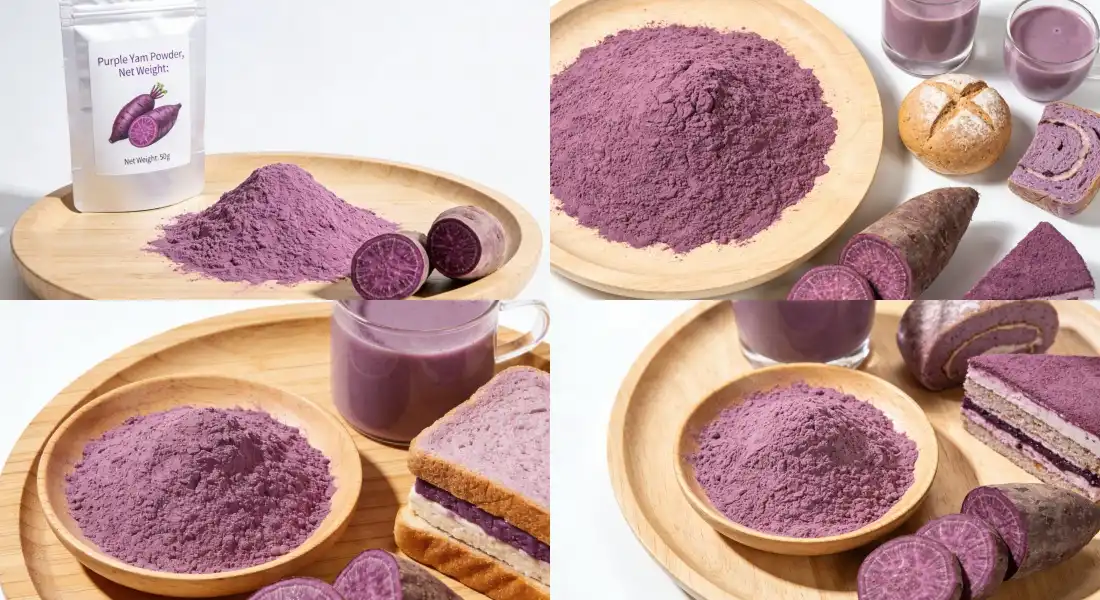
Procurement Guide: Sourcing Natural Ube Powder for B2B Buyers
Minimum Order Quantities and Pricing Structure
Prices and MOQ vary from supplier to supplier, requirements, packing types and order sizes. Procurement teams should ask for a quote based on their exact needs rather than relying on general market percentages or expected savings.
Please provide the desired use, projected yearly or per order volume, target specification, packaging choice and destination country for a quote for Natural ube powder. This allows the provider to have enough information to produce a more appropriate business proposition.
With new items it might also be worth getting a sample before you commit to a bigger buy. This lets the formulation team analyse colour, flavour, dispersion, and processing performance under actual situations.
Supplier Reliability Indicators
You should be able to get clear product specs, batch paperwork, applicable certifications, and practical packaging and storage instructions from a trustworthy ingredient source.
Traceability is especially critical for plant-based powders since the properties of the raw materials might vary between harvests. Buyers should enquire about the supplier’s method for determining the botanical source and testing quality before shipping.
The product paperwork, communication, sample procedure and specifications offered for individual ube powder under consideration may be used to judge NT Biotech. Rather of making blanket statements about a supplier’s capabilities, procurement teams need to analyse current documents.
International Shipping and Lead Time Management
Shipping choices are based on order quantity, location, delivery mode, and what the supplier is currently offering for logistics. Buyers should verify the exact lead time and delivery arrangements before ordering, especially if the ingredient is needed for a planned production run.
Packaging for overseas sourcing should be able to withstand predicted transit and storage conditions. Procurement teams should also make sure that the commercial documentation and ingredient information needed for their market are accessible before shipping.
The best method is to design the delivery timetable around the real production plan and not to utilise a predetermined shipping time as a general guideline.
Sample Request Process
A sample allows R&D teams to test the ingredient before approving it for commercial use. When requesting a sample, provide the intended application and any important specifications, such as target color, flavor profile, particle size, or processing conditions.
The testing process can then focus on questions that matter to the finished product:
- Does the powder provide the expected purple color?
- How does it affect flavor?
- Does it disperse or blend as required?
- Does the color remain acceptable after processing?
- Does it perform consistently in the intended recipe?
This application-based evaluation gives both the buyer and supplier a clearer understanding of whether the ingredient is suitable for the project.
Conclusion
Natural ube powder is a practical ingredient for food makers to impart the unique colour and flavour of purple yam to a range of goods. The application applicability of the powder relies on many parameters, including botanical source, processing, powder qualities, formulation conditions and storage.
The most crucial thing for business customers is to look at the precise constituent specification, not just broad assertions regarding ube powder. Testing the substance in the target food matrix may assist establish the correct dose and possible impacts on colour, flavour, texture, and processing.
A supplier that can give clear specifications, appropriate paperwork, samples and practical assistance may also help ease the transition from laboratory testing to commercial sourcing.
FAQ
1. Is natural ube powder gluten-free and suitable for allergen-sensitive formulations?
Ube itself is a root vegetable and doesn’t naturally contain wheat gluten. However, the supplier must check the final ingredient against the manufacturer's production and allergy control information.
Cross-contact may happen when a manufacturing facility handles more than one ingredient. Buyers who have strict allergen requirements should ask for the supplier’s allergen statement and check manufacturing conditions before approving the ingredient for a sensitive application.
2. Can this powder function as a natural colorant in commercial food production?
Ube powder may have a natural purple colour because purple yams contain anthocyanin pigments. However, its colour intensity and durability depend on the source material and food matrix.
pH, heat, light, oxygen and other elements may alter the final colour. Before claiming a colour, manufacturers should undergo application and stability testing and also examine the labelling and regulatory requirements of the end market.
3. What shelf life and storage conditions ensure optimal powder quality?
Consult the supplier’s current product specification for the suitable shelf life and storage conditions. Botanical substances in powdered form should generally be kept against moisture, extreme heat, direct light and inappropriate air exposure.
The package must be resealed correctly after opening, and the powder must be handled in a clean, dry environment. The purchasers should also consider stock rotation and warehouse conditions when setting up their internal storage processes for bulk buying.
4. Is natural ube powder vegan?
Yes, ube is purple yam (Dioscorea alata), a plant therefore naturally an ube powder does not include any animal-derived ingredients on its own and may support vegan ube powder claims. Finished-product labelling: Buyers should continue to examine the supplier’s processing aids, facility allergy controls and any vegan certification. Vegan acceptability is decided by the whole manufacturing chain, not simply the botanical source.
Partner with NT Biotech for Premium Natural Ube Powder Supply
NT Biotech supplies plant-based ingredients for food and related product applications. If you are sourcing Natural ube powder for baking, beverages, dessert products, powdered mixes, or another formulation, the first step is to match the ingredient specification with your application requirements.
Before placing a commercial order, your team can discuss the intended application, required specification, packaging, quantity, and destination market with NT Biotech. This makes it easier to determine whether the available ube powder is appropriate for your formulation and quality-control process.
For product specifications, samples, or sourcing discussions, contact info@newthingsbiotech.com and share your application and purchasing requirements. NT Biotech can then provide the relevant product information for your evaluation of Natural ube powder.
References
1. Thompson, M.R. & Chen, L. (2021). "Anthocyanin Stability and Functional Properties in Purple Yam Processing." Journal of Food Science and Technology, 58(4), 1523-1531.
2. Rodriguez, P.A. (2020). "Natural Colorants in Modern Food Formulation: Technical and Regulatory Perspectives." International Food Ingredients Review, 32(2), 78-92.
3. Kim, S.J. & Park, H.W. (2022). "Resistant Starch and Dietary Fiber in Purple Yam: Nutritional Implications for Functional Foods." Nutrition and Food Science Research, 19(3), 245-258.
4. Martinez, D.L. (2019). "Clean Label Ingredients: Market Trends and Consumer Preferences in North America." Food Industry Analysis Quarterly, 27(1), 112-128.
5. Wang, Y.F. et al. (2023). "Quality Control Parameters for Botanical Powder Ingredients in Industrial Food Production." Quality Assurance in Food Manufacturing, 41(2), 189-204.
6. Anderson, K.R. (2021). "Storage Stability of Plant-Based Pigments: Practical Guidelines for Ingredient Procurement." Food Ingredients Technology, 15(4), 67-81.