- English
- French
- German
- Portuguese
- Spanish
- Russian
- Japanese
- Korean
- Arabic
- Greek
- German
- Turkish
- Italian
- Danish
- Romanian
- Indonesian
- Czech
- Afrikaans
- Swedish
- Polish
- Basque
- Catalan
- Esperanto
- Hindi
- Lao
- Albanian
- Amharic
- Armenian
- Azerbaijani
- Belarusian
- Bengali
- Bosnian
- Bulgarian
- Cebuano
- Chichewa
- Corsican
- Croatian
- Dutch
- Estonian
- Filipino
- Finnish
- Frisian
- Galician
- Georgian
- Gujarati
- Haitian
- Hausa
- Hawaiian
- Hebrew
- Hmong
- Hungarian
- Icelandic
- Igbo
- Javanese
- Kannada
- Kazakh
- Khmer
- Kurdish
- Kyrgyz
- Latin
- Latvian
- Lithuanian
- Luxembou..
- Macedonian
- Malagasy
- Malay
- Malayalam
- Maltese
- Maori
- Marathi
- Mongolian
- Burmese
- Nepali
- Norwegian
- Pashto
- Persian
- Punjabi
- Serbian
- Sesotho
- Sinhala
- Slovak
- Slovenian
- Somali
- Samoan
- Scots Gaelic
- Shona
- Sindhi
- Sundanese
- Swahili
- Tajik
- Tamil
- Telugu
- Thai
- Ukrainian
- Urdu
- Uzbek
- Vietnamese
- Welsh
- Xhosa
- Yiddish
- Yoruba
- Zulu
Ask a nutrition researcher to identify a plant chemical with a lengthy scientific pedigree and they’ll probably say OPCs. These small antioxidant compounds have been investigated since the 1940’s. They are currently in the formulae of circulation, health and ageing capsules, beauty beverages and luxury skin care. This article discusses the major advantages of OPCs from head to toe and how the body copes with them. It also discusses the dosages utilised in study, who would benefit most, and the quality checks that all buyers should perform. NT Biotech is a committed provider of opc oligomeric proanthocyanidins to supplement, food and cosmetic companies throughout the globe. Our opc oligomeric proanthocyanidins are extracted from selected Vitis vinifera grape seeds by unique processes that maximise the production of low molecular weight OPCs, and are standardised to at least 95% OPC by UV testing. The fine reddish-brown powder is freely soluble in water. Each batch is accompanied by a Certificate of Analysis. For samples and prices, please contact info@newthingsbiotech.com.
The Five Headline Benefits of OPCs
A Quick Benefit Map
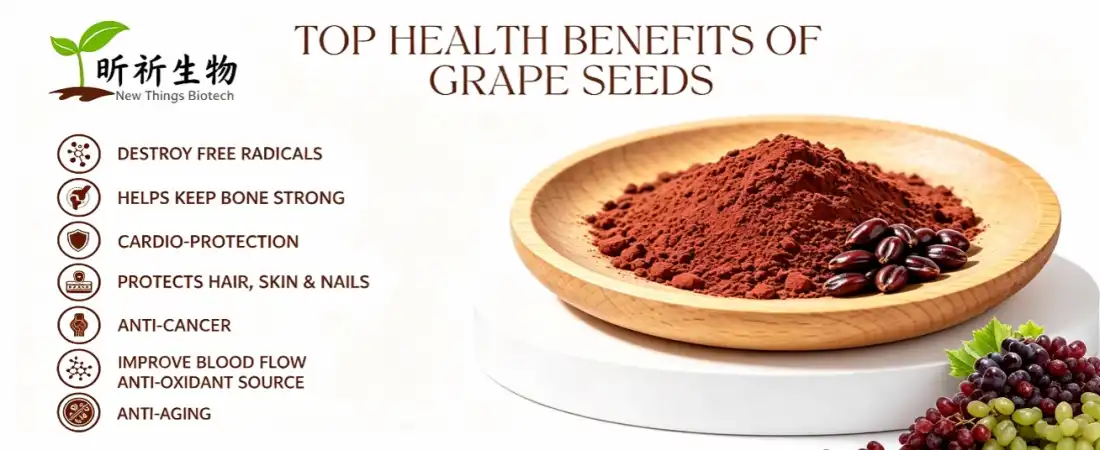
If you have only a minute, the table below summarises what research has related to grape seed OPCs and where each benefit falls in a product line. The following sections discuss each topic in further detail.
| Benefit | What Research Suggests | Key Study | Typical Product Positioning |
|---|---|---|---|
| Antioxidant defense | Stronger free radical scavenging than vitamins C and E in lab models | Bagchi et al., 1997 | Daily wellness, healthy aging |
| Healthy blood pressure | Reduced systolic and diastolic readings in adults with metabolic syndrome | Sivaprakasapillai et al., 2009 | Heart and circulation blends |
| Vascular health markers | Improvements across several vascular measures, including LDL in those with higher levels | Weseler et al., 2011 | Cardiovascular support |
| Cognitive function | Better attention and memory scores in healthy older adults | Calapai et al., 2017 | Brain and healthy-aging formulas |
| Skin and connective tissue | Protection of collagen and elastin from oxidative breakdown | Weseler & Bast, 2017 | Beauty-from-within, skincare |
Why "Oligomeric" Sits Behind Every Benefit
All five advantages hinge upon one structural element. Proanthocyanidins are polymers of catechin and epicatechin molecules. Long polymer chains are bulky and typically pass through the small intestine without absorption. Oligomers of 2-5 units are short and small enough to circulate more readily. Japanese researchers, lead by Sano, found the simple OPC dimer, procyanidin B1, in human blood only a few hours after ingestion of grape seed extract. This results helps to understand how oligomer-rich extracts may have observable impacts. If you are choosing an ingredient, the OPC content is a much more relevant statistic than a general “polyphenol” value.
The Grape Seed Advantage
French scientist Jack Masquelier was the first to extract OPCs from peanut shells and pine bark, and subsequently found grape seeds to be an excellent source. In their evaluation of his work, Weseler and Bast showed how research on fundamental flavonoids developed grape seed extract into a well-characterized dietary supplement with demonstrated health benefits. Grape seeds are rich in nature, traceable and plentiful in low molecular weight proanthocyanidins. They also provide marketers with an attractive upcycling narrative as a by-product of winemaking.
Head to Toe: Where OPC Benefits Show Up
Blood Vessels and Circulation
Good circulation requires flexible, well-supported blood vessel walls. OPCs attach to collagen and elastin in the vascular matrix, helping guard these proteins against oxidative and enzymatic degradation that occurs with age and stress. Weseler and colleagues conducted a randomised controlled pilot research in which male smokers consumed 200 mg/day of grape seed flavanols for 8 weeks . They saw benefits on several measures of vascular health. This is one reason why oligomeric proanthocyanidins water-soluble and opc oligomeric proanthocyanidins are so frequent in formulae for weary legs, circulation and long trip travellers.
Heart and Metabolic Markers
One of the most investigated consequences of OPC is blood pressure; Adults with metabolic syndrome were given either 150 mg or 300 mg of grape seed extract per day for four weeks by Sivaprakasapillai and colleagues. In both groups, systolic and diastolic blood pressure were significantly reduced compared with placebo. The same study group also showed that grape seed extract helped prevent LDL cholesterol from oxidation. The findings provide heart-health companies a well-referenced component that naturally complements CoQ10, omega-3s, magnesium and resveratrol.
Brain and Cognitive Aging
The brain is particularly susceptible to oxidative stress because it consumes a big fraction of the body’s oxygen. In a randomised, double-blind research, Calapai and colleagues gave healthy people between the ages of 60 and 70 a polyphenol-rich grape extract for 12 weeks. Participants improved on measures of attention, language and immediate and delayed memory. Cognitive health is one of the fastest growing supplement categories, and OPCs have a strong research narrative for brain-focused mixes.
Skin and Connective Tissue
The blood-vessel supporting, collagen-protecting function is good for the skin, as well. OPCs promote collagen and elastin, helping to maintain firm, smooth, resilient skin from the inside out. They also play a role in recycling vitamin C, a substance the body requires to make new collagen. In beauty products, OPCs are commonly combined with collagen peptides and hyaluronic acid and encapsulated or added to beverages. They’re also used as antioxidant actives in serums and creams.
Trying to figure out the right OPC level and serving size for your circulation, brain, or beauty formula? Send us your product concept on info@newthingsbiotech.com. Our technical staff will get back within 2 hours with customised advice and a free sample with its batch CoA.
Getting the Most from OPCs: Absorption, Dosing, and Pairing
What Happens After You Swallow an OPC
Once eaten, OPCs go one of two routes. The Sano research indicates that monomers and tiny oligomers like dimers are absorbed partially in the small intestine and enter the circulation. The remainder passes into the colon, where bacteria in the stomach break it down into smaller phenolic compounds that may also have health benefits. In a wide review of flavonoid bioavailability, Rodriguez-Mateos and colleagues highlighted that when researchers analyse health impacts, the parent chemicals and these microbial metabolites matter. In reality, an extract rich in genuine oligomers makes a greater use of both ways.
Dose Ranges Used in Research
Clinical trials have tended to employ a somewhat constant range, making formulation easy. The majority of studies used a dose between 100 mg and 300 mg for many weeks. The table below provides typical research dosages by aim.
| Goal | Daily Amount Studied | Study Duration | Reference Study |
|---|---|---|---|
| Blood pressure support | 150–300 mg | 4 weeks | Sivaprakasapillai et al., 2009 |
| Vascular health markers | 200 mg | 8 weeks | Weseler et al., 2011 |
| Cognitive function in older adults | 250 mg | 12 weeks | Calapai et al., 2017 |
| General antioxidant wellness | 100–200 mg | Ongoing daily use | Common formulation practice |
Our powder is standardised to 95% OPC, so these dosages fit neatly into a single capsule, pill or liquid serving.
Smart Pairings That Amplify Results
OPCs play nicely together. The traditional companion of OPCs is vitamin C, which OPCs assist replenish once it has neutralised free radicals. Premium antioxidant stacks include Resveratrol and Quercetin. Bilberry and lutein are great for eye-wellness treatments, while collagen peptides are great for beauty solutions. It’s an easy habit for customers to get into, taking OPCs with meals.
Who Uses OPCs, and How Brands Formulate Them
Consumer Groups Driving Demand
Good circulation requires flexible, well-supported blood vessel walls. OPCs attach to collagen and elastin in the vascular matrix, helping guard these proteins against oxidative and enzymatic degradation that occurs with age and stress. Weseler and colleagues conducted a randomised controlled pilot research in which male smokers consumed 200 mg/day of grape seed flavanols for 8 weeks . They saw benefits on several measures of vascular health. This is one reason why oligomeric proanthocyanidins water-soluble and opc oligomeric proanthocyanidins are so frequent in formulae for weary legs, circulation and long trip travellers.
Format Freedom Thanks to Water Solubility
A weakly soluble extract affords the formulator significantly fewer alternatives than a water-soluble powder of oligomeric proanthocyanidins. It dissolves rapidly in wellness shots, sparkling drinks and stick packs , it mixes uniformly in wet granulation for tablets and it disperses evenly into the water phase of toners and serums. In gummies it may be added during the cooling step, without leaving gritty particles. Its little astringency plays well with flavours of grape, berry, cherry, pomegranate and chocolate. It also has a warm crimson tone to give items a genuine botanical feel. Mildly acid formulae and opaque packaging contribute to maintaining activity throughout shelf life.
Quality Checkpoints and Choosing Your OPC Supplier
Read the Specification Before You Buy
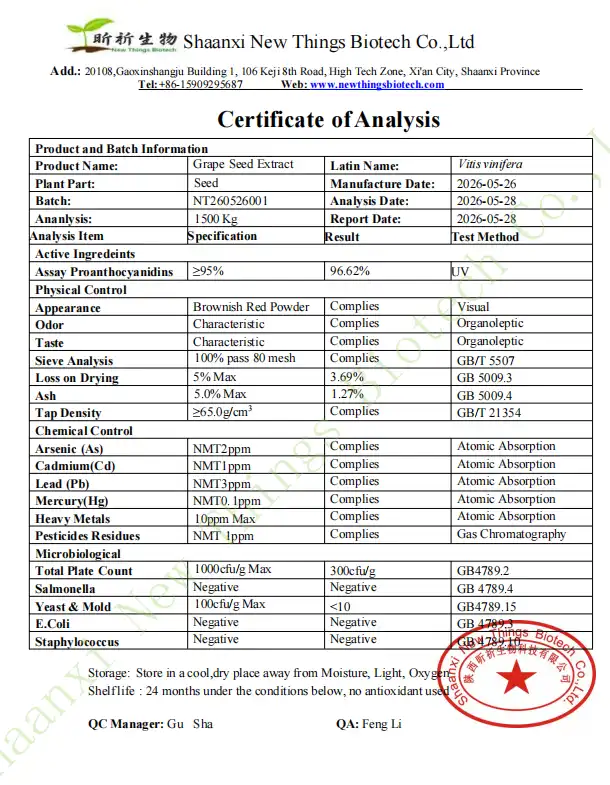
The advantages mentioned above are based on verified material. Ask for a detailed spec sheet and a CoA that is particular to the batch and look at the test procedure utilised for the OPC content. The table below illustrates the usual profile of OPC powder of NT Biotech, validated on every manufacturing batch.
| Item | Specification | Test Method |
|---|---|---|
| Botanical Source | Vitis vinifera L. (grape seed) | TLC |
| Active Compound | Oligomeric proanthocyanidins ≥ 95% | UV |
| CAS No. | 84929-27-1 | — |
| Appearance | Reddish-brown fine powder | Visual |
| Solubility | Water soluble | — |
| Particle Size | 100% pass 80 mesh | Sieve |
| Loss on Drying | ≤ 5.0% | USP |
| Ash | ≤ 5.0% | USP |
| Heavy Metals | ≤ 10 ppm | ICP-MS |
| Microbiology | TPC ≤ 1,000 cfu/g; E. coli and Salmonella negative | USP |
| Storage and Shelf Life | Sealed, cool, dry, away from light; 24 months | — |
Speed, Stock, and Logistics
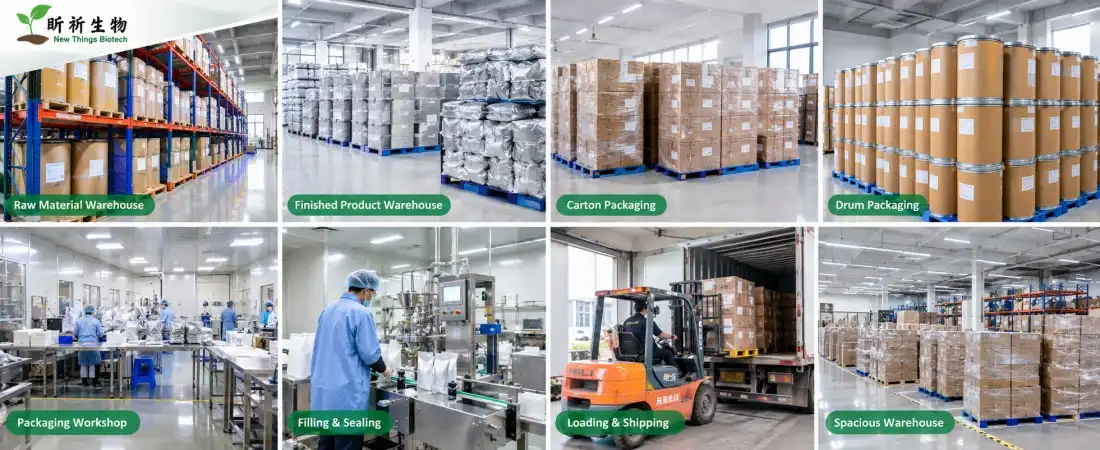
A dependable opc oligomeric proanthocyanidins provider keeps your launches on track. NT Biotech will get back to you within two hours with your first query. Popular grades are available in stock and ship within 1 to 3 working days after your purchase has been confirmed. The production orders generally take between 3 to 10 working days, which includes acquisition of raw materials, proprietary extraction, laboratory testing and packaging. Samples and small quantity orders are sent directly from our facility on our own FedEx and UPS accounts, while large orders are shipped by air or sea via reputable freight forwarders.
Certifications, OEM Support, and Payment
We are ISO9001 quality management certified and possess KOSHER and HALAL certifications. Each shipment is accompanied with UV and HPLC data. Through our OEM and ODM service, we can customise OPC levels, particle size, packaging and final forms for diverse markets. We also take local currencies of the customer.
Conclusion
OPC oligomeric proanthocyanidins provide a very wide spectrum of advantages. They preserve collagen for strong skin, help keep the mind bright, maintain good blood pressure and vascular function and give antioxidant protection. They dissolve in water so they fit in nearly any shape. The results rely on the genuine oligomer concentration and on the validated quality. Shaanxi New Things Biotech - your reliable provider of plant derivatives. We provide grape seed OPCs 95% standardised, with patented extraction, comprehensive UV, HPLC and CoA documentation, and ISO9001, KOSHER, HALAL certifications. We help supplement, food and cosmetic businesses from plant source to completed product with rapid stock delivery and adaptable OEM solutions. Partner with us now and convert nature’s gift into science-supported outcomes.
FAQ
Q1: What are the main benefits of OPCs?
Antioxidant defense, blood pressure and vascular support, cognitive health, and collagen protection.
Q2: How much OPC is used in research?
Most studies use 100–300 mg per day for several weeks.
Q3: Why does oligomer content matter?
Short-chain oligomers are absorbed more readily than large polymers.
Q4: Is NT Biotech's OPC water soluble?
Yes. It suits drinks, gummies, tablets, and water-based skincare.
Q5: What certifications do you hold?
ISO9001, KOSHER, and HALAL. A CoA comes with every batch.
Unlock the Full Power of OPCs with NT Biotech
Shoppers want antioxidants with real research behind them, and OPCs deliver benefits for the heart, the brain, and the skin. NT Biotech supplies opc oligomeric proanthocyanidins standardized to 95% from premium grape seeds. The powder is fully water soluble, consistent from batch to batch, and documented with a CoA for every shipment. We reply within two hours, ship stock grades within days, accept payment in your local currency, and offer OEM and ODM support for capsules, beverages, gummies, and skincare. Whether you are building a circulation formula, a brain-health blend, or a beauty-from-within line, our technical team is ready to help. Email info@newthingsbiotech.com today for a free sample, full specifications, and a competitive quotation.
References
1. Weseler AR, Bast A. Masquelier's grape seed extract: from basic flavonoid research to a well-characterized food supplement with health benefits. Nutrition Journal. 2017;16(1):5.
2. Weseler AR, Ruijters EJB, Drittij-Reijnders MJ, Reesink KD, Haenen GRMM, Bast A. Pleiotropic benefit of monomeric and oligomeric flavanols on vascular health—a randomized controlled clinical pilot study. PLoS One. 2011;6(12):e28460.
3. Sivaprakasapillai B, Edirisinghe I, Randolph J, Steinberg F, Kappagoda T. Effect of grape seed extract on blood pressure in subjects with the metabolic syndrome. Metabolism. 2009;58(12):1743–1746.
4. Sano A, Yamakoshi J, Tokutake S, Tobe K, Kubota Y, Kikuchi M. Procyanidin B1 is detected in human serum after intake of proanthocyanidin-rich grape seed extract. Bioscience, Biotechnology, and Biochemistry. 2003;67(5):1140–1143.
5. Calapai G, Bonina F, Bonina A, et al. A randomized, double-blinded, clinical trial on effects of a Vitis vinifera extract on cognitive function in healthy older adults. Frontiers in Pharmacology. 2017;8:776.
6. Bagchi D, Garg A, Krohn RL, Bagchi M, Tran MX, Stohs SJ. Oxygen free radical scavenging abilities of vitamins C and E, and a grape seed proanthocyanidin extract in vitro. Research Communications in Molecular Pathology and Pharmacology. 1997;95(2):179–189.