- English
- French
- German
- Portuguese
- Spanish
- Russian
- Japanese
- Korean
- Arabic
- Greek
- German
- Turkish
- Italian
- Danish
- Romanian
- Indonesian
- Czech
- Afrikaans
- Swedish
- Polish
- Basque
- Catalan
- Esperanto
- Hindi
- Lao
- Albanian
- Amharic
- Armenian
- Azerbaijani
- Belarusian
- Bengali
- Bosnian
- Bulgarian
- Cebuano
- Chichewa
- Corsican
- Croatian
- Dutch
- Estonian
- Filipino
- Finnish
- Frisian
- Galician
- Georgian
- Gujarati
- Haitian
- Hausa
- Hawaiian
- Hebrew
- Hmong
- Hungarian
- Icelandic
- Igbo
- Javanese
- Kannada
- Kazakh
- Khmer
- Kurdish
- Kyrgyz
- Latin
- Latvian
- Lithuanian
- Luxembou..
- Macedonian
- Malagasy
- Malay
- Malayalam
- Maltese
- Maori
- Marathi
- Mongolian
- Burmese
- Nepali
- Norwegian
- Pashto
- Persian
- Punjabi
- Serbian
- Sesotho
- Sinhala
- Slovak
- Slovenian
- Somali
- Samoan
- Scots Gaelic
- Shona
- Sindhi
- Sundanese
- Swahili
- Tajik
- Tamil
- Telugu
- Thai
- Ukrainian
- Urdu
- Uzbek
- Vietnamese
- Welsh
- Xhosa
- Yiddish
- Yoruba
- Zulu
Somewhere right now, at a product development meeting, a team is discussing the same topic yours is undoubtedly asking: remain with Brilliant Blue FCF, or go natural? It’s one of the most consequential sourcing decisions in modern food formulation – with implications that span label claims and consumer trust all the way to regulatory risk and cost-in-use. This article compares phycocyanin powder bulk with synthetic blue pigments on the factors that really matter to buyers: origin, safety perception, regulation, performance, labelling and total economics. Spoiler: The gap is smaller than sceptics say and bigger than synthetic loyalists will acknowledge. We’ll reference throughout the standards of NT Biotech (Shaanxi New Things Biotech), whose bulk phycocyanin powder combines patented solvent-free extraction, >98% purity benchmarks on key products and HPLC/UV-verified documentation on each batch. For specs or samples, contact info@newthingsbiotech.com.
Two Blues, Two Worlds: Where Each Pigment Comes From
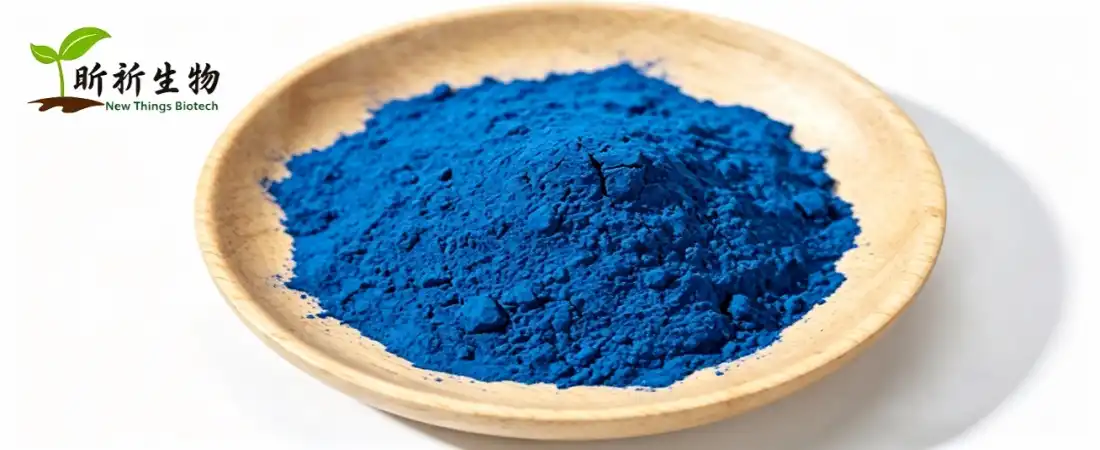
The key distinction between these colourants is their origins – and that origin narrative is increasingly dictating which products people pick up, and which ones they put back. Synthetically made blues like Brilliant Blue FCF (Blue #1, E133) and Indigotine (Blue #2, E132) are petroleum-based compounds, synthesised in chemical reactors by techniques that have no connection to food. However, the phycocyanin powder is derived from living spirulina that is grown in regulated ponds and then processed using a mild water extraction technique into a lively blue protein-pigment combination. One is a chemical that just happens to be permitted in food; the other is a component of food that just happens to be magnificently blue. That is a conceptual distinction but it cascades into every practical difference that follows—labeling, marketing, regulatory trajectory, consumer acceptance.
How Synthetic Blues Are Made
Blue #1 is produced from aromatic hydrocarbons through a multi-step chemical reaction, and then purified to food-grade standards. The technique is efficient, inexpensive and consistent – the attributes that made synthetic dyes popular for a century – but it leaves firms with an ingredients list entry that customers increasingly see as a warning flag, not a neutral truth.
How Phycocyanin Is Made
NT Biotech’s phycocyanin powder starts with cultured Arthrospira platensis, from which the pigment is liberated and purified using a water-based process – no organic solvents, no synthetic intermediates – and then spray-dried into a thin, easily dispersible powder. The outcome is vegan, kosher- and halal-certifiable, and traceable from pond to packaging via NT Biotech’s integrated value chain of autonomous growth, proprietary extraction, and batch-level lab verification.
A Pigment with a Bonus Function
Here’s something synthetic dyes can’t deliver: phycocyanin is a bioactive protein with well documented antioxidant capabilities. While Blue #1 adds nothing to a product but colour, phycocyanin can double up as a functional ingredient – a real marketing asset in supplements, functional beverages and better-for-you snacks.
The Regulatory and Consumer Landscape: Momentum Matters
The philosophical divergence is origin, but the business divergences are regulation and consumer attitude – and they’re both going in one direction. Synthetic dyes are under siege. The EU has already mandated warning labels for several synthetic colourants. Certain markets have prohibited or discouraged their use in products for children. And headlines about reformulation by big food are already commonplace. In 2013, spirulina extract was approved by the FDA as a colour additive, becoming the first natural blue permitted for use in food in the United States. Since then, its approved uses have gradually grown. For firms with five- or ten-year product lifecycles, it’s not only a question of which pigment works today, but which will still be accepted on labels tomorrow. In this respect bulk phycocyanin powder has the obvious long-term edge.
| Dimension | Synthetic Blue (Blue #1 / E133) | Phycocyanin (Spirulina Extract) |
|---|---|---|
| Origin | Petroleum-derived synthesis | Water-extracted from spirulina |
| Label declaration | "Blue 1" / "E133" | "Spirulina extract" |
| Regulatory trend | Increasing scrutiny, warning labels in EU | Expanding approvals since 2013 |
| Consumer perception | Negative, "artificial" | Positive, clean-label |
| Nutritional value | None | Antioxidant protein |
| Vegan/Kosher/Halal fit | Varies, perception issues | Fully compatible (NT Biotech certified) |
| Marketing usability | Liability to minimize | Asset to highlight |
The Clean-Label Economics
It’s not cosmetic to see “spirulina extract” on an ingredient panel instead of “Blue 1” – it alters purchasing behaviour. Consistently, price premiums and greater repeat rates are seen with clean-label items, demonstrating that the pigment selection drives compliance as well as revenue. Phycocyanin makes your label’s colourant line a selling point instead of a liability.
Where Regulation Is Heading
In recent years, several states have tried to prohibit synthetic dyes, while bans at the retailer level – when large chains refuse to stock private-label goods containing artificial colours – add commercial pressure on top of the legal. Brands that reframe early control the transformation Brands that wait reframe under deadline pressure.
Certification Pathways
The paperwork trail for phycocyanin is substantially simpler for certified kosher, halal, vegan or organic-adjacent product lines. ISO9001, KOSHER and HALAL certified by NT Biotech, phycocyanin powder bulk slips right into certified supply chains without the perception battles synthetic dyes typically provoke with certifying bodies and consumers alike.
Performance Head-to-Head: Stability, Shade, and Cost Reality
Honest laying out of the trade-offs is required for credible comparisons. Synthetic Blue #1 is highly indestructible—stable at severe pH, high heat, and long light exposure—and can be cheaper per kilogram in raw pricing. That would make this a short article if that were all. But the reality of formulation is more complicated. Phycocyanin shines under the conditions that cover most real-world food and beverage applications – it’s a brilliant, stable sky-blue from pH 4.5 to 8.0, it works in cold-processed and moderate-heat systems, and it has a warmer, more natural-looking blue that many developers actually prefer aesthetically to the slightly electric cast of Blue #1. And on economics: Sticker pricing is misleading. Add clean-label price surcharges, marketing value and reformulation risk and the overall cost equation often works in the natural’s favour. NT Biotech further narrows the performance gap with standardised high E-value grades that minimise dose and application guidance that keeps colour vibrant through processing.
Where Synthetics Still Hold an Edge
High-acid beverages below pH 4.5, retorted products and direct high-heat baking are still tough territory for any protein-based pigment. Synthetic dyes do have a real technical advantage in certain niches – although territory that is steadily being reduced year on year by protective formulation techniques, late-stage addition and continual advancements in stability.
Where Phycocyanin Wins Outright
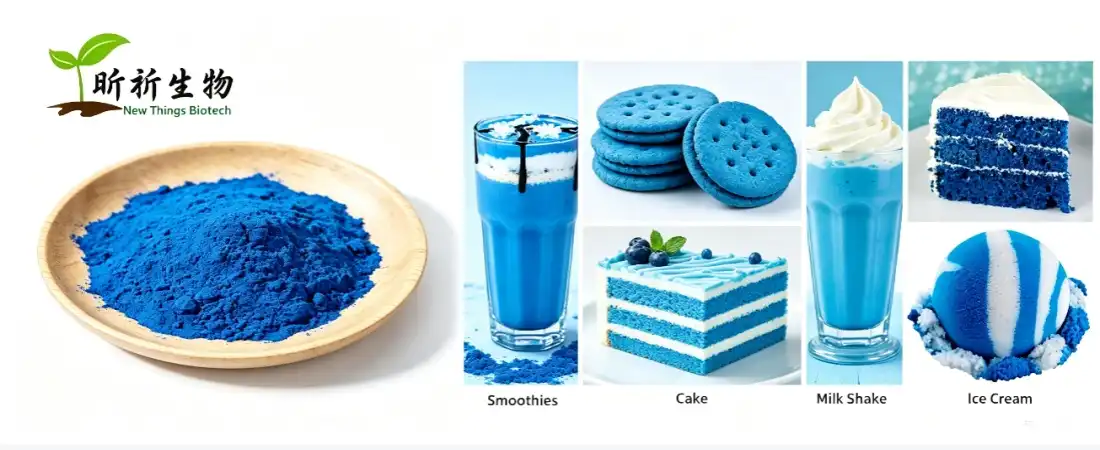
In beverages, frozen desserts, dairy, candies, icings, powder mixes and supplements – the bulk of blue colourant demand – phycocyanin powder offers synthetic performance and label value no dye can equal. Stability differences essentially disappear, especially in freezing and dry applications, leaving phycocyanin’s advantages unquestioned.
The True Cost Comparison
Compare cost per kg at target shade, not cost per finished unit. High-E grades (E18, E25) dosage at fractions of a percent, thus the per-product cost difference vs synthetic is typically just pennies – inconsequential against the premium positioning and customer goodwill the natural label wins back.
Weighing a reformulation project right now? The fastest way to settle the synthetic-versus-natural question is with real numbers from your own product: send your application, current colorant, and target shade to NT Biotech at info@newthingsbiotech.com, and their technical team will return a grade recommendation, dosing estimate, and cost-in-use comparison — typically within two hours — along with a free sample for bench trials.
Making the Switch: What Reformulation Actually Requires
For teams convinced by the analogy, the last issue is pragmatic: how hard is the switch? The honest answer – a lot easier than most formulators think, if the supplier does its job. The replacement of Blue #1 with phycocyanin is not a one-for-one substitution but rather a short, planned project to match shade, verify stability and optimise process parameters. The success or failure of that effort hinges on the quality and consistency of the bulk phycocyanin powder it is based on. Batch-to-batch E-value drift requires continuous re-standardization Poor documentation delays quality clearances Slow supplier replies turn three-week projects into quarter-long projects That’s why picking the correct phycocyanin powder bulk supplier is really part of the reformulation itself. Thus, NT Biotech is building its whole business on eliminating these friction points and is, more than anything, a long-term technical partner, not a powder provider.
| Reformulation Step | What's Involved | How NT Biotech Supports It |
|---|---|---|
| Grade selection | Match E-value to matrix and process | Application-specific recommendations within 2 hours |
| Shade matching | Dose to instrumental color targets | Certified E-values on every CoA for precise dosing |
| Stability trials | pH, heat, light verification in your matrix | Documented stability guidance + free samples |
| Quality approval | Documentation for QA/regulatory sign-off | Lot-specific CoA, HPLC/UV data, ISO9001/KOSHER/HALAL |
| Scale-up | Consistent color at production volume | Standardized batches; 1–3 day stock dispatch |
| Ongoing supply | Reliable reorders, flexible volumes | 3–10 day production cycle; OEM/ODM; local-currency payment |
Typical Timeline and Effort
The simplest applications — beverages, frozen desserts, gummies, powders — finish bench testing in one to three weeks. The long pole is usually supplier paperwork and sample logistics, which NT Biotech shortens with two-hour inquiry responses and direct FedEx/UPS sample shipping from its own factory accounts.
Supply Security at Scale
With a natural pigment provider you have to gain that same confidence operationally. Synthetic dyes spoilt buyers with endless supply. NT Biotech stocks popular standardised grades for delivery within 1–3 working days, completes full production cycles in 3–10 working days, and ships commercial volumes by air or sea through reliable freight forwarders - matching your speed, volume and cost preferences.
Beyond the First Purchase Order
Reformulation is the start of the relationship, not the end. Custom E-values, private-label packaging, market-specific documentation through comprehensive OEM/ODM services, and buyer-friendly payment terms—including settlement in your local currency—keep the collaboration as flexible as your product roadmap demands.
Conclusion
Set side by side, the verdict is clearer than the debate suggests. Synthetic blues win on raw heat and acid tolerance and sticker price — and lose on everything consumers and regulators increasingly care about. Phycocyanin powder bulk delivers comparable performance across the majority of real applications while transforming the colorant from a label liability into a marketing asset: natural origin, clean declaration, antioxidant function, and regulatory momentum all point the same way. The practical difference between a smooth switch and a stalled one is the supplier — and NT Biotech, with >98% purity standards, lot-specific CoAs, ISO9001/KOSHER/HALAL certification, two-hour responses, and 1–3 day stock dispatch, makes natural blue the easy choice as well as the right one.
FAQ
Q1: Can phycocyanin fully replace Blue #1 in most products?
A: Yes — in beverages (pH 4.5+), frozen desserts, gummies, dairy, powders, and supplements, phycocyanin matches synthetic performance with a far better label.
Q2: Where do synthetic blues still outperform phycocyanin powder?
A: In very high-acid (below pH 4.5), retorted, or direct high-heat baked applications — a shrinking niche with formulation workarounds available.
Q3: Is phycocyanin more expensive than synthetic dye?
A: Per kilogram, yes; per finished unit at typical 0.01–0.1% dosages, the difference is often pennies — easily offset by clean-label premiums.
Q4: How is bulk phycocyanin powder declared on labels?
A: Simply as "spirulina extract" in most markets — no E-numbers, no warning labels.
Q5: How quickly can NT Biotech support a reformulation trial?
A: Technical recommendations within two hours, free samples via FedEx/UPS, and stock orders shipped in 1–3 working days.
Make the Switch to Natural Blue with NT Biotech
The synthetic-to-natural transition is happening with or without your brand — the only question is whether you lead it or chase it. NT Biotech makes leading easy: standardized phycocyanin powder bulk across the full E-value range, every batch verified by HPLC/UV and shipped with a lot-specific CoA, all under ISO9001, KOSHER, and HALAL certification. Add guaranteed two-hour inquiry responses, 1–3 day stock dispatch, direct factory shipment on company FedEx/UPS accounts, full OEM/ODM customization, and payment in your local currency, and reformulation risk shrinks to nearly nothing. Email info@newthingsbiotech.com today for a free sample and a side-by-side cost-in-use analysis against your current synthetic dye — and give your label the natural blue it deserves.
References
1. Newsome, A. G., Culver, C. A., & van Breemen, R. B. "Nature's Palette: The Search for Natural Blue Colorants." Journal of Agricultural and Food Chemistry, 2014.
2. Sigurdson, G. T., Tang, P., & Giusti, M. M. "Natural Colorants: Food Colorants from Natural Sources." Annual Review of Food Science and Technology, 2017.
3. U.S. Food and Drug Administration. "Listing of Color Additives Exempt from Certification; Spirulina Extract." Federal Register, 2013.
4. Jespersen, L., Strømdahl, L. D., Olsen, K., & Skibsted, L. H. "Heat and Light Stability of Three Natural Blue Colorants for Use in Confectionery and Beverages." European Food Research and Technology, 2005.
5. Oplatowska-Stachowiak, M., & Elliott, C. T. "Food Colors: Existing and Emerging Food Safety Concerns." Critical Reviews in Food Science and Nutrition, 2017.
6. Eriksen, N. T. "Production of Phycocyanin—A Pigment with Applications in Biology, Biotechnology, Foods and Medicine." Applied Microbiology and Biotechnology, 2008.