- English
- French
- German
- Portuguese
- Spanish
- Russian
- Japanese
- Korean
- Arabic
- Greek
- German
- Turkish
- Italian
- Danish
- Romanian
- Indonesian
- Czech
- Afrikaans
- Swedish
- Polish
- Basque
- Catalan
- Esperanto
- Hindi
- Lao
- Albanian
- Amharic
- Armenian
- Azerbaijani
- Belarusian
- Bengali
- Bosnian
- Bulgarian
- Cebuano
- Chichewa
- Corsican
- Croatian
- Dutch
- Estonian
- Filipino
- Finnish
- Frisian
- Galician
- Georgian
- Gujarati
- Haitian
- Hausa
- Hawaiian
- Hebrew
- Hmong
- Hungarian
- Icelandic
- Igbo
- Javanese
- Kannada
- Kazakh
- Khmer
- Kurdish
- Kyrgyz
- Latin
- Latvian
- Lithuanian
- Luxembou..
- Macedonian
- Malagasy
- Malay
- Malayalam
- Maltese
- Maori
- Marathi
- Mongolian
- Burmese
- Nepali
- Norwegian
- Pashto
- Persian
- Punjabi
- Serbian
- Sesotho
- Sinhala
- Slovak
- Slovenian
- Somali
- Samoan
- Scots Gaelic
- Shona
- Sindhi
- Sundanese
- Swahili
- Tajik
- Tamil
- Telugu
- Thai
- Ukrainian
- Urdu
- Uzbek
- Vietnamese
- Welsh
- Xhosa
- Yiddish
- Yoruba
- Zulu
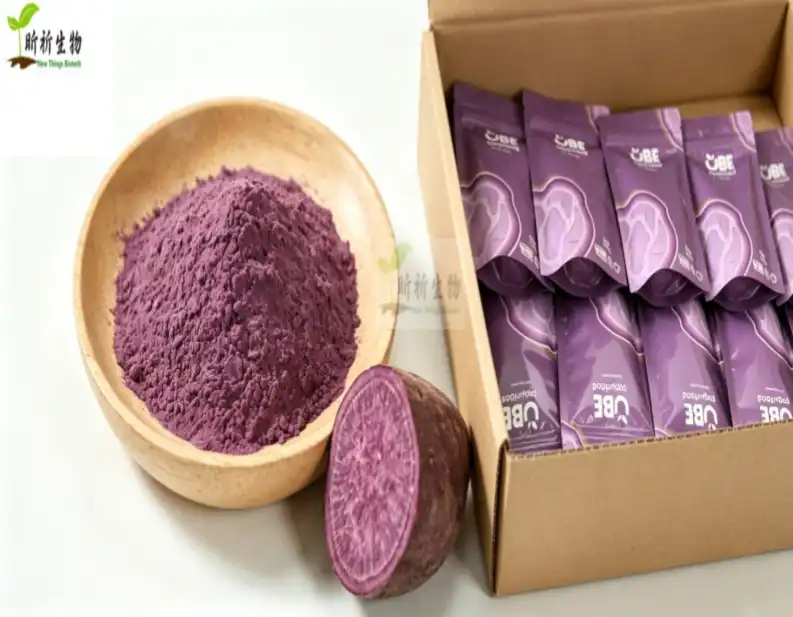
Pure purple yam powder gives food, beverage and nutrition makers two practical benefits in one ingredient: the natural purple colour of Dioscorea alata and the starch, fibre and plant chemicals naturally contained in the tuber. Unlike a synthetic colourant, purple yam powder may provide colour, flavour and ingredient value to a completed recipe. Anthocyanins, phenolic compounds, starch, amylose and dietary fibre have been reported in Dioscorea alata and their quantities vary with the cultivar, age and processing technique.
For B2B buyers, the more relevant question is not whether ube is a “superfood.” It is whether the ingredient has a consistent botanical source, clear requirements, appropriate processing and documentation that suits the desired product. This guide examines those topics from a formulation and procurement standpoint.

Understanding Pure Ube Powder: Nature, Nutritional Value, and Health Benefits
What Makes Pure Ube Powder Different from Blended Alternatives
It is manufactured from pure ube, a purple yam also known botanically as Dioscorea alata L. Pure specification indicates the substance is provided as purple yam, not diluted with carriers, fillers or other root powders. This difference is important if one want to retain the particular flavour and colour of ube in the completed product.
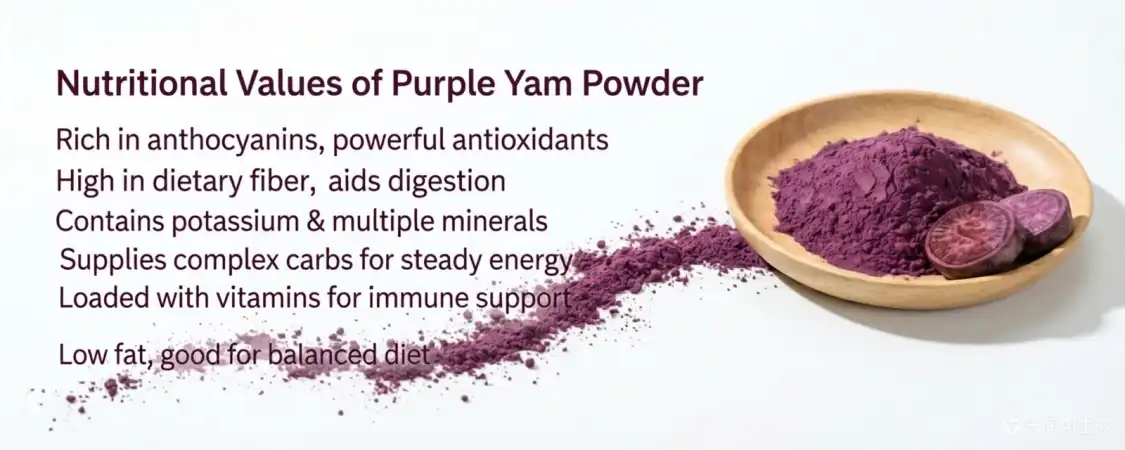
Purple yam includes naturally occurring carbohydrates, dietary fibre, anthocyanins and other phenolic substances. Research has revealed that the composition may vary widely from one variety to another thus purchasers should avoid using a single published nutritional profile as a uniform criteria for every powder.
NT Biotech’s product specification indicates that the raw material is Dioscorea alata L. It is extracted from the root with a particle size of 80 mesh and a 100% purity criterion. Certifications: Kosher, Halal, ISO.
There is also processing to mention. NT Biotech’s manufacturing sequence comprises raw material selection, washing, steam cooking, low temperature dehydration, grinding and sieving, metal detection, quality inspection and packing. These procedure specifics are more relevant to a customer than unsubstantiated promises of maintaining a certain proportion of nutrients.
Core Nutritional Profile of Purple Yam Powder
Carbohydrates and starch are the main nutrients in Dioscorea alata . The quantities of fibre and amylose differ across cultivars . The investigation of 20 kinds of water-yam showed significant diversity in the amount of dietary fibre, dry matter, amylose and minerals. This difference is one of the reasons formulation teams should utilise the supplier’s product specification or batch paperwork to calculate the nutrition panel of a completed product.
The protein level of ube is often lower than the major starch and carbohydrate percentage of the powder. Dioscorea alata is prized mostly for its starch, nutritional fibre and anthocyanins, rather than for protein, and purchasers should not use ube as a source of protein. The actual protein number will still vary with cultivar and processing, which is why the supplier’s specification or batch Certificate of Analysis is the only credible source to verify this.
Purple cultivars include anthocyanins and other phenolic chemicals; Studies on Thai purple yams revealed the presence of cyanidin- and peonidin-based anthocyanins and their variation by accession and tuber development stage . Processing and storage conditions may also have an influence on anthocyanins, the research observed.
Another interesting feature is resistant starch. The digestibility and fermentation behaviour of resistant starch produced from purple yam have been studied. In vitro studies have also studied the relationship between purple-yam resistant starch and Bifidobacterium adolescentis. These results promote further research in purple yam as a functional dietary ingredient, but should not be taken as evidence of a particular clinical health impact from ordinary powder.
To complete the nutrition panel, the protein content of ube should be obtained from the validated COA value, not from a general published average, since processing might affect the relative proportions of carbohydrate, fibre and protein in the final powder. The amount of the measured protein may always be used to defend any description of a protein in the target market.
Health Benefits Supported by Research and Traditional Use
Studies on Dioscorea alata have mainly concerned its antioxidant activity, dietary fibre, starch properties, anthocyanins and possible impacts on metabolic and gastrointestinal systems. However, the data is not consistent across all research and some conclusions are based on laboratory or animal models and not human clinical trials.
For product producers, the best defensible strategy is thus to concentrate on the documented composition of the substance rather than on disease-treatment claims. Fibre and resistant starch may be important in the development of meals positioned around digestive or nutritional functioning. Naturally occurring anthocyanins contribute to the purple colour and antioxidant capacity that is distinctive of purple cultivars .
That’s a differentiator that marketing teams will care about. An ingredient may have good research behind it but that doesn’t mean the completed product may make medical claims. Formulators need to separate the science of the raw ingredient from the claims authorised for the finished food, beverage or supplement in its intended market.
How to Use Pure Purple Yam Powder in B2B Applications and Supply Chains
Food Manufacturing and Beverage Production Applications
The most obvious uses of pure purple yam powder are in meals and drinks when its colour, mild distinctive flavour, and starch functionality are appropriate for the product being formulated.
For beverages, the ube powder may be added to smoothies, plant-based drinks, nutrition beverages and other powdered or ready-to-mix goods. Dispersion and sedimentation should be verified in the real formula since performance is dependent upon particle size, solids content, protein level, pH and processing conditions.
Bakery items provide another useful application. Ube powder may be used to cakes, cookies, breads, pancakes and the like for a purple colour and a recognisable yam character. The best way to determine the right inclusion rate is to use product trials rather than a flat proportion for all recipes.
Purple yam may also be used as a flavouring and colouring element in frozen desserts and sweet items. Again, the final answer depends on how the question is worded. Sugar amount, fat content, pH, heat exposure and storage conditions may impact colour and texture.
A modest pilot study will generally tell manufacturers more than a generic application rate. The powder should be tested for colour, flavour, dispersion, texture and stability under the real manufacturing process before scaling up to commercial production.
Regional Formulation Considerations for Market Adaptation
Ube and purple yam are heavily tied to culture and cuisine in certain regions of Asia but the item is increasingly employed in worldwide bakery, beverage, dessert and plant-based food ideas.
The naming technique might so differ from market to market. In scientific, commercial, or consumer-facing publications, you’ll see “Ube,” “purple yam,” and Dioscorea alata, but they’re not the same thing. The botanical source should be explicitly specified in the procurement documentation so that no ambiguity exists about the ingredient being procured.
Certification standards can vary depending on the target market and the completed product category. Buyers may demand evidence on quality systems, religious certification, food safety, allergy management or other market standards. Rather than assume that one certificate will meet all regulatory requirements, buying teams should verify the paperwork necessary for their individual goods.
Bulk Storage, Handling, and Logistics Best Practices
Store powdered plant components away from moisture, contamination, extreme heat, and direct light. The actual storage conditions and shelf life should be taken from the supplier’s specification and packing instructions and not from a generic number.
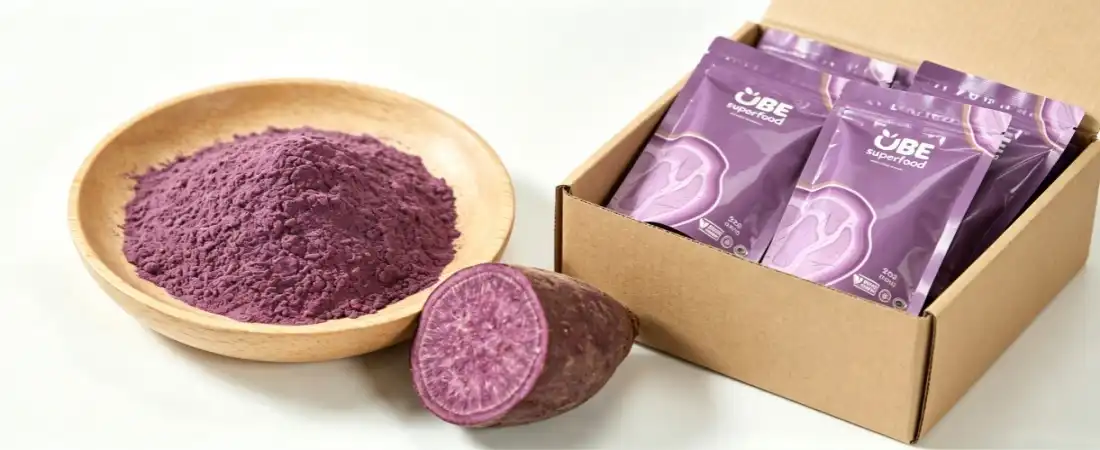
Packaging is especially crucial for powders since moisture may impact flowability, texture and product stability. Packaging NT Biotech offers ube yam powder in 1 kilogram bags, 10 kg boxes, and bespoke packaging choices. Standard packaging options are available to meet varied buying needs.
Logistics planning should include the link between order quantity, shipment mode, lead time and destination. NT Biotech shows the medicine as in stock and says it can be delivered within 2–4 days after payment.
Comparing Pure Ube Powder with Alternative Purple Root Powders
Nutritional and Functional Distinctions Between Purple Root Varieties
Purple yam and purple sweet potato are similar looking but botanically distinct. Purple yam is Dioscorea alata, and purple sweet potato is Ipomea batatas. They don’t have the same starch structures, phenolic profiles, flavour attributes or processing behaviour.
Purple yam has gained study interest for its starch, amylose, dietary fibre and anthocyanin content. Purple sweet potato is also a common source of anthocyanins and natural colour explored thoroughly. So the right decision relies on the formulation, not on whether chemical is more purple.
When comparing purple root powders, the protein content of ube is typically a secondary differentiator to the starch structure and anthocyanin profile. Taro or purple sweet potato may have different protein levels so the purchase specification - not a generic assumption - should state the protein figure for each candidate material.
Taro may be another choice, although it too has a distinct botanical identity and use. For procurement teams, the major comparative criteria should include botanical source, ingredient purity, particle size, colour, flavour, processing technique, application performance, certifications and accessible documentation.
A more direct ingredient match for pure purple yam powder, instead of replacing it with another purple root, if you want to have a recognisable ube taste and Dioscorea alata source in your product.
Organic Certification and Quality Assurance Considerations
Organic status should be evaluated separately from conventional quality certification. Whether organic material is required depends on the target market, product positioning, and certification strategy of the finished product.
For B2B procurement, more useful questions include:
- Is the botanical identity clearly specified?
- Is the powder supplied at a defined purity?
- Is the particle size documented?
- What certifications are available?
- Is batch documentation provided?
- Can the supplier provide a sample before commercial purchasing?
- Are packaging and delivery options suitable for the intended production volume?
NT Biotech lists ISO, Kosher, and Halal certifications for its ube yam powder and states that the standard product is 100% pure with an 80-mesh specification.
Where a buyer needs additional testing or documentation, those requirements should be confirmed with the supplier before an order is placed.
Procurement Strategies: Buying Pure Purple Yam Powder for Bulk and Wholesale Needs
Criteria for Selecting Reliable Ingredient Suppliers
Price should not be the starting point for a supplier assessment, but product specifications. For pure purple yam powder buyers should check on botanical source, purity, mesh size, packaging, certifications, sample availability and supply status.
Technical documentation is also significant. Depending on the application, procurement teams may seek a Certificate of Analysis, microbiological parameters, heavy-metal testing, allergy information and other documentation needed by their internal quality system or target market.
Samples are especially valuable when the substance is to be utilised in a novel formulation. A sample lets the R&D team to evaluate colour, scent, flavour, dispersion, texture and processing performance before making a bigger purchase.
Supply capacity is also important. Even a product that tests well in the laboratory might lead to production issues if the supplier is unable to meet the standard or the delivery timeline needed. NT Biotech presently offers their ube yam powder as in stock, with a minimum order quantity of 10 kg, and free samples.
Pricing Structures and Cost Optimization Approaches
The cost of purple yam powder can vary according to raw-material quality, purity, processing, packaging, certification requirements, order volume, and shipping conditions. It is therefore risky to apply a fixed percentage premium to one processing method or certification without a supplier quotation.
For purchasing teams, a better approach is to compare the total procurement package rather than the unit price alone. Consider:
- Product purity and specification
- Minimum order quantity
- Packaging format
- Sample and testing requirements
- Certification and documentation
- Shipping method
- Lead time
- Customization requirements
Before placing a bulk order, test the ingredient in the intended formula. This can reveal whether the powder delivers the expected color, flavor, texture, and processing performance. It also gives the buyer a clearer basis for comparing suppliers.
NT Biotech lists free samples, a 10 kg MOQ, 80-mesh particle size, 100% purity, and customized packaging options for its ube yam powder. These specifications provide a practical starting point for a B2B evaluation.
Conclusion
Pure purple yam powder should be best considered as a botanical food ingredient and not only a “superfood.” Dioscorea alata is a natural source of starch, dietary fibre and anthocyanin rich pigments. Its resistant starch, antioxidant and other functional qualities are under investigation. Because composition varies by cultivar and processing, producers should consider product specifications and batch documents when making formulation or nutrition choices.
The real-world requirements for B2B purchasers are straightforward: botanical identification, purity, particle size, manner of processing, certificates, paperwork, sample performance, packaging and dependability of supply. NT Biotech’s ube yam powder is 100% pure Dioscorea alata L. root powder, 80 mesh and is ISO, Kosher and Halal certified.
FAQ
1. Is purple yam powder safe for consumers with gluten intolerance?
Pure purple yam is a tuber ingredient, not a wheat, barley or rye ingredient. But a producer making a gluten-free claim should evaluate the manufacturing and supply chain, including potential cross-contact during processing, handling and packaging. When the gluten-free claim is vital to the completed product, buyers should obtain necessary specifications or testing documents from the supplier.
2. What is the typical shelf life and optimal storage conditions?
Shelf life is dependent on the exact powder, packaging, processing technique and storage environment. Buyers should not apply a generic 24-month shelf-life to all products but should consult the supplier’s specification and check the date and storage requirements for the exact batch. In general, keep the powder covered and protected from moisture, contamination, high heat and direct light.
3. Can ube powder be used in non-food industrial applications?
The use of NT Biotech’s ube yam powder in food, beverage, nutritional and functional product compositions is the most well documented. Purple yam elements may also be found in personal-care ideas, although a food-grade ingredient should not be immediately considered as a cosmetic-grade raw material. Buyers should consult the provider on the correct grade, specifications, safety paperwork and regulatory requirements for cosmetic applications before usage.
Partner with NT Biotech as Your Trusted Pure Purple Yam Powder Supplier
For manufacturers sourcing pure purple yam powder, NT Biotech provides a defined product specification and established purchasing options. Its official product information identifies the ingredient as Dioscorea alata L. root powder, with 100% purity and an 80-mesh particle size. The listed certifications include ISO, Kosher, and Halal.
The company also lists a 10 kg MOQ, free samples, in-stock availability, and delivery within 2–4 days after payment. Packaging can be supplied in 1 kg bags, 10 kg boxes, or customized formats according to customer requirements.
For product developers, the next step is to evaluate the powder in the actual formulation. A sample can help your R&D team assess color, flavor, dispersion, texture, and processing behavior before moving to bulk purchasing.
If you are developing beverages, bakery products, desserts, functional foods, or other formulations that require a natural purple yam ingredient, contact NT Biotech at info@newthingsbiotech.com to request product information, samples, or a quotation for pure purple yam powder.
References
1. Champagne, A., & Boutry, M. (2021). Bioactive Compounds in Purple Yam (Dioscorea alata): Chemical Composition and Health Implications. Journal of Agricultural and Food Chemistry, 69(8), 2456-2468.
2. Simsek, S., & El, S. N. (2020). Resistant Starch in Purple-Fleshed Tubers: Nutritional Properties and Metabolic Effects. Critical Reviews in Food Science and Nutrition, 60(12), 2015-2031.
3. Zhang, Y., Mu, T., & Sun, H. (2019). Anthocyanin Stability and Degradation Kinetics in Purple Root Vegetables During Processing. Food Chemistry, 285, 169-178.
4. Rodriguez-Amaya, D. B. (2019). Natural Food Colorants from Plant Sources: Functionality and Regulatory Aspects. Annual Review of Food Science and Technology, 10, 415-439.
5. Viacava, F., & Roura, S. I. (2022). Functional Properties of Dioscorea Species: From Traditional Knowledge to Industrial Applications. Comprehensive Reviews in Food Science and Food Safety, 21(3), 2789-2815.
6. Thompson, K., & Marshall, S. (2020). Sourcing and Quality Assessment of Purple Yam Ingredients for Food Manufacturing: A Procurement Guide. Food Industry Insights Quarterly, 34(2), 112-129.