- English
- French
- German
- Portuguese
- Spanish
- Russian
- Japanese
- Korean
- Arabic
- Greek
- German
- Turkish
- Italian
- Danish
- Romanian
- Indonesian
- Czech
- Afrikaans
- Swedish
- Polish
- Basque
- Catalan
- Esperanto
- Hindi
- Lao
- Albanian
- Amharic
- Armenian
- Azerbaijani
- Belarusian
- Bengali
- Bosnian
- Bulgarian
- Cebuano
- Chichewa
- Corsican
- Croatian
- Dutch
- Estonian
- Filipino
- Finnish
- Frisian
- Galician
- Georgian
- Gujarati
- Haitian
- Hausa
- Hawaiian
- Hebrew
- Hmong
- Hungarian
- Icelandic
- Igbo
- Javanese
- Kannada
- Kazakh
- Khmer
- Kurdish
- Kyrgyz
- Latin
- Latvian
- Lithuanian
- Luxembou..
- Macedonian
- Malagasy
- Malay
- Malayalam
- Maltese
- Maori
- Marathi
- Mongolian
- Burmese
- Nepali
- Norwegian
- Pashto
- Persian
- Punjabi
- Serbian
- Sesotho
- Sinhala
- Slovak
- Slovenian
- Somali
- Samoan
- Scots Gaelic
- Shona
- Sindhi
- Sundanese
- Swahili
- Tajik
- Tamil
- Telugu
- Thai
- Ukrainian
- Urdu
- Uzbek
- Vietnamese
- Welsh
- Xhosa
- Yiddish
- Yoruba
- Zulu
Hyaluronic acid is a glycosaminoglycan that occurs naturally and is found in large amounts in synovial fluid, skin, and bones. There is a sodium salt of hyaluronic acid that is called sodium hyaluronate. The best sodium hyaluronate is more solid, dissolves better, and goes deeper than its parent ingredient when it is used in skincare goods. This living substance can hold 1,000 times its own weight in water. It is very helpful for keeping the right amount of moisture in the epidermis, making skin more elastic, and making anti-aging products work better in cosmetic, nutritional, and pharmaceutical settings.
Hyaluronate Meaning: What the Term Refers To
Many consumers seeking for hyaluronate definition want to understand how the term is connected to the more recognised hyaluronic acid. In chemistry, hyaluronate is the anionic (salt) form of hyaluronic acid. Sodium hyaluronate is the sodium salt, and is the form most widely utilised in cosmetics and nutraceuticals. So when formulators ask what hyaluronate means, the practical response is that hyaluronate is the stabilised, water-compatible form of hyaluronic acid that provides moisture-binding performance in completed skincare products.
Understanding Sodium Hyaluronate: What It Is and How It Works?
Chemical Structure and Enhanced Stability
Sodium hyaluronate is different from hyaluronic acid because it is an ionic form. This makes it more stable across a wider pH range and temperature range. A straight polysaccharide chain is made up of D-glucuronic acid and N-acetyl-D-glucosamine disaccharide units that are repeated many times. This structure keeps the ingredient active for longer amounts of time and while it is being stored, which is a big problem for formulators who work with actives that don't like water. The sodium salt form breaks quickly in water-based systems. This means that standard hyaluronic acid powders don't stick together as much, which can lead to "fish-eye" effects.
Molecular Weight Variations and Skin Penetration
The molecular weight of sodium hyaluronate changes how skincare items with it work. High molecular weight types (above 1.5 million Daltons) protect the skin's surface by putting down layers that keep it moist and smooth right away. These bigger molecules do a great job of forming walls and keeping water on the top. Types with a molecular weight of between 500,000 and 1.5 million Daltons work well as daily cleansers and anti-aging creams because they mix water on the surface with some penetration. High molecular weight sodium hyaluronate (more than 500,000 Daltons) hydrates the stratum corneum better but doesn't get as deep into it. It also sets off processes in cells that help make collagen and fix tissue that has been destroyed. The people who work in procurement have to make a list of molecular weight bands that work with their goods.
Mechanism of Moisture Retention and Bioavailability
Because it has many hydroxyl and carboxyl groups that form hydrogen bonds with water molecules, the best sodium hyaluronate can soak up water, creating a three-dimensional hydration network in the skin matrix. It actively moves water from the dermis to the epidermis, unlike occlusive agents that simply block pores. Studies show application increases skin moisture by 15–30% within hours, with effects lasting up to 12 hours. This makes it essential for high-performance skincare products requiring sustained bioavailability.
Safety Standards and Regulatory Compliance
Skincare-grade sodium hyaluronate has to meet high quality standards to keep people safe and make sure the law is followed. International rules say that the amount of protein must be less than 0.1% and the amount of nucleic acid must be within certain limits for absorption. This is to avoid immunogenic responses. NT Biotech makes sodium hyaluronate powder that is 99% pure and has the CAS number 9004-61-9. These labels say that it is ISO9001, KOSHER, and HALAL. The ingredient doesn't change much when the pH level is between 5.0 and 8.5, so it can be used in most skincare items without having to be balanced first. HPLC and UV spectroscopy are used to make sure that each run is the same, and each package comes with a full Certificate of Analysis. In order to follow FDA, EU, and CFDA rules and keep the supply chain open, makers can use these quality promises.
Sodium Hyaluronate for Skin Care: Why It Became a Standard Active
Sodium hyaluronate is recognised in skin care for its superior hydrating properties compared to raw hyaluronic acid, as well as its improved penetration into the stratum corneum. Brands use sodium hyaluronate in skin care formulae such as serums, creams and masks to give deep, long-lasting hydration.
For product producers, sodium hyaluronate for skin provides a multi-weight solution with high molecular weight for surface barrier support and low molecular weight for deeper hydration. That adaptability is why skin care using sodium hyaluronate is found in everything from daily moisturiser to post-procedure recovery lines
Key Benefits and Applications of Sodium Hyaluronate in Skincare
Deep Hydration and Barrier Function Enhancement
Best sodium hyaluronate maintains optimal stratum corneum moisture, slowing transepidermal water loss by up to 20% and strengthening skin barrier. This effect is ideal for sensitive skin products. Serums contain 0.1–2% for deep hydration; creams use 0.5–1% for sustained release. It works synergistically with peptides, ceramides, and niacinamide to boost individual benefits for comprehensive skincare.
Anti-Aging Efficacy and Wrinkle Reduction
Sodium hyaluronate fights aging without irritation or photosensitivity. It hydrates and thickens skin from within, reducing fine lines and wrinkles while supporting fibroblast activity to produce collagen and elastin. Blends of high and low molecular weight grades provide immediate surface smoothing and long-term structural support. It works in both day and night formulations without special usage requirements.
Specialized Applications for Sensitive Skin
Sodium hyaluronate is non-irritating and non-comedogenic, making it excellent for sensitive skin products. Its anti-inflammatory properties reduce redness and discomfort. It is used in post-procedure skincare lines to accelerate healing after chemical peels, laser treatments, and microneedling. It hydrates without clogging pores, suiting acne-prone and combination skin types. Extensive safety testing supports its use in dermatologist-recommended lines.
How to Choose the Best Sodium Hyaluronate for Your Skincare Product Lines?
Purity Standards and Quality Benchmarks
People who buy things should look for the best sodium hyaluronate that is at least 95% pure and has more than 46% glucuronic acid. NT Biotech sells pharmaceutical-grade sodium hyaluronate powder that is 99% pure. It is made using bio-fermentation methods that get rid of any animal-based impurities. That the product was fermented backs up claims that it is vegan, halal, or kosher, and it lowers the risk of virus contamination that comes with taking rooster comb out. This size of 80-mesh particles makes sure that all the recipes break down at the same speed and are spread out evenly. Suppliers should give formulators readings of the viscosity that are based on the weight of the molecules. In this way, formulators can figure out the exact amounts that are needed to get the performance and sensory scores that they want.
Molecular Weight Selection and Formulation Compatibility
High molecular weight (>1.8M Da) provides rich feel and surface hydration for creams. Medium weight (1.0–1.5M Da) suits serums targeting multiple aging concerns. Low molecular weight (10k–100k Da) delivers deep hydration for intensive anti-aging products. Many innovative brands use multi-weight blends with three molecular weight bands to address short-, medium-, and long-term hydration needs simultaneously.
Supplier Evaluation and Certification Requirements
Top suppliers demonstrate capability through quality documentation and regulatory compliance. NT Biotech holds ISO9001, KOSHER, and HALAL certifications for North America, Europe, and Asia-Pacific. Suppliers should verify GMP practices, contamination controls, and safety testing. Leading providers offer technical support including formulation assistance, stability studies, and regulatory filings. Batch-to-batch consistency must show coefficient of variation below 5%.
Customization for OEM and Bulk Manufacturing
OEM partnerships require suppliers to offer custom solutions. NT Biotech provides packaging options from 25 kg drums to custom configurations. Their own extraction methods ensure supply chain stability. Custom molecular weight blends enable product differentiation. Suppliers offer small batch runs (25 kg MOQ) for market testing before full production, reducing financial risk associated with new product launches.
Procurement and Sourcing Strategies for Sodium Hyaluronate
Direct Manufacturer Relationships vs. Distributors
Direct relationships with manufacturers like NT Biotech provide better pricing, technical support, and supply chain visibility, eliminating middlemen and providing access to R&D teams. Vertical integration enables ingredient traceability and batch consistency. Suppliers with over ten years of global shipping experience understand regional regulations and can expedite customs paperwork and product registration.
Sample Evaluation and Supplier Qualification
The first step in the buying cycle for the best sodium hyaluronate should be thorough sample evaluation. Formulators can get free samples from NT Biotech with full Certificates of Analysis before bulk orders, allowing testing of dissolution, viscosity, and compatibility with existing formulas. Sample requests must specify application, target molecular weight, and regulatory needs. Qualification requires passing accelerated stability tests, microbial load verification, and heavy metal screens. Suppliers responding within two hours demonstrate customer service essential for tight production schedules and scale-up troubleshooting.
Logistics and Inventory Management
Effective supply chain management balances production risk against inventory costs. NT Biotech keeps popular specs in stock for 1–3 day shipping. They offer express shipping via FEDEX/UPS for samples, air freight for medium volumes, and sea freight for bulk orders. Procurement managers should maintain safety stock for 1–2 production cycles and negotiate 6–12 month pricing agreements to reduce working capital while maintaining production continuity.
Long-Term Partnership Development
Strong supplier relationships provide competitive advantages. NT Biotech acts as a technical partner with dedicated quality control and R&D teams. Long-term contracts securing specific volumes can secure better pricing during raw material shortages. Suppliers accepting local currency payments simplify financial tracking and reduce foreign exchange risk. Regular business reviews and technical seminars enable collaborative problem-solving and innovation for mutual benefit.
Best Practices for Using Sodium Hyaluronate in Skincare Formulations
Optimal Concentration Ranges by Product Type
Formulation works best when the amount of sodium hyaluronate is just right for the shape of the product and the benefits that are needed. Most light serums have 1% to 2% sodium hyaluronate in them to fully hydrate the skin without making it feel heavy. Emulsions and creams use 0.3 to 1% to help multipurpose products stay wet. Sheet masks and rubber patches can have 1% to 3% flow for a long time while they are being worn. For leave-on products, multi-weight mixes work well because they use 0.5% high molecular weight to work right away on the top and 0.5% low molecular weight to go deep. Smaller amounts (0.1 to 0.3%) are used in cleansers, exfoliants, and other rinse-off products to quickly hydrate and soothe the skin after washing it.
Incorporation Techniques and Stability Considerations
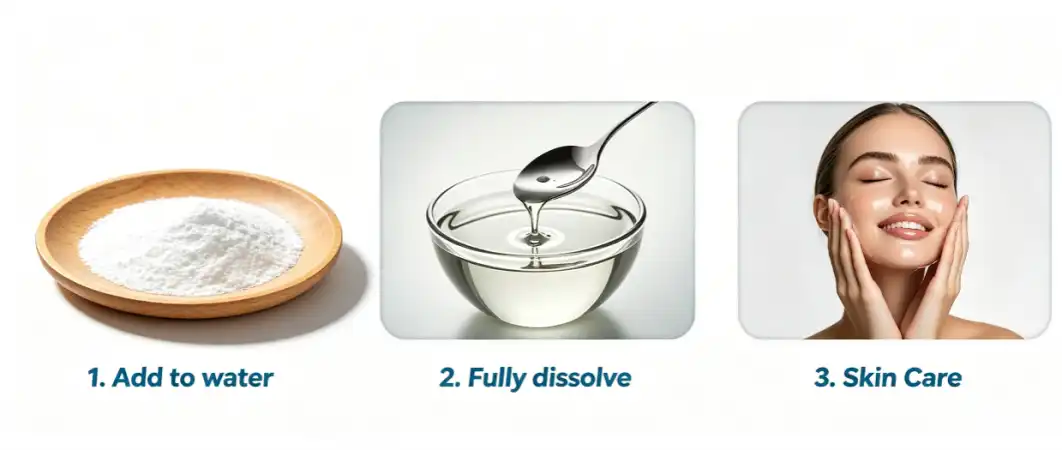
Getting something to dissolve in the right way keeps processes from going wrong and makes sure the product is spread out properly. A high-shear mix should be used to slowly add sodium hyaluronate powder to a water swirl. The surface of the powder won't get wet, so water can't get to the center of the particles. Before adding to the main water phase, it is easier for the particles to spread out when glycerin or propylene glycol are mixed in at a 1:5 ratio. If you heat it to 40°C to 60°C, it dissolves faster without breaking down the polymer. But when it gets hotter than 80°C, the chain breaks and becomes less stiff. Putting the pH level between 6.0 and 7.5 makes the item safer for skin and more stable. As soon as the sodium hyaluronate fluid breaks down, a method for keeping things fresh has to be added because it helps germs grow. Metal-catalyzed breakdown can happen while the substance is being stored, but chelating agents like EDTA can stop it.
Performance Validation and Efficacy Claims
To back up what you say in marketing, you need to use consistent testing methods to get an unbiased picture of how well something works. A test called corneometry can prove that a product really does moisturize by measuring the skin's capacitance before and after it's been used for 4 to 8 weeks. With better lighting, TEWL tests show that the barrier function has gotten better, and high-resolution photos show that the wrinkles aren't as deep. In addition to scientific data, consumer impression studies look at things like how soft, smooth, and glowing the skin is to find out how people feel about them. You can get solid proof from NT Biotech that products work. For example, they give you stability data and testing methods they recommend. Dermatologists lead studies that are approved by a third party. This builds trust with lawmakers and with customers.
Conclusion
Best sodium hyaluronate is a versatile ingredient that has been shown to help with many skin issues, from keeping the skin moist to slowing down the growth of aging skin cells. If someone in procurement needs to find reliable sources of high-purity sodium hyaluronate, they should look at providers based on their quality certifications, molecular weight standards, and experienced customer service. This company, NT Biotech, offers sodium hyaluronate powder that is 99% pure and has been approved by ISO9001, KOSHER, and HALAL. Because they can work in different ways, they can deliver in two to four days. Ten years of experience shipping to more than 100 countries and full value-chain integration, which means growing plants and using the finished product, make sure that each batch is stable and follows all regulations, which is important for making competitive skincare recipes.
FAQ
1. Is sodium hyaluronate safe for all skin types including sensitive skin?
It is safe for all skin types, even sensitive and allergic skin, to use sodium hyaluronate. Its safe structure is like glycosaminoglycans that are found naturally in human skin. This makes it less likely to cause an immune response. Clinical tests show that it doesn't make people feel too bad or make them more sensitive, so it can be used in safe goods. The relaxing properties of the ingredient make sensitive skin less red, and its non-comedogenic properties keep acne-prone skin's pores from getting plugged.
2. What distinguishes sodium hyaluronate from hyaluronic acid in formulations?
Salt of hyaluronic acid in the form of sodium is called sodium hyaluronate. It is more solid, dissolves more quickly, and is made up of smaller molecules. It is now easier to get through the stratum corneum and breaks down faster in water-based systems because of this chemical change. It stays more solid than hyaluronic acid over a wider pH and temperature range. That means things made with it can be made in more ways and last longer.
3. How should bulk sodium hyaluronate powder be stored and handled?
It is best to keep bulk sodium hyaluronate powder in a cool, dry place away from strong smells, direct sunlight, and water. Powder that absorbs water must be put back in its container right away after use so that it doesn't stick and soak up water. If you want to store something, it should be between 2°C and 25°C and the relative humidity should be less than 60%. When you handle something the right way, you keep its useful properties and lower the chance that it will get dirty.
4. What does hyaluronate mean, and what does sodium hyaluronate do for skin?
If you are seeking for the hyaluronate definition, the quick answer is that hyaluronate is the anionic (i.e., salt) form of hyaluronic acid, and sodium hyaluronate is the sodium variant utilised in cosmetics. Sodium hyaluronate for skin traps water, reinforces the barrier, and diminishes fine wrinkles without causing irritation. That’s why this ingredient is included in serums, creams and masks for regular use.
Partner with NT Biotech for Premium Sodium Hyaluronate Supply
If skincare manufacturers, original equipment manufacturers (OEMs), or marketers need pharmaceutical-grade ingredients to make competitive products, they can trust NT Biotech to be their best sodium hyaluronate source. The sodium hyaluronate powder we sell is 99% pure and meets the requirements of ISO9001, KOSHER, and HALAL. It makes your goods stable and helps them work well. It's easier to buy things from us because we have ready stock that can be sent out in two to four days, a 25 kg minimum order size, and free trials that come with full COA paperwork. You can talk to our expert team about your specific needs, get samples, or get bulk prices that fit the size of your production by emailing info@newthingsbiotech.com. We have been shipping to over 100 countries for ten years and can help with research and development (R&D). We have been a long-term partner in beauty.
References
1. Bukhari, S. N. A., Roswandi, N. L., Waqas, M., et al. (2018). Hyaluronic acid, a promising skin rejuvenating biomedicine: A review of recent updates and pre-clinical and clinical investigations on cosmetic and nutricosmetic effects. International Journal of Biological Macromolecules, 120, 1682-1695.
2. Papakonstantinou, E., Roth, M., & Karakiulakis, G. (2012). Hyaluronic acid: A key molecule in skin aging. Dermato-Endocrinology, 4(3), 253-258.
3. Goa, K. L., & Benfield, P. (1994). Hyaluronic acid: A review of its pharmacology and use as a surgical aid in ophthalmology, and its therapeutic potential in joint disease and wound healing. Drugs, 47(3), 536-566.
4. Pavicic, T., Gauglitz, G. G., Lersch, P., et al. (2011). Efficacy of cream-based novel formulations of hyaluronic acid of different molecular weights in anti-wrinkle treatment. Journal of Drugs in Dermatology, 10(9), 990-1000.
5. Stern, R., Asari, A. A., & Sugahara, K. N. (2006). Hyaluronan fragments: An information-rich system. European Journal of Cell Biology, 85(8), 699-715.
6. Garantziotis, S., & Savani, R. C. (2019). Hyaluronan biology: A complex balancing act of structure, function, location and context. Matrix Biology, 78-79, 1-10.